
Two state audits of the Department of Public Instruction are running late, and the agency conducting them won’t say why.
The nonpartisan Legislative Audit Bureau originally listed both reviews for release in the “Summer of 2026.”
As summer ended, the bureau updated its website and moved the target to “Fall 2026.” It offered no explanation.
Dairyland Sentinel asked the bureau for records showing why the schedule slipped. The request was denied.
The audits cover two of the most disputed operations under State Superintendent Jill Underly: how DPI disciplines teachers accused of misconduct, and how it measures school performance on standardized tests.
Until the reports come out, lawmakers, local school boards and parents are left waiting.

What Auditors Are Looking At
The Joint Legislative Audit Committee ordered both reviews after clashes in the Capitol over agency oversight and transparency.
The first audit focuses on DPI’s licensing division. Auditors are reviewing how the state investigates reports of educator misconduct, criminal complaints and professional violations.
Lawmakers directed the bureau to examine how long it takes, on average, to resolve those cases. They also asked whether internal backlogs allow questionable teachers to remain in classrooms, and how DPI shares credential restrictions, suspensions and revocations with local school districts and police.
The second audit covers the state’s accountability system, specifically the annual school report cards and the Wisconsin Forward Exam.
Lawmakers ordered that review after DPI held standard-setting workshops that changed student proficiency benchmarks in reading and math. The workshops, conducted in part at a Wisconsin Dells waterpark, were the subject of a series of reports by Dairyland Sentinel. DPI’s critics have argued the new scoring lowered the bar and made student achievement look better than it was.
Auditors are examining the technical methodology behind those cut scores. They are also examining whether DPI violated state Open Meetings law and administrative rule-making procedures when it ran the workshops.
How LAB Conducts an Audit
While an audit is underway, the bureau says very little in public. Here is how the process works.
The Legislature created the Legislative Audit Bureau, and the state auditor runs it. The nonpartisan agency operates under Chapter 13 of the Wisconsin Statutes as the state’s independent watchdog over public spending and agency operations.
To keep partisan politics out of the work, state law shields auditors while an audit is in progress.
Under the bureau’s procedures, an evaluation generally moves through five stages:
- Scoping and the entrance conference. Once the Joint Legislative Audit Committee votes to direct an audit, bureau managers define the scope and draft an audit plan. They then hold an entrance conference with the agency’s leadership to set the parameters and lines of communication.
- Fieldwork and research. Bureau staff follow federal “Yellow Book” government auditing standards. They review files, test financial data, check internal controls and interview agency employees. Under state law, auditors have unrestricted access to agency records, databases and facilities.
- Drafting and the exit conference. Auditors meet with top agency officials in a confidential exit conference to walk through the draft and verify facts. The bureau then gives agency leaders a watermarked, confidential copy of the draft report.
- The agency response. The agency gets a set window to review the findings and write an official response. State law guarantees that letter is printed verbatim as an appendix to the final report.
- Publication and hearings. The bureau posts the final report on its website and sends it to legislative leaders. The Joint Legislative Audit Committee then typically holds a public hearing in Madison, where auditors and agency officials answer lawmakers’ questions.
What’s Still Unknown
The bureau notes publicly that its expected release dates are estimates, not hard deadlines.
That is fair as far as it goes. But without the records, and without any public comment, taxpayers have no way to know what pushed these two audits off schedule.
The delay could have come from DPI dragging its feet on documents, from disputes over data, or from a drawn-out exit conference.
Finding out which one was the point of the records request.
The Records Request
On Oct. 1, Dairyland Sentinel filed an open records request with the Legislative Audit Bureau.
The request did not seek confidential work papers or preliminary findings. It asked for a procedural log or index of correspondence between bureau staff and DPI from March 4, 2025, through Sept. 30, 2026.
The goal was a timeline. The request was limited to transmission dates, senders and high-level subject lines, such as data delivery notices, extension requests or exit conference confirmations.
State Auditor Joe Chrisman denied the request in full on Oct. 14.
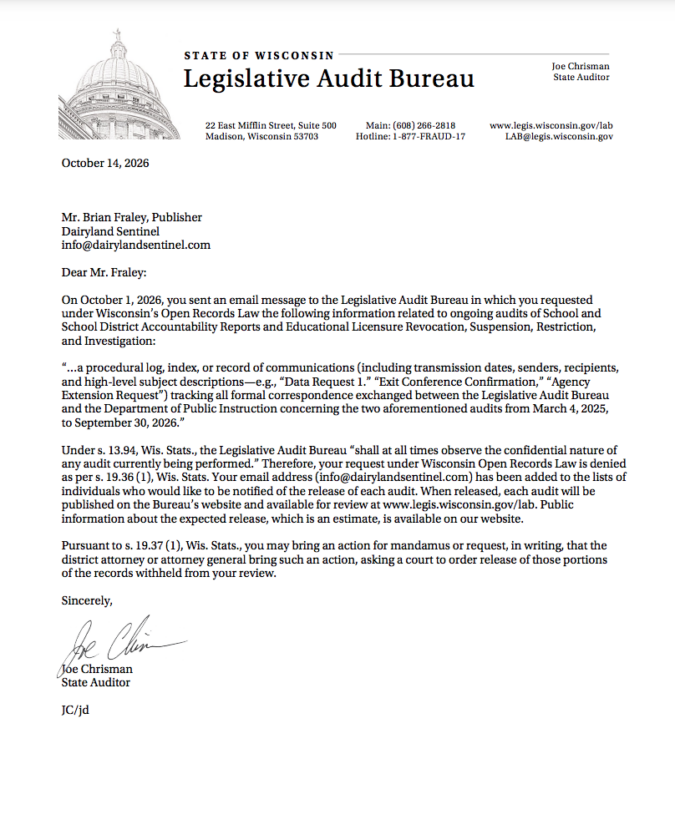
In his denial letter, Chrisman cited Wisconsin Statutes Section 13.94, which requires the bureau to “at all times observe the confidential nature of any audit currently being performed”. He pointed to Section 19.36(1) to justify withholding the log.
Chrisman added that Dairyland Sentinel has the statutory right under Section 19.37(1) to ask a district attorney, the attorney general or a court to compel release of the records.
Dairyland Sentinel sent a separate inquiry to the Joint Legislative Audit Committee at the same time. It got no further.
In a joint written response, committee co-chairs Sen. Eric Wimberger, R-Oshkosh, and Rep. Robert Wittke, R-Racine, said their offices have no responsive records.
“The co-chairs and members of the Joint Legislative Audit Committee are not afforded processing information, or communication with the Legislative Audit Bureau regarding specific audits in process as determined by statute 13.94,” Wimberger and Wittke wrote. “Audits are confidential, and once ordered, we do not get status reports in keeping with the nonpartisan independent nature of the Legislative Audit Bureau’s work.”
Why Dairyland Sentinel Disagrees
Dairyland Sentinel disputes the LAB’s position.
Wisconsin’s open records law starts from a presumption of complete public access. Under Section 19.31, denying access is supposed to be the exception, not the rule.
Section 13.94 protects audit working papers, draft conclusions and sensitive source data. Dairyland Sentinel asked for none of that.
Dairyland Sentinel asked for dates, senders and subject lines. That information shows when documents changed hands and who asked for more time. None of it necessarily reveals what auditors found, if portions did, they could be redacted.
The statute was never meant to hide administrative scheduling or an agency’s foot-dragging. A blanket claim of secrecy over basic procedural records turns the presumption of access on its head.
The public has a right to know whether DPI requested extensions, delayed turning over documents or dragged out the draft review process.
Under Wisconsin’s open records law, state officials should have released those records. Dairyland Sentinel is weighing it’s legal options. We will report on these audits and our pursuits of public records as the stories develop.
Previously at Dairyland Sentinel