
Wisconsin’s early vote is almost back to its 2022 pace. Data analyst Joe Handrick’s regional breakdown shows most of the remaining gap is in Milwaukee County and the Dane County region.
Voters had returned 377,058 absentee ballots as of Friday, 11 days before the Nov. 3 election, Wisconsin Elections Commission data show. That count includes mail ballots and in-person absentee votes. Handrick’s analysis shows that is 20,116 ballots, or 5.1%, behind the 397,174 returned at the same point before the 2022 midterm. On Thursday the gap was 10.4%.

Since our launch in 2023, Dairyland Sentinel has been checking in with Handrick, a former Republican state lawmaker who now analyzes Wisconsin election data. His latest breakdown sorts all 72 counties into eight regions. He groups them by how each region usually votes, with Milwaukee and the Dane region as the blue regions, the north, central and southeastern suburban counties as red, and the Fox Valley, Kenosha-Racine and western counties as purple.
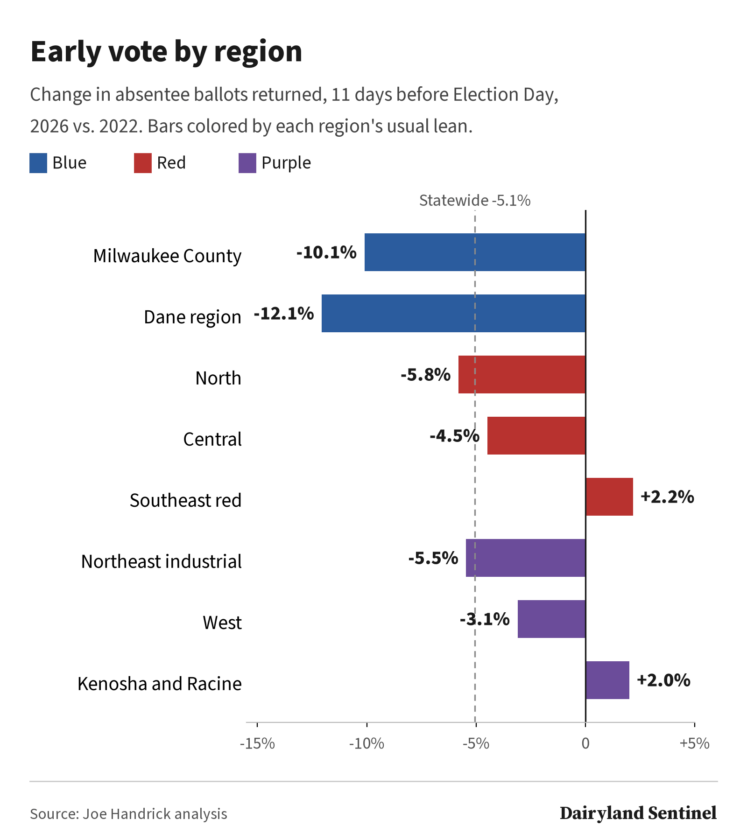
The two blue regions account for most of the shortfall. Milwaukee County is down 6,440 ballots, or 10.1%. The Dane region, which is Dane County plus Columbia, Green, Iowa, Lafayette, Rock and Sauk counties, is down 9,738, or 12.1%. Each decline is double the state average, Handrick’s analysis shows.
Together the two regions are 16,178 ballots behind 2022. That is about 80% of the statewide gap, from regions that cast about 36% of the early vote four years ago.
Dane County itself drives the Dane region number. Its returns are down 14.9%, from 59,890 to 50,974, or almost three times the state average, according to Handrick. Rock County is almost even with 2022, down 23 ballots. Lafayette County is down 24.7%, the steepest decline in the region.
The red regions, taken together, are within half a percent of 2022. The southeastern red region of 10 counties, including Waukesha, Washington and Ozaukee, is up 2.2%. Handrick’s analysis shows it is now ahead of its 2022 pace.
Washington County is the main reason. Its returns are up 22.0%, from 10,236 to 12,489, the largest increase of any county in the state, by Handrick’s count. Waukesha County is up 2.4%, to 39,530. Fond du Lac County is down 11.1%, the largest decline in the region.
Farther north, the picture is softer. The 22-county north region is down 5.8%, and Iron County is down 18.6%, the region’s largest drop. The 11-county central region is down 4.5%. Waushara County fell 31.6% there, from 942 ballots to 644. Portage County, the only county in the central region that Handrick does not classify as red, is up 0.8%.
The purple regions are down 3.0% combined, but they split. Kenosha and Racine counties, which Handrick calls the southeast industrial region, are up 2.0% and also ahead of 2022. Racine is up 6.0% and Kenosha is down 2.3%. The northeast industrial region of Brown, Door, Kewaunee, Outagamie and Winnebago counties is down 5.5%. The 14-county western region is down 3.1%.
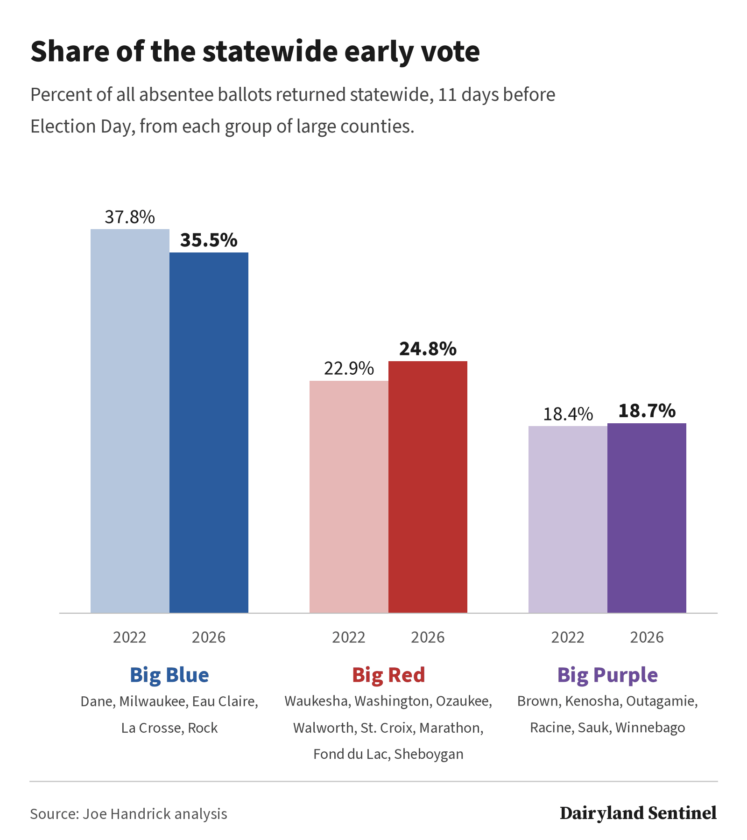
Handrick also compared the five biggest Democratic counties with the eight biggest Republican ones. Dane, Milwaukee, Eau Claire, La Crosse and Rock counties made up 37.8% of the statewide early vote at this point in 2022. They make up 35.5% now. Waukesha, Washington, Ozaukee, Walworth, St. Croix, Marathon, Fond du Lac and Sheboygan counties went from 22.9% to 24.8%.
The gap is wider in the big cities. Handrick found early returns down 18.1% combined in Milwaukee, Madison, Green Bay, Kenosha and Eau Claire. Madison is down 21.3%. Waukesha, Washington and Ozaukee counties are up 4.9% combined.
In-person absentee voting, which began Oct. 20, has narrowed the gap all week. Wisconsin voters have cast 148,896 in-person absentee ballots, according to WEC. Handrick’s daily sample shows 55,659 on the first day, 47,551 on the second and 45,686 on the third, a decline of 17.9% from the first day. The city of Milwaukee and the city of Waukesha both saw more in-person voters on the third day than the second. Handrick cautions that some of the daily swings may reflect inconsistent reporting by municipal clerks.
None of these numbers show how anyone voted. Wisconsin voters do not register by party, and absentee ballots are not counted until Election Day. The red, blue and purple labels describe how regions have usually voted, not how this year’s early voters cast their ballots.
-The crucial caveat
In-person absentee voting continues through Sunday, Nov. 1, though hours and locations vary by municipality. Voters can find their clerk’s schedule at MyVote Wisconsin.
Early vote by region
Absentee ballots returned (mail and in person) 11 days before Election Day. Region definitions and 2022 figures are from Joe Handrick’s analysis. 2026 figures match WEC’s Oct. 23 county report.
| Region | Lean | Counties | 2022 | 2026 | Change | % change |
| Milwaukee County | Blue | Milwaukee | 63,733 | 57,293 | -6,440 | -10.1% |
| Dane region | Blue | Columbia, Dane, Green, Iowa, Lafayette, Rock, Sauk | 80,768 | 71,030 | -9,738 | -12.1% |
| Central | Red | Adams, Clark, Green Lake, Juneau, Marathon, Marquette, Portage, Shawano, Waupaca, Waushara, Wood | 26,297 | 25,119 | -1,178 | -4.5% |
| North | Red | Ashland, Barron, Bayfield, Burnett, Chippewa, Douglas, Florence, Forest, Iron, Langlade, Lincoln, Marinette, Menominee, Oconto, Oneida, Polk, Price, Rusk, Sawyer, Taylor, Vilas, Washburn | 27,701 | 26,093 | -1,608 | -5.8% |
| Southeast Red | Red | Calumet, Dodge, Fond du Lac, Jefferson, Manitowoc, Ozaukee, Sheboygan, Walworth, Washington, Waukesha | 92,974 | 95,003 | +2,029 | +2.2% |
| Northeast industrial | Purple | Brown, Door, Kewaunee, Outagamie, Winnebago | 48,025 | 45,405 | -2,620 | -5.5% |
| Southeast industrial | Purple | Kenosha, Racine | 24,019 | 24,502 | +483 | +2.0% |
| West | Purple | Buffalo, Crawford, Dunn, Eau Claire, Grant, Jackson, La Crosse, Monroe, Pepin, Pierce, Richland, St. Croix, Trempealeau, Vernon | 33,657 | 32,613 | -1,044 | -3.1% |
| Statewide | 72 counties | 397,174 | 377,058 | -20,116 | -5.1% |
Sources: Joe Handrick analysis; Wisconsin Elections Commission absentee ballot report, Oct. 23, 2026.