In-person voting is up 56.9% statewide, enough to cover a big drop in other absentee returns. Waukesha leads the gains; Dane and Milwaukee still trail.
Wisconsin’s early vote has caught up, and then some.
Voters had returned 513,602 absentee ballots as of Tuesday, seven days before the Nov. 3 election, according to Wisconsin Elections Commission data. At the same point before the 2022 midterm, the count was 503,180. That puts this year 10,422 ballots ahead, up 2.1%.
It’s the first time this fall the statewide number has been ahead of 2022.
Wisconsin elections data guru Joe Handrick says analysis of the data should come with a word of caution.

While the early returns are encouraging for the GOP, they are not predictive.
“We do not have voter registration by party, so even though red county voting is up we don’t know who is voting. And even though blue county voting may be down, it doesn’t mean Dane County won’t still turn out huge on election day,” elections data guru Joe Handrick told Dairyland Sentinel.
On Oct. 8, Dairyland Sentinel reported returns down 22.6%. The gap hit 30.6% on Oct. 13. In-person absentee voting opened Oct. 20, and the deficit has shrunk with every report since. It was 15.6% on Oct. 21, 10.4% on Oct. 22 and 5.1% on Oct. 23. On Monday, returns trailed by 3,735 ballots, or 0.8%.
Then 72,461 more ballots came in on Tuesday’s report. On the same day in 2022, the count rose 58,304.
In person is doing the work
Voters have cast 251,092 in-person absentee ballots. That’s 91,096 more than at this point four years ago, an increase of 56.9%. In-person ballots now make up 48.9% of all returns, up from 31.8% in 2022.
Everything else is down. Subtract the in-person votes and 262,510 ballots have come back by mail, drop box or delivery (not in person). That’s 80,674 fewer than in 2022, a 23.5% drop. Those other absentee returns trail 2022 in all 72 counties.
WEC does not break out how those ballots came back, so the other absentee figures are a Dairyland Sentinel calculation: ballots returned minus in-person absentee.
In-person voting is ahead of 2022 in 70 counties. Buffalo and Taylor are the exceptions.
Demand for absentee ballots hasn’t grown to match. Voters have filed 641,771 applications, down 8,402, or 1.3%. Clerks have issued 638,952 ballots, down 6,150, or 1.0%. What has changed is how many come back. Voters have returned 80.4% of the ballots sent to them, compared with 78% at this point in 2022. That increase reflects, at least in part, the growing share of voters casting their absentee ballots in person.
Waukesha up, Dane and Milwaukee behind
Thirty-nine of the state’s 72 counties are at or above their 2022 return pace.
Waukesha County leads all counties in raw gains, and Washington County is close behind. Washington has the biggest percentage jump in the state.
- Waukesha: 55,556 (+4,081) +7.9%
- Washington: 17,421 (+4,018) +30.0%
- Racine: 18,146 (+2,158) +13.5%
Waukesha’s in-person absentee count is up 9,777, or 44.5%. Its other absentee returns are down 5,696, or 19.3%.
The state’s two largest counties are still short of 2022.
- Milwaukee: 81,243 (-1,604) -1.9%
- Dane: 72,021 (-5,319) -6.9%
Dane has the largest raw drop of any county. Both have far more in-person voters than in 2022. Milwaukee’s in-person count is up 14,681, or 55.1%. Dane added 12,822, a 55.3% increase.
Their other absentee returns fell further. Milwaukee’s dropped 16,285, or 29%. Dane’s fell 18,141, or 33.5%, the steepest decline among the big three.
Outside Milwaukee and Dane, the other 70 counties combined are up 17,345 ballots, or 5.1%.
The gains and losses don’t sort neatly by politics. La Crosse is up 10.2% and Rock is up 6.5%. Eau Claire is down 3.3%. Waushara has the steepest percentage drop in the state at 23.6%, down 262 ballots to 850.
Applications follow a similar pattern in the big three.
- Milwaukee: 102,557 (-4,270) -4.0%
- Dane: 90,585 (-7,337) -7.5%
- Waukesha: 66,977 (+1,790) +2.7%
What the numbers can’t tell you
These are ballots returned. They aren’t vote totals, and clerks don’t count absentee ballots until Election Day.
As Handrick cautioned, Wisconsin does not register voters by party, so the data say nothing about who these voters support.
The 2022 baseline is a November midterm with races for governor and U.S. Senate on the ballot. The calendar is lined up so each comparison falls the same number of days before Election Day. Tuesday’s file is compared with WEC’s Nov. 1, 2022, file. Unlike in 2022, Wisconsin does not have a U.S. Senate race on the ballot this November.
The files also can’t show how many of this year’s in-person voters returned an absentee ballot some other way in 2022. Some of the in-person jump is likely the same people using a different door.
In-person absentee voting runs through Sunday, Nov. 1, in some municipalities, and local hours vary. Absentee ballots must reach the clerk by 8 p.m. on Election Day to count.
Dairyland Sentinel will keep tracking the WEC numbers through Nov. 3.
County Results
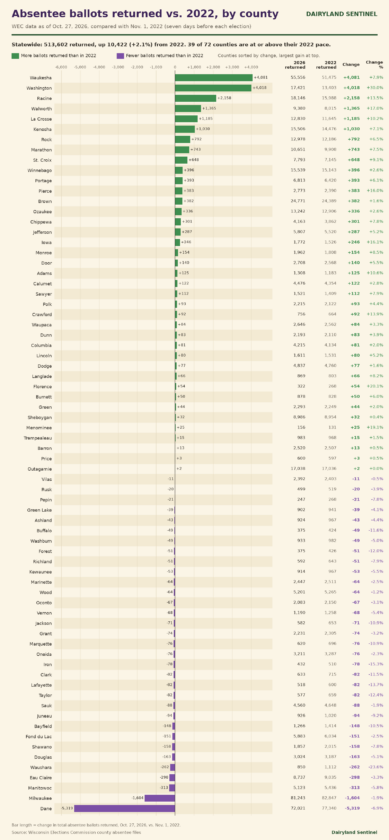
Each bar shows how many more or fewer absentee ballots a county had returned as of Oct. 27, 2026, than at the same point in 2022 (Nov. 1, 2022), both seven days before Election Day. Counties that gained extend right of zero. Source: Wisconsin Elections Commission county absentee files.