Andrew Carnegie made his money in steel and spent a good share of it on books. In his 1889 essay “Wealth,” later known as The Gospel of Wealth, he argued that a rich man should give his fortune away while he was alive. “The man who dies thus rich dies disgraced,” he wrote. The best gifts, in his view, were the ones that would “place within its reach the ladders upon which the aspiring can rise,” and he put the free library at the top of that list.
Wisconsin took him up on it more than most states did.
How the deal worked
Carnegie did not hand out endowments. A town had to supply the building site, pledge 10% of the grant every year in tax money to run the library and offer free service to the public. The Digital Public Library of America lays out the formula, which put the long-term bill on local taxpayers.
That fit Wisconsin. The state passed its free library law in 1872, and Black River Falls set up the first public library under it that same year, according to the Wisconsin Library Association Foundation’s library history timeline. Plenty of towns already had a library board and a few shelves of books in a city hall or a storefront. What they lacked was a building.
Carnegie’s first library opened in 1883 in his hometown of Dunfermline, Scotland, with his motto “Let there be light” carved into the sandstone entrance. By 1929, Carnegie money had paid for 2,509 libraries around the world, including about 660 in Britain and Ireland and 125 in Canada, according to the list compiled from library historians’ records. For the United States, the Carnegie Corporation of New York puts the count at 1,681 free public libraries built between 1886 and 1917.
Each town picked its own architect and style. Many chose Classical Revival or Beaux-Arts designs with a flight of steps up to the front door and a lamp out front, meant to suggest a reader rising through learning. In Wisconsin, the Madison firm Claude and Starck designed 25 of the state’s 63 Carnegie public libraries, many of them in the Prairie School style, according to the WLA Foundation’s Library Heritage Trail.
Wisconsin’s share
Between 1901 and 1915, 60 Wisconsin communities received 63 Carnegie public library grants worth a little over $1 million. Two colleges, Beloit and Lawrence in Appleton, also got library buildings. That makes 65 Carnegie buildings in all. According to the WLA Foundation, only six states received more Carnegie grants. By number of communities funded, Wisconsin ranked seventh, behind Indiana, California, Illinois, Iowa, Ohio and Nebraska, according to the national list of Carnegie libraries.
Green Bay landed the first Wisconsin grant, on Feb. 13, 1901, with Sheboygan, Superior and Janesville close behind that March. Superior’s library on Hammond Avenue was the first to be finished. It opened in 1902 as a three-story sandstone building with three employees, the Superior Telegram reported. Superior also got the last one. Its East End branch, paid for with a $20,000 grant in 1917, opened Sept. 10, 1918, according to Library History Buff.
What happened to them
Fifteen of Wisconsin’s 65 Carnegie buildings have been torn down, according to the WLA Foundation’s count. The razed list includes Madison’s central library, Fond du Lac, Manitowoc, Neenah, Stevens Point, Wausau and Wauwatosa. Lawrence College’s library came down in 1974. Two Rivers lost its building, too. A few pieces survived. Sheboygan’s facade now stands in a garden at the John Michael Kohler Arts Center.
Many more buildings found new work. Antigo’s and Darlington’s are county historical museums, as are buildings in Racine, Waupaca and Waupun, according to the WLA Foundation. Ladysmith’s became a bed-and-breakfast. Green Bay’s was home to the Neville Public Museum until 1983. Beloit College turned its Carnegie library into the Pettibone Center for World Affairs in 1962.
A few worth knowing about:
Black River Falls. The town that started Wisconsin’s public library movement got its Carnegie grant late, $10,000 in 1914. The Prairie School building at 321 Main St. was finished in 1915 and served as the library into the 1990s. Today it is the Jackson County Historical Society’s Carnegie Library Museum, open on summer weekends.
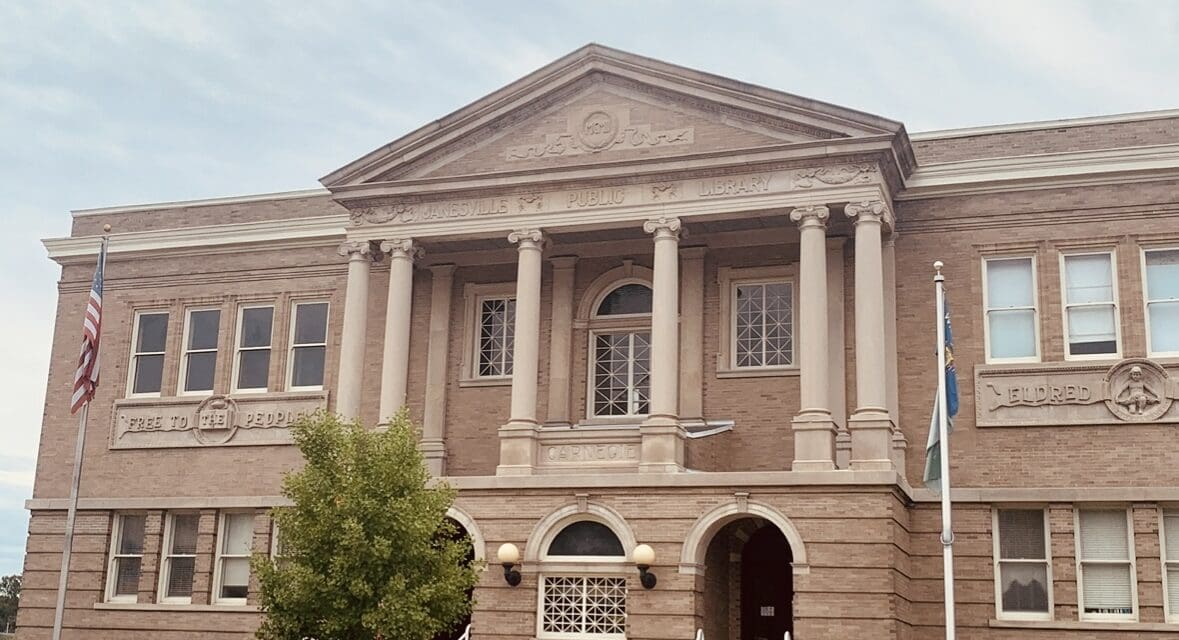
Janesville. Architect John T.W. Jennings designed the Neoclassical library at 64 S. Main St., built in 1902, according to the Wisconsin Historical Society. The library moved out in 1968, and the building has been the city’s Senior Center on its own since 1981, with a 6,000-square-foot addition finished in 2000.
Kaukauna. The Kaukauna Public Library moved into the old Thilmany Eagle Mill in 2016, according to the library’s history page. The 1906 Carnegie building was restored and redeveloped, with apartments in the 1970s addition.
Superior. Both Superior Carnegie buildings closed as libraries at the end of 1991. The East End branch is now a private home. The Hammond Avenue building sat empty for three decades until the city bought it for $175,000 in July 2022 to fix it up and put it back on the market. That November, the council approved a $275,000 roof membrane to keep the water out.
Carnegie libraries still in use
By my count, checked against library websites and local news this fall, 18 of Wisconsin’s original Carnegie buildings still serve as public libraries. Most have additions, some bigger than the original, but the Carnegie building is still part of the library you walk into. The WLA Foundation’s earlier tally was 20. Arcadia moved its library into the Wanek Center in 2020, and New London opened in a former bank building on June 8, 2026. Viroqua’s library moved to Rock Avenue in 2016.
Here is where to find the ones still open:
- Baraboo: Carnegie-Schadde Memorial Public Library, 230 Fourth Ave. The 1903 Neoclassical building by Claude and Starck took a new name in 2021 after Juanita Schadde’s $2.5 million gift. An 18,600-square-foot addition opened in June 2023 as part of an $11 million renovation and expansion.
- Barron: Barron Public Library, 10 N. Third St. Prairie School, opened in 1913.
- Bayfield: Bayfield Carnegie Library, 37 N. Broad St. Architect Henry Wildhagen designed it with columns of local brownstone. It opened Jan. 10, 1904.
- Berlin: Berlin Public Library, 121 W. Park Ave. Opened in 1903 and expanded in 1976.
- Columbus: Columbus Public Library, 223 W. James St. A Claude and Starck Prairie School design, dedicated Nov. 1, 1912, and in use ever since.
- Cumberland: Thomas St. Angelo Public Library, 1305 Second Ave. Opened March 17, 1906.
- Edgerton: Edgerton Public Library, 101 Albion St. Dedicated in January 1907, with a 2006 addition.
- Elroy: Elroy Public Library, 501 Second Main St. Opened March 4, 1908.
- Merrill: T.B. Scott Free Library, 106 W. First St. Built with a $17,500 grant, opened in 1911 and expanded in 2001.
- Neillsville: Neillsville Public Library, 409 Hewett St. Built in 1914 on a $10,000 grant.
- Plymouth: Plymouth Public Library, 130 Division St. The 1915 Carnegie building is preserved whole, with a 1988 addition behind it.
- Rhinelander: Rhinelander District Library, 106 N. Stevens St. Dedicated in November 1904 and nearly doubled by a 1985 addition.
- Sparta: Sparta Free Library, 124 W. Main St. Opened in 1903 on the courthouse square. A new addition had its grand opening in 2025.
- Stoughton: Stoughton Public Library, 304 S. Fourth St. A Claude and Starck design dedicated in 1908, wrapped by a later addition that kept the original intact.
- Tomah: Tomah Public Library, 716 Superior Ave. A 1916 Prairie School building by Claude and Starck, expanded in 1980.
- Washburn: Washburn Public Library, 307 Washington Ave. Another Wildhagen brownstone, built in 1904.
- Watertown: Watertown Public Library, 100 S. Water St. Opened June 14, 1907, after Carnegie turned down a $25,000 request and settled on $20,000.
- Waukesha: Waukesha Public Library, 321 Wisconsin Ave. in Cutler Park. Opened in 1904, with six additions and renovations since.
Carnegie’s foundation is still paying attention to them. Last fall, the Carnegie Corporation of New York announced a $10,000 gift for each Carnegie library still operating in the U.S. to mark America’s 250th anniversary. Eligibility followed the library, not the building. Kaukauna’s library left its Carnegie home a decade ago and still got its check in February.
If you’re on a Wisconsin road trip, most of these buildings are a block or two off Main Street. Go inside. They were built to be used.