For much of the past two decades, I’ve been involved in Wisconsin’s fight over open government.
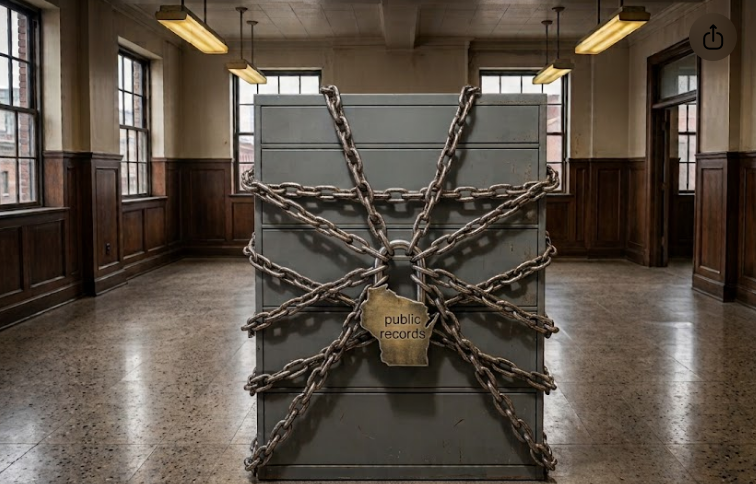
Our state’s transparency law starts with an uncompromising promise. The foundational text of Wis. Stat. § 19.31 states clearly that because “a representative government is dependent upon an informed electorate, it is declared to be the public policy of this state that all persons are entitled to the greatest possible information regarding the affairs of government.” The Legislature explicitly commanded that the law “shall be construed in every instance with a presumption of complete public access,” adding that the “denial of public access generally is contrary to the public interest.”

Back in 2011, I joined the MacIver Institute to sue then-State Sen. Jon Erpenbach after his office redacted the identities of public employees using government emails to lobby lawmakers during the Act 10 debate. We lost the first round in circuit court, but the Court of Appeals ultimately sided with transparency and ordered the names released.
But winning that legal fight didn’t mean the records magically landed on my desk.
The state hit us with more than $1,800 in copying fees. Instead of a clean, searchable digital file, they handed over a mountain of paper after my boss, Brett Healy, cut the hefty check. We ended up hauling bankers’ boxes across the Capitol Square from the Senator’s office to ours and then spent days sorting through the mess by hand.
It was a stark lesson: Wisconsin’s Open Records Law is only as strong as a requester’s willingness to bleed time, money, and persistence to enforce it.
But the teeth were kicked out of that law in 2022. In Friends of Frame Park v. City of Waukesha, the Wisconsin Supreme Court killed the long-standing “catalyst test” and handed weaponized stalling a massive loophole. The court ruled that if an agency voluntarily turns over the records after you sue them—but before a judge can issue a final ruling on the merits—they completely escape the penalty of paying your legal fees. Before 2022, if a requester sued and the lawsuit caused the agency to release records, the requester could recover attorney fees. Now, a government entity can stonewall you for months, wait until you shell out the money to hire a lawyer and file a lawsuit, and then dump the documents at the eleventh hour. By beating the gavel to the punch, they avoid paying a dime of your legal costs, effectively destroying the only real compliance hammer citizens and newsrooms had left.
I’ve never pretended our system was flawless. It wasn’t. But after spending the past several months digging into how the state handles transparency today, the reality is clear: it’s getting worse. Much worse.
What started as a straightforward public records request to the Department of Public Instruction quickly pulled back the curtain on a systemic problem. I spent months digging through court opinions, active lawsuits, and settlements. Looking back at press coverage and agency paper trails, I discovered the pattern spans multiple state agencies, different administrations, and requesters from every corner of the political spectrum.
The names and the politics change, but the stonewalling tactics remain exactly the same. And Wisconsinites are often left in the dark.
Requests languish for months or even years. Agencies slap requesters with five-figure cost estimates designed to price them out. Public interest groups are forced to sue just to get a basic response, and the courts are left reshaping state law through appellate decisions.
This investigation forced me to a conclusion I’ve been reluctant to admit: Wisconsin doesn’t have a transparency problem because our laws are weak. We have a problem because state government has systematically made enforcing those laws slow, prohibitively expensive, and almost entirely dependent on litigation.
That is a far cry from what the Legislature intended when it declared that providing the greatest possible information about the affairs of government is an essential function of a representative democracy.
The good news is we don’t need to reinvent the wheel. The statutory framework is already there; we just need to make it work again.
Here are five places to begin.
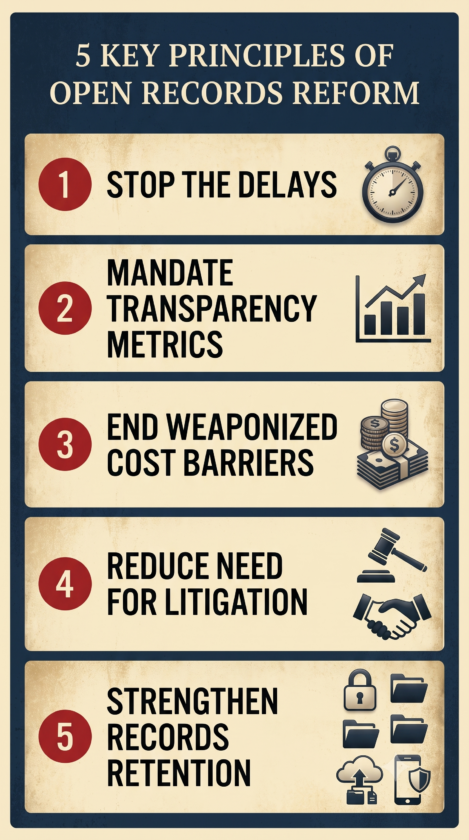
1. Stop treating “as soon as practicable and without delay” like a suggestion. Those seven words directing compliance are the backbone of the Open Records law, yet they are the primary source of constant litigation. Genuinely complex requests take time, but agencies should be required to promptly acknowledge a request, provide real progress updates, and explain any delays. Requesters shouldn’t be left in the dark for months wondering if their email went into a black hole. Silence shouldn’t be a bureaucratic policy.
2. Track the foot-dragging with mandatory transparency metrics. Government counts everything else; it’s time to count transparency. The Department of Justice already tracks and publishes its own response times. There is no reason every other cabinet agency shouldn’t do the same. Every public agency should put out an annual report detailing how many requests they received, how many they closed, their average wait times, their oldest pending files, the fees they charged, and how many disputes ended up in a courtroom.
3. End the weaponized price tags. Taxpayers shouldn’t have to subsidize massive, overly broad fishing expeditions. Cost recovery for actual, direct expenses is reasonable. But when an agency slaps a $34,000 price tag on a request, it functions exactly like a denial. Large estimates should require an itemized breakdown, and agencies should be forced to suggest narrower, cheaper alternatives. The goal should be sharing information, not using fees as a gatekeeper.
4. Tighten records retention and modern search rules. A delayed response means you wait; a deleted record means the public never knows. Every agency needs clear, unyielding standards for preserving public records and documenting how they search for them. Government business doesn’t stop being public just because a public official moves the conversation to a text message or a personal device. Technology has evolved, and our enforcement needs to keep pace.
5. Make lawsuits the exception, not the baseline. A transparency law is broken if journalists, citizens, and watchdogs routinely have to hire lawyers just to get a state agency to respond. Courts should be the final resort, not the expected next step. Wisconsin needs to re-examine whether our current system gives agencies too much room to stall and regular citizens too few practical ways to defend their rights.
None of this is partisan. Republicans, Democrats, business owners, environmental groups, media outlets, and everyday citizens all file records requests. Sooner or later, everyone wants to know what happens behind closed doors.
Open government isn’t a partisan tool; it belongs to the public. So do public records.
The report Dairyland Sentinel published this week lays out the proof. This isn’t a collection of isolated incidents or bureaucratic hiccups. It’s a documented pattern across multiple agencies and administrations.
Whether these roadblocks evolved out of bad institutional habits or shifting court incentives, the practical result is identical: government is harder to watch, records take longer to get, they cost more, and you have to sue to get them.
That should bother every single person in this state. It should outrage every news outlet.
Wisconsin entered statehood with one of the strongest free expression guarantees in the nation. Wisconsin’s Legislature gave us one of the strongest open records declarations in the country. We don’t need a new promise from Madison. We just need them to start keeping the one they already made.