- Traditional media appears secondary, with infrastructure and data receiving the bulk of early spending.
- Hong’s campaign is built around a unified digital infrastructure, not a collection of standalone tools.
- Her spending shows a deliberate shift toward organizing technology, with Middle Seat, EveryAction, Reverbal and Mobilize forming the backbone.
- Creative branding is treated as core campaign architecture, not an add‑on.
- The campaign is structured to treat every supporter interaction as connected, from ads to volunteer shifts to donations.
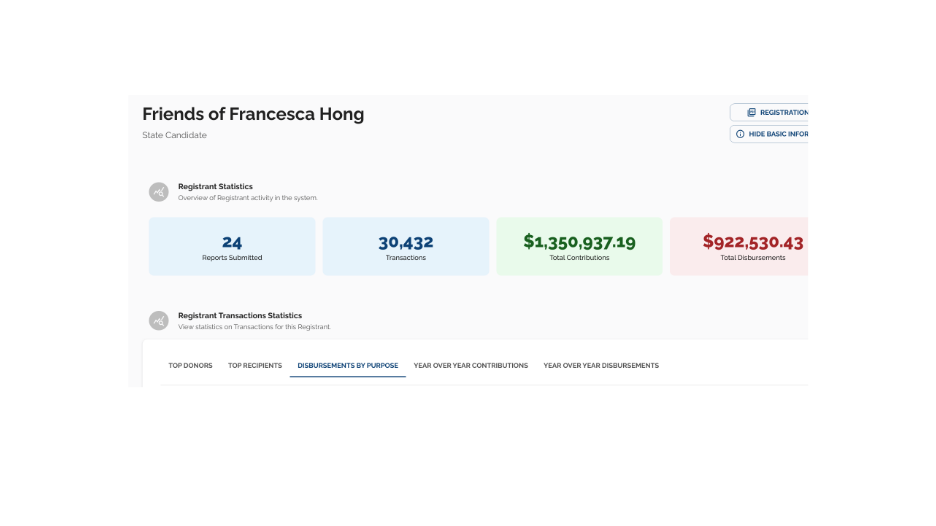
Campaign finance reports are usually treated like box scores. Who raised the most money? Who spent the most? Who’s ahead? Those are legitimate questions, but they’re not the most interesting ones. Spend enough time reading these reports and they start telling a larger story. They reveal priorities. They reveal assumptions. They reveal what a campaign believes will win elections. That’s why I spent several hours over the last couple of day digging through Francesca Hong’s July campaign finance report. The dollars themselves were interesting. The architecture behind them was even more interesting.
Every serious statewide campaign buys digital advertising. Every campaign hires consultants. Every campaign sends fundraising emails. None of that is new. What appears different is how deliberately Hong’s campaign has assembled a technology stack designed to make every piece reinforce the next. Instead of treating advertising, fundraising, volunteer recruitment, event management and voter contact as separate activities, or all contingent on what’s left after buying ads, the campaign seems to have invested in making them function as one connected system. Campaign finance reports can’t prove strategy, but they can reveal priorities.
The state’s Sunshine website allows users to search campaign finance expenditures by purpose. A search for how much Hong has spent on Media-TV certainly tell a story. She’s spent…nothing. She’s leading in the polls in the Democratic primary and she’s spent…zero dollars on traditional TV.
Hong’s vendors also tell a story.
The largest outside digital firm in the report is Middle Seat. According to its own website, Middle Seat describes itself as “the full-service firm for progressive causes and candidates.” Its published client list reads like a who’s who of progressive politics, including the Biden Victory Fund, Gov. Maura Healey, AFL-CIO, Alexandria Ocasio-Cortez, John Fetterman, Working Families Party, Human Rights Campaign, National Nurses United, Greenpeace, Bob Casey, Wes Moore and many others. Hong’s campaign paid Middle Seat more than $101,000 between September 2025 and March 2026, according to the Wisconsin Campaign Finance System. At least $81,095 was reported as online advertising. That’s important. But Middle Seat isn’t simply an advertising firm. It’s an organizing and fundraising firm that happens to buy advertising. Those aren’t the same thing.
Hong’s campaign has turn to Reverbal Communications for $31,464.00 in digital ads/consulting work so far as well. They worked with now Supreme Court Justice Chris Taylor, Dan Osborn’s US Senate Campaign, Rock the Vote and Wisconsin Democrats.
Then there’s Bonterra. Most Wisconsin voters have probably never heard of it. Campaign professionals almost certainly have. Hong’s campaign purchased EveryAction, Bonterra’s constituent relationship management platform. EveryAction functions as the campaign’s institutional memory. It stores donor information, volunteer records, email activity, text messaging, fundraising history, advocacy activity and supporter engagement. EveryAction’s own description emphasizes creating a unified supporter record so campaigns can see every interaction someone has with an organization in one place. That changes how campaigns think. Instead of asking, “Did this person donate,” campaigns can ask: Did they volunteer. Open emails. Attend events. Recruit friends. Respond to text messages. Give money. Everything becomes connected. Most statewide campaigns aspire to have a seamless system. Hong appears to have invested heavily into building one that is scalable.
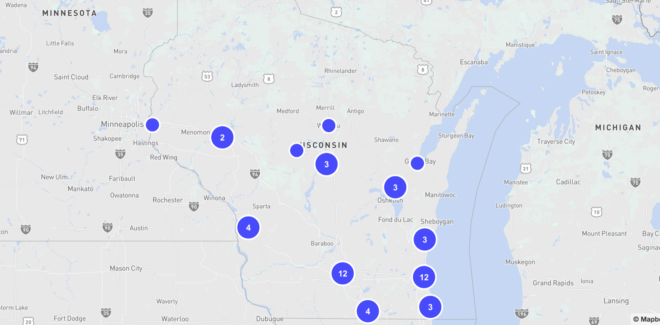
Volunteer recruitment follows the same philosophy. The volunteer link on Hong’s campaign website sends supporters to Mobilize. Mobilize isn’t simply an online calendar. It organizes canvasses, phone banks, training sessions, recurring volunteer shifts, petitions, town halls and virtually every other campaign activity. She currently lists 50 planned activities in the next three weeks. See Bonterra’s description of Mobilize. Mobilize also sits inside the broader Bonterra ecosystem alongside EveryAction. Bonterra describes Mobilize and EveryAction as connected products that combine volunteer management with supporter records and fundraising capabilities. Mobilize itself notes it has helped thousands of advocacy organizations, nonprofits, unions and political campaigns, including the Biden-Harris campaign, sign up millions of supporters for campaign actions.
Think about what that means. A voter sees a digital ad, visits the website, signs up to volunteer, registers for a phone bank, receives reminder texts, attends training, knocks doors, donates and comes back for another event. Every interaction becomes another data point. Every interaction strengthens the campaign. The technology isn’t simply supporting the campaign. Increasingly, the technology is becoming the campaign.
One payment particularly caught my attention. Hong’s campaign paid Milwaukee creative agency Unfinished Legacy $38,000 during the first half of 2026 for media consulting. Unlike traditional political consulting firms, Unfinished Legacy built its reputation through branding, photography, creative direction and visual storytelling. Campaign finance reports don’t reveal exactly what work was produced. Perhaps it is just really stylized campaign swag. But this expenditure fits the vibe she’s building. The reports do reveal that Hong’s campaign devoted significant resources to creative branding alongside organizing infrastructure. That combination is notable. Build the technology. Build the brand. Connect every interaction. Repeat.
Could this simply reflect the normal modernization of campaigns. Absolutely. Campaigns evolve. Technology improves. Every cycle looks different than the last. Every current campaign operative is going to read this column and say ‘We do that, too!” But after spending decades watching Wisconsin campaigns, I think something more significant may be happening with the Hong campaign. For most of my career, statewide campaigns revolved around television. Television drove fundraising. Fundraising bought more television. In some cases, field operations were directed to support the television strategy. Hong’s expenditures suggest almost the opposite.
Of course the definition of television has changed dramatically too. It’s no longer broadcast and cable, although lazy media buyers still operate as if it were 2004. Device-specific, streaming and digital video ads have brought a level of targeting that would shock the typical voter. Nevertheless, for the Hong team, video advertising appears to be digital/streaming only so far, and even at that merely one tool within a much larger organizing operation built around digital infrastructure, supporter engagement and continuous relationship building.
As of the end of last month, she appears to have invested far more in infrastructure and data than message delivery. That doesn’t make her campaign better. It doesn’t make it worse. It does make it different.
No spin or clickbait in this four minute update.
Campaign finance reports can only tell us so much. They don’t tell us when advertisements actually aired. They don’t distinguish between creative production, consulting and media placement. They don’t reveal internal strategy memos. They’re accounting records. They are not campaign diaries. Still, they reveal where campaigns choose to invest finite resources. Those choices matter. Hong appears to be making a significant bet that an integrated digital organizing operation can outperform a more traditional statewide campaign built primarily around television, online ads, direct mail and polling. Campaign finance reports can reveal strategy. Elections reveal whether the strategy worked. Early results will give the first indication in three weeks. If Hong advances, Wisconsin voters will render the final verdict in November.
But one conclusion doesn’t have to wait for Election Day. After nearly four decades around Wisconsin campaigns, I can say this with confidence: Francesca Hong isn’t running a conventional statewide campaign. She’s building an organization first and using it to power the campaign, not the other way around. Whether that becomes the new model for winning statewide races in Wisconsin may be one of the most consequential political questions this election cycle.
This isn’t about me, it’s about what campaign finance reports can tell us if we stop treating them as little more than fundraising scorecards. Still, readers deserve to know from where my perspective comes. My first campaign was in the mid 1980s. My favorite substitute teacher decided to run for the Wauwatosa School Board. I became the campaign manager, such as it was. There were no voter files. No predictive models. No smartphones. No digital advertising. We walked every neighborhood we could, left a palm card with a No. 2 pencil and hoped people remembered to vote. They did. She won in a landslide.
From 1992 through 2002, I worked on Republican Assembly and Senate campaigns across Wisconsin, sometimes as paid staff and sometimes as a volunteer. I started as the guy willing to do whatever needed to be done and eventually took on leadership roles. Up through 2022, I also advised or volunteered on statewide campaigns for governor, attorney general and state superintendent. I’ve watched Wisconsin campaigns evolve from paper walk lists to laptops to real-time smart phone data entry. from television dominance to sophisticated voter targeting, from buying news adjacencies with limited funds to geofencing online ads for retargeting. There’s more to life that politics and elections, to be sure. But I’ve never stopped finding campaigns fascinating. That’s why these reports caught my attention. Not because of how much Francesca Hong raised or spent. Because of what she appears to be building.
Originally published July 20, 2026
Previously