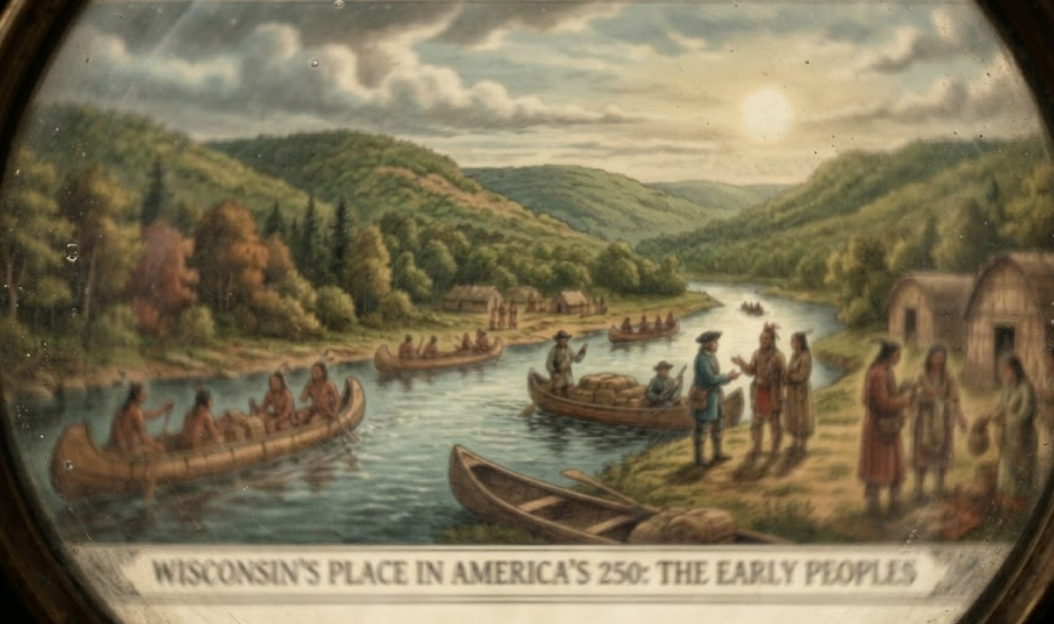
Wisconsin’s story did not open with statehood in 1848. It did not begin with the declaration of a new republic in 1776 either. The actual narrative belongs to sovereign Indigenous nations who managed resources, established trade networks, fought, negotiated, and adapted across this landscape long before any European footprint was pressed into the soil.
Long before modern borders were drawn, human engineering was already reshaping this landscape. It is believed that thousands of years ago hunters first established a presence here, following the retreating glaciers into the region. By 500 BC, these early populations had transitioned into a sophisticated society capable of large-scale earthworks, constructing the massive effigy mounds that still mark our topography today. During this same era, the Hopewell culture introduced organized agriculture to the area. Far from isolated, these early communities built vast commercial networks, managing trade routes that reached all the way to the Atlantic Coast and the Gulf of Mexico.
Archaeological evidence like the ancient dugout canoes recovered from Lake Mendota confirms thousands of years of engineering and deep history across the landmass that is now the State of Wisconsin, yet much of it is unknowable. However, the period between 1600 and 1848 represents something entirely different. It was a volatile era of documented tribal migration, shifting alliances, and geopolitical conflict.
This history is not a collection of mythic folklore or a single narrative of uninterrupted peace. It is a material, provable record of human societies navigating the realities of economic competition, physical displacement, and political survival. In other words, history.
The Beaver Wars and the Subsequent Refugee Migrations

The structural makeup of Wisconsin tribes changed permanently during the mid-17th century. The disruption started hundreds of miles to the east. The Iroquois Confederacy, seeking to control the highly lucrative fur trade with European merchants, launched a series of aggressive military expansions known as the Beaver Wars. Armed with Dutch and English firearms, Iroquois raiders systematically dispersed weaker tribal networks throughout the eastern Great Lakes. This triggered an unprecedented westward refugee migration into the Upper Midwest.
Wisconsin became a primary destination for these displaced populations. The Potawatomi, originally situated in lower Michigan, migrated to the Door County peninsula and eventually expanded across southeastern Wisconsin, constructing extensive trade networks linking the Illinois river systems to Lake Michigan.
The Sauk and Meskwaki nations were similarly forced out of their ancestral lands in Michigan and Ohio, seeking refuge along the Fox-Wisconsin waterway. This sudden influx of thousands of eastern refugees created severe spatial friction. It forced existing resident nations like the Menominee and Ho-Chunk to renegotiate their territories, alter their political strategies, or defend their resources through localized warfare.
The Fox Wars and More Intertribal Violence
French fur traders did not bring peace to the region. They brought an insatiable demand for pelts that weaponized existing rivalries. Take the Meskwaki. By holding the Fox-Wisconsin waterway, they controlled the literal highway connecting Green Bay to the Mississippi River. They demanded steep tolls from French merchants and barred rival tribes from passing entirely. To the French colonial government, this was not tribal sovereignty. It was an economic blockade. The friction turned bloody, sparking the Fox Wars of 1712 to 1738.
The French did not fight this war alone. They leveraged existing intertribal rivalries, securing military alliances with the Ojibwe, Potawatomi, Huron, and Ottawa to break the Meskwaki monopoly.
The resulting conflict was characterized by brutal sieges and tactical executions, reducing the Meskwaki population to a historical low point by the 1740s. Facing potential extermination, the surviving Meskwaki formed a permanent defensive and political confederacy with the neighboring Sauk Nation.
Meanwhile, the Ojibwe expanded their presence south from Lake Superior into northern Wisconsin, pushing into territories historically held by the Dakota Sioux. This expansion triggered decades of intermittent, low-intensity border warfare over access to prime hunting grounds and wild rice beds (manoomin). It established a shifting, heavily militarized boundary between the two nations across the northern forests.
The Military Conflict at Bad Axe
By the turn of the 19th century, the geopolitical friction shifted to systematic expropriation by the United States government. The transition from autonomous trade networks to forced land containment was executed through highly asymmetrical, aggressive treaty negotiations.
The blueprint for this began with the Treaty of St. Louis in 1804. Under the pretext of resolving an alleged murder involving a Sauk tribal member, federal officials and powerful fur traders coerced a small, unauthorized delegation of Sauk and Meskwaki leaders into signing away more than 50 million acres of tribal land, an area encompassing significant portions of southwestern Wisconsin, Illinois, and Missouri. This treaty laid the groundwork for future armed resistance, including the Black Hawk War of 1832.
When analyzing the tragic culmination of this war at the Battle of Bad Axe, the strategic rationale of the US Army regulars and Illinois-Wisconsin militia can be evaluated on its own operational terms. From the perspective of General Henry Atkinson and the frontier authorities, Black Hawk’s “British Band” of roughly 1,000 warriors and non-combatants was an armed, hostile force executing an illegal invasion of sovereign US territory in open defiance of the 1804 and 1816 treaties.
The American military response was seen by natives and other observers as a massacre. It was driven by acute panic among frontier lead miners and homesteaders. This panic was fueled by earlier localized raids on farms and small stockades like Apple River. In the field, tactical communication between the two forces was entirely broken.
When Black Hawk’s representatives attempted to surrender under a white flag on the banks of the Mississippi, the crew of the armed steamboat Warrior assumed the signal was a tactical ruse designed to lure the vessel into an ambush, a common frontier warfare strategy.
American commanders faced immense political pressure from Washington to decisively end the disruption to westward migration. Operating under intense tactical momentum, the pursuing forces viewed the remaining Sauk and Meskwaki fighters on the riverbanks not as refugees seeking exit, but as an active, armed rearguard attempting to buy time for a counter-escalation. The resulting action was brutal and destroyed the British Band as a functional military entity.
The Mechanism of Land Cession: 1829–1848
Following the Black Hawk War, the federal government accelerated its campaign of forced removal. The strategy shifted from active battlefield engagements to legal containment. Between 1829 and 1848, a succession of treaties stripped the Ho-Chunk, Potawatomi, Menominee, and Ojibwe of their remaining ancestral territories in Wisconsin.
The Ho-Chunk were subjected to multiple waves of forced military removal to reservations in Iowa, Minnesota, and Nebraska. Family bands consistently walked back to Wisconsin anyway, exploiting the terrain to evade federal authorities.
The Menominee, facing complete expulsion from the state, successfully negotiated the Treaty of 1854. Through calculated political maneuvering, they secured a permanent reservation on a fraction of their ancestral lands along the Wolf River.
The structural survival of these distinct cultures came at a severe cost. Following the arrival of European and American powers, these nations survived waves of smallpox epidemics, direct military conflict, systematic land dispossession, and mid-19th-century federal policies aimed at forced removal out of the state.
They did not disappear. Today, Wisconsin is home to 11 federally recognized tribal nations. They exist not as historical symbols or static cultural exhibits, but as contemporary sovereign governments managing natural resources, operating economies, and dictating law within the modern boundaries of the state. Their influence and impact is everywhere.
The story of Wisconsin cannot be evaluated accurately without analyzing the infrastructure and political systems that preceded statehood. They did not merely occupy the land. They engineered it, and their modern sovereignty remains an active, foundational force in the state’s ongoing legal and economic reality.
Brutal. Honest. History.
This is the truth: Before it was “our land,” it was claimed by someone else; before them, someone else; and before them (before we even had a historical record) likely someone else.
The exact same friction, displacement, and territorial conflict referenced above also played out across dozens of states during the era of our nation’s western expansion.
But, the American experience is not unique in this regard. Examined through a modern lens generations later, the formation of virtually every nation in human history involves conquest, shifting borders, and morally questionable actions.
Acknowledging these cold historical facts is not an apology for them. Nor is having pride in our state and nation during this 250th anniversary celebration an assertion that every past policy, broken promise, or bloody battle hundreds or thousands of years ago was a simple, clear cut conflict of good versus evil.
But to understand how Wisconsin fits into America’s 250 years, you have to understand how the state actually began. Before we charted the path to 1848, it was necessary to look honestly at life on this land prior to statehood. It’s a part of OUR history.
Up next: Jean Nicolet and the early explorers reach Wisconsin.
For further information
Wisconsin Legislative Reference Bureau
Wisconsin First Nations Project
The Black Hawk War of 1832. University of Oklahoma Press
How the West Was Stolen: A Closer Look at the St. Louis Treaty of 1804.
Jesuits in the North American Colonies and the United States