Far too few know the incredible story of Wisconsin’s Feller School and the promise it holds to address the literacy crisis that affects schools across the state and country.
By George Mitchell, for Dairyland Sentinel
That’s about to change. A new book authored by the trailblazing Wisconsin founder of the school has caught the attention of a major journal affiliated with Harvard’s Kennedy School of Government.
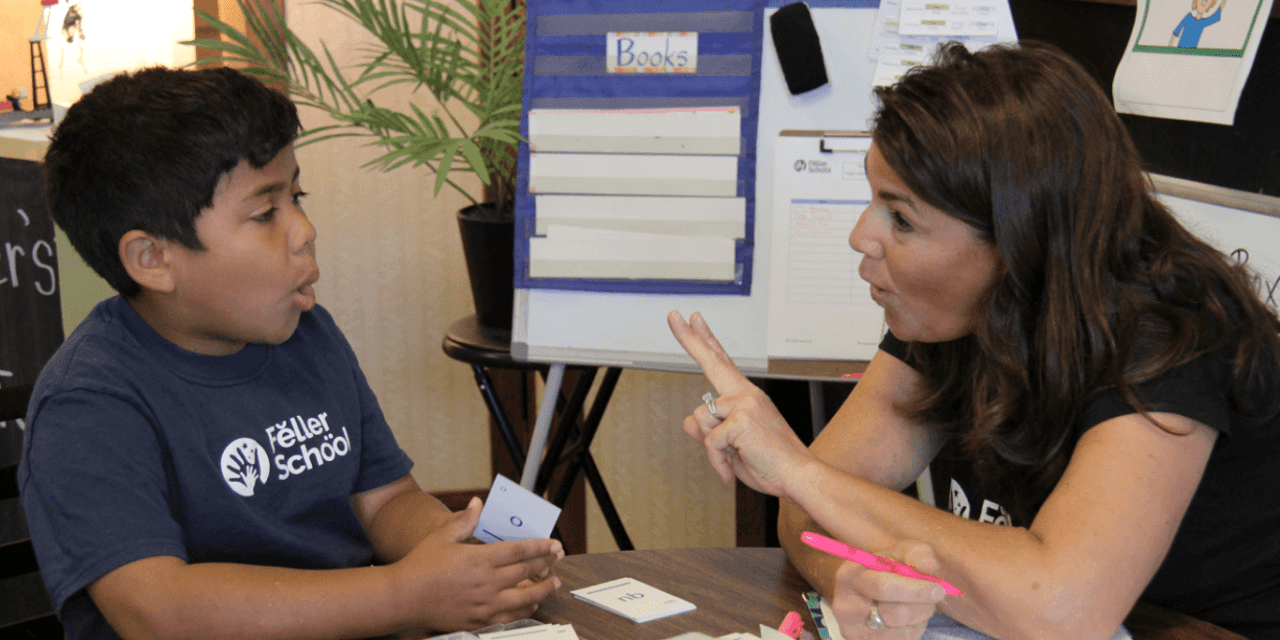
Kim Feller is the founder of The Feller School on Madison’s West Side. She wrote and recently published Your Brain Loves Patterns: A Parent’s Guide to Dyslexia and the Science of Reading.
Today an excerpt was posted at Education Next, an important journal founded three decades ago by Paul E. Peterson, the Henry Lee Shattuck Professor of Government and Director of the Program on Education Policy and Governance at Harvard University.
Feller’s powerful story thus will gain an important audience. There are an estimated 125,000 monthly visitors to the Education Next website. The nation’s most influential education scholars and reformers subscribe. GOP gubernatorial candidate Tom Tiffany is among several elected officials who have come away impressed after a visit to The Feller School.
Feller’s school is at ground zero when it comes to making a meaningful difference in addressing the literacy crisis plaguing Wisconsin’s and America’s schools. Her results offer a path forward that warrants the attention of elected officials and educators across the state and beyond.
The scale of the problem she is addressing: untreated dyslexia: is massive. Tens of thousands of Wisconsin children likely are affected. While The Feller School shows that effective treatment is possible, it is the only independent school in the state dedicated to serving affected students. Private, charter, and traditional public schools all have the opportunity to learn from her.
The excerpt published today by Education Next begins with the story of Jermiah, a public school student of Feller’s many years ago.
She begins: “He was a scrawny little boy with buzzed hair and more energy than three kids combined. He’d burst into my intervention room like a firecracker, all spunk and spirit [but] he was falling farther behind every single day. I was his reading interventionist in a large public elementary school. My job was to take the ‘lowest of the low’ (kids in the bottom 20 percent on standardized tests) and help them catch up.”
Feller says her strategies at the time reflected now-discredited practices taught for decades at education schools across the country. She writes that “Everyone thought this was good teaching. The principal praised my work. Parents thanked me. Classroom teachers were grateful to get a break from kids who couldn’t keep up and frequently were the same kids who were full of mischief. Jermiah loved coming to see me, and I loved seeing him.
“But here’s what I knew in my gut: He wasn’t learning to read.”
Feller would not accept conventional wisdom. Through independent research, she concluded “the problem wasn’t with the kids. The problem was with the untrained and uninformed teacher. The problem was with the method of teaching. Ultimately, the problem fell in the laps of teachers like me. I needed to change. There was so much to learn and then so much more to learn how to teach to children.”
Feller resigned and made a commitment four years ago to make a difference by starting a school. Enrollment has quadrupled to 32 in grades K through five. Dozens more children have attended her summer classes. Most promising, more than 100 teachers have attended her training program. She has plans to move from leased space in a Catholic school to her own building. If she can raise the capital to expand, there will be new Feller Schools elsewhere in Wisconsin.
Results? Per Feller:
“Every student at Feller arrives needing intensive reading support. Most perform below the 20th percentile nationally on standardized literacy measures, and many below the 10th.
“In 2024-25, every one of our 19 students improved their oral reading fluency as measured by (scientifically valid indicators). We track progress 3 times in each school year. [In 2024-25] students averaged an 85% increase in fluency in a single year: roughly double the [expected] annual growth of typical readers in public schools, and far above what dyslexic students achieve in mainstream classrooms. Nearly half doubled their reading rate. A third tripled it.
“One third grader began the year reading 4 words per minute at 40% accuracy. By June she was reading 40 words per minute at 91% accuracy. She is not the exception. She is what happens when kids get instruction matched to how their brains learn.”
I have visited The Feller School and can vouch for the exuberance of students who previously “felt they were dumb” and now are active learners.
I have spoken with teary-eyed parents who describe the 180-degree turn in the trajectory of their children.
In my 40 years of following the K-12 education scene, the story of The Feller School ranks as one of the most promising I have encountered.
Mitchell is a supporter of education reform, a former journalist and leader within Wisconsin local and state government, and a frequent contributor to Dairyland Sentinel.
How to buy the book by Kim Feller.