
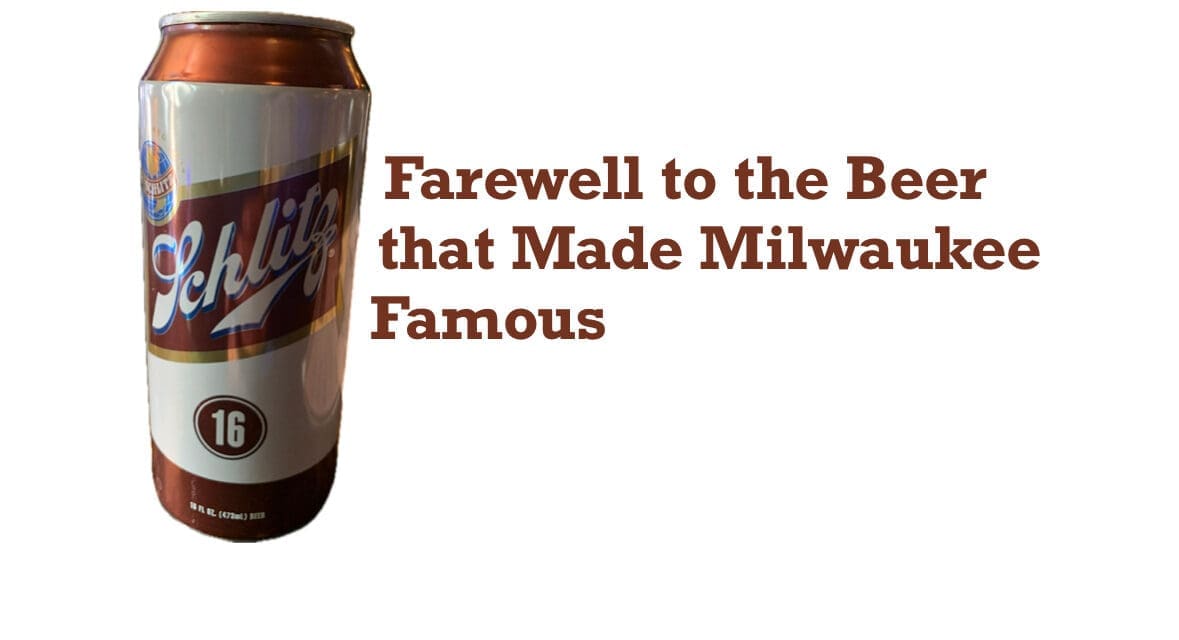
An era of Wisconsin brewing history is quietly reaching its final pour. Pabst Brewing Company has officially discontinued Schlitz, the historic lager marketed for generations as “the beer that made Milwaukee famous.” The decision marks the end of a 177-year legacy that shaped the industrial and cultural identity of Brew City.
The brand’s final chapter will not close in Milwaukee, but rather ten miles south of Madison. Wisconsin Brewing Company in Verona announced it received permission from Pabst to brew one last ceremonial batch. Driven by historical brewing logs from 1948, the final run aims to honor the brand’s mid-century peak before it disappears entirely from tavern taps and retail shelves.
The Rise to National Prominence
The roots of Schlitz trace back to 1849, when German immigrant August Krug opened a tavern brewery in Milwaukee. Following Krug’s death, bookkeeper Joseph Schlitz took control of the operation, later marrying Krug’s widow and renaming the business the Joseph Schlitz Brewing Company.

The brewery’s path to national prominence was accelerated by regional tragedy. When the Great Chicago Fire of 1871 devastated Illinois breweries, Schlitz shipped thousands of barrels of beer down Lake Michigan to relief points. The gesture solidified its famous slogan and anchored its distribution network across the United States.
By introducing innovative practices like the industry’s first brown glass bottle to protect beer from light damage, Schlitz became a pioneer in mass production. In 1902, it surpassed Pabst to become the largest brewery in the world, a title it traded back and forth with national rivals for decades.
A Citadel on the Milwaukee River
At its height, the physical footprint of Schlitz was a city within a city. The massive brewing complex was anchored just north of downtown Milwaukee, bound by West Cherry Street to the south, North Pleasant Street to the north, and stretching along the west bank of the Milwaukee River. This strategic location allowed the company to harvest ice directly from the river during winter months and quickly load product onto commercial vessels.
The sprawling, multi-block industrial citadel eventually encompassed dozens of brick structures, including specialized brewhouses, a massive grain elevator, extensive ice houses, stables for hundreds of delivery horses, and dedicated cooperage facilities where workers assembled wooden barrels. The architectural style, dominated by Cream City brick, reflected the heavy, permanent German industrial design of the late 19th century. Today, the preserved grounds survive as Schlitz Park, a repurposed commercial office campus that retains the historic structural shells, including the famous Brown Bottle tasting room, which served as a corporate hospitality center.
The Tied-House Monopoly
To guarantee a steady and exclusive outlet for its massive production volume, Schlitz heavily adopted the European “tied-house” system during the late 1880s and 1890s. Under this aggressive real estate strategy, the brewing company purchased land, built neighborhood taverns, and leased the buildings directly to independent operators. The binding condition of the lease was absolute: the tavern keeper could exclusively serve Schlitz products.
These commercial properties were easily identifiable by distinct architectural hallmarks. Schlitz hired prominent architects to design corner taverns featuring Queen Anne towers, mock-Tudor half-timbering, and decorative brickwork. Most crucially, every authentic Schlitz tied-house featured a prominent, built-in stone or concrete relief of the company’s trademark globe logo embedded directly into the exterior masonry.
The strategy allowed Schlitz to dominate the retail market in Milwaukee and Chicago. While federal and state laws banned the tied-house system following the repeal of Prohibition to prevent monopolies, dozens of these historic structures still stand across the Midwest, many still operating as independent neighborhood taverns recognizable by the vintage corporate emblems carved into their facades.
Bowling, Gusto, and Working-Class Culture
As mass media expanded in the mid-20th century, Schlitz cemented its place in working-class culture by embedding itself into regional recreation. The brewery became one of the foremost corporate sponsors of organized bowling leagues across Wisconsin, a sport intimately tied to the social life of industrial laborers.
Schlitz funded high-stakes tournaments, sponsored prominent local teams, and provided custom tavern league trophies, linking the consumption of their product with the era’s dominant working-class pastime. Inside neighborhood bowling alleys and corner taps, glowing neon signs and Schlitz-branded scoring sheets were ubiquitous, reinforcing the brand’s identity as the reward for a hard day’s labor.
The Recipe That Wrecked a Giant
By the 1970s, Schlitz was a corporate behemoth, producing over 24 million barrels annually. However, aggressive cost-cutting measures by management triggered an unprecedented collapse.
In a bid to streamline production, the company implemented an accelerated batch fermentation process and altered its traditional recipe, substituting high-quality ingredients with cheaper alternatives like corn syrup. The resulting liquid lacked the flavor profile consumers expected.
Compounding the taste issue, a 1976 production error caused the beer to develop a hazy, flaky appearance in the bottle. Though safe to consume, the visual flaw led to public backlash. Desperate attempts to quietly recall millions of cans failed to prevent a catastrophic loss of market share.
Internal turmoil peaked in 1981 when Milwaukee plant workers launched a major strike over proposed wage concessions. Financially depleted by plummeting sales, leadership closed the flagship Milwaukee brewery permanently and sold the company to Stroh Brewing Company in 1982.
The Nostalgic Revival and Final Drop
Pabst acquired the Schlitz brand profile in 1999 alongside other legacy labels. In 2008, Pabst attempted a high-profile revival, research-brewing the classic 1960s formula to appeal to vintage enthusiasts and regional tavern keepers.
While the nostalgic comeback initially succeeded in capturing local interest, long-term sales eventually succumbed to broader shifts in consumer habits, characterized by a declining market for regional lagers and the expansion of craft breweries. According to production partners, liquid volumes eventually dropped below the minimum thresholds required to justify commercial brewing.
The ceremonial final batch will be tapped and sold exclusively at the Wisconsin Brewing Company facility in Verona on Saturday, June 27, 2026, drawing a definitive line under one of the most significant names in American brewing history
Further review
- Joseph Schlitz Brewing Company Historical Profile (Encyclopedia of Milwaukee)
- The Corporate Decisions Behind the Fall of Schlitz (Beer Connoisseur)
- Pabst Brewing Company Overview and Brand Portfolio (Wikipedia)
- Brewing the Last Schlitz Beer in Wisconsin (WTMJ News)
- Brew City Heartbreak As Schlitz Shuts Down After 175-Year Run (Hoodline)