The searches for the next president of the University of Wisconsin System and the next chancellor of University of Wisconsin–Madison are not routine HR exercises. These are the two most important higher education hires in Wisconsin. For taxpayers, employers, students and lawmakers, the people selected will shape the direction of public higher education for years.
Which makes one question impossible to ignore.
Who, exactly, is speaking for the rest of Wisconsin in these searches?
Not just faculty insiders. Not just administrators. Not just governance groups and professional academic networks that already tend to see the world the same way.
Wisconsin is a politically divided state. A culturally divided state, too. The people funding these universities include conservatives, liberals, independents and plenty of exhausted people who are sick of politics altogether. They include manufacturers in the Fox Valley, dairy farmers in western Wisconsin, suburban parents in Waukesha County, startup founders in Madison and workers trying to decide whether sending their kids to college is still financially realistic.

From the outside, these searches increasingly feel like the same small ecosystem talking to itself.
That is a problem.
Not because conservatives are owed control over the university system. They are not. Public universities should not become ideological trophies for either side, no matter which party control the Governor’s office. But institutions that depend on public trust cannot afford to look dismissive of large portions of the public.
And too often, modern higher education does exactly that. And the searches for the System president and UW-Madison chancellor are already tainted.
The Wisconsin Idea was never supposed to mean the university serves only itself or only one ideological culture. The entire premise was that the boundaries of the university were the boundaries of the state. That requires engagement with all of Wisconsin, including people campus culture may not naturally agree with politically.
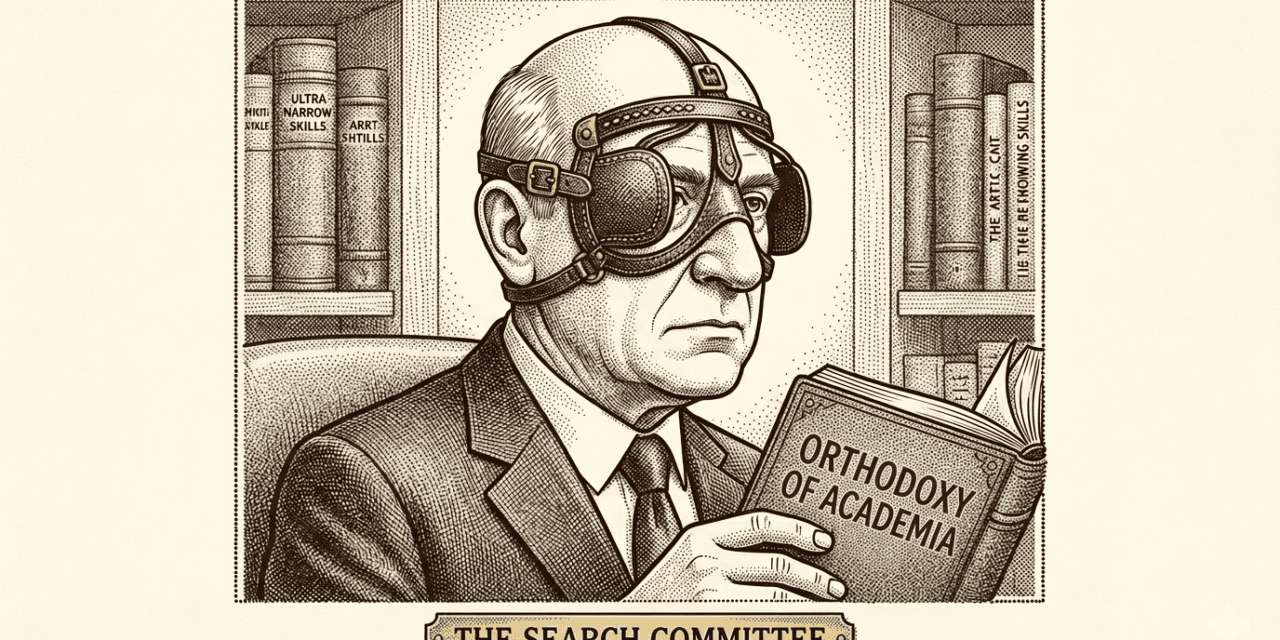
Instead, many leadership searches in higher education now operate through an increasingly narrow lens. Candidates are filtered by campus insiders, administrators and governance circles that often share similar assumptions about politics, culture and institutional priorities. Diversity is celebrated in almost every form except viewpoint diversity.
Then universities act surprised when public skepticism grows. Which underscores just how insular and out-of-touch their leaders are.
The next UW System president and UW-Madison chancellor will inherit serious challenges. Enrollment pressures. Rising costs. Questions about the value of a degree. Political scrutiny. Donor pressure. Workforce shortages in critical industries.
These are not purely academic leadership positions anymore. They are economic leadership positions, civic leadership positions and public trust leadership positions.
Wisconsin employers need graduates prepared for engineering, healthcare, agribusiness, technology, finance, the trades, AI and advanced manufacturing. Parents want confidence their children are being challenged intellectually, not pressured ideologically. Taxpayers want accountability. Legislators want evidence the system understands fiscal realities outside the campus bubble
Those are not extremist expectations. They are normal expectations.
A credible search process would reflect that reality intentionally. Not symbolically, but actually.
Where are the major private-sector voices within these search committees?
Where are the center-right alumni?
Where are the representatives of industries helping drive Wisconsin’s economy?
Where are the people who understand how competitiveness, hiring and investment decisions work outside academia?
A university system that constantly talks about stakeholder engagement should not conduct leadership searches that feel culturally inaccessible to half the state.
And there is a practical consequence here that university leaders ignore at their own peril. Funding stability depends on political durability.
Public trust erodes gradually, then suddenly. Legislative relationships weaken. Donors become more cautious. Families begin looking elsewhere. Prestige helps, but prestige alone is not a permanent shield against growing public distrust.
That trajectory is avoidable. But pretending the problem does not exist will not avoid it.
The irony is that broader ideological representation would strengthen these institutions, not weaken them. Universities become healthier when leaders do what people outside academia do every day: work with people with whom they disagree without treating dissent as moral contamination.
That should not be controversial.
The next UW System president and UW-Madison chancellor do not need to be conservatives. However, they do need to understand conservatives are part of the state they serve. They also need to recognize employers are partners, not adversaries. And they need enough intellectual confidence to lead institutions where disagreement is not quietly filtered out before the conversation even begins.
Wisconsin’s flagship university and the entire UW system belong to the public, not an ideological club.
The search committees don’t reflect that truth.