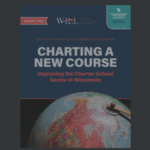
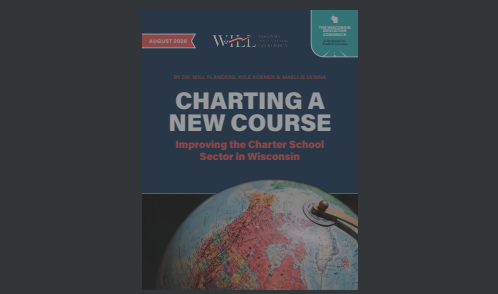
Wisconsin was among the first states to authorize charter schools, but a new report indicates that funding disparities, political uncertainty, and an unpredictable approval system have caused the state to fall behind much of the country.
Released Wednesday by the Wisconsin Institute for Law & Liberty (WILL), the report calls for creating a politically balanced statewide charter school board, increasing financial support for school facilities, and establishing a formal appeals process for denied charter applicants.
“Wisconsin once led the nation in education reform, but charter schools, a vital option for families, have stagnated in recent years,” WILL Research Director Will Flanders said in a statement. “Families want and deserve innovative public-school options, but unnecessary and costly roadblocks prevent charter school expansion. Wisconsin must reverse this trend so our students can access real education options and thrive.”
Charter schools are publicly funded but operate under contracts with school districts or other authorized public entities. They generally receive greater control over curriculum, staffing, and budgeting in exchange for meeting strict performance requirements. Wisconsin enacted its charter school law in 1993.
The Data
Despite its early start, Wisconsin ranked 41st out of 45 states in the National Alliance for Public Charter Schools’ 2022 evaluation of state charter laws. The state received low marks for its application and renewal processes, operating funding, and access to state and federal aid. A separate 2026 assessment by the Center for Education Reform gave Wisconsin’s charter school law a B-minus, ranking it 15th nationally and awarding zero points for facility funding.
According to WILL, independent charter school enrollment in Wisconsin has grown by nearly 35% since 2015, but that growth has slowed to 11.6% over the past three years. When all charter schools are included, Wisconsin’s enrollment increased about 9.8% from the 2019–20 school year through 2023–24, placing the state in the second-lowest growth category nationally.
WILL based its findings on state funding and policy data, national comparisons, and interviews with 15 charter school operators, authorizers, advocates, and policy experts. Interviewees repeatedly cited inadequate facility funding, burdensome licensing requirements, political instability, and the absence of a strong support network for new schools.
“You’re one election away from the whole thing falling apart,” one national charter school strategist told the report’s authors.
The report highlights a stark funding gap: Independent charter schools received $12,369 per student during the 2025–26 school year. By contrast, traditional public school districts received an average of about $18,746 per student. Unlike traditional districts, independent charter schools generally lack access to local property tax revenue or dedicated state facility funding, leaving them reliant on private donations to acquire, renovate, or maintain buildings.
Education Establishment: Reluctant Partners
Wisconsin has empowered numerous public entities to authorize independent charter schools, including Universities of Wisconsin campuses, technical college district boards, tribal colleges, the Milwaukee Common Council, and the Waukesha County executive. However, most do not use that authority.
During the 2025–26 school year, only five entities actively oversaw independent charter schools: UW-Milwaukee, UW-Parkside, the Universities of Wisconsin Office of Educational Opportunity, the city of Milwaukee, and the Waukesha County executive.
Through public records requests, WILL found no charter school applications submitted to Wisconsin technical college boards since lawmakers granted them authorizing authority.
Aside from UW-Milwaukee, UW-Parkside, and the Office of Educational Opportunity, other Universities of Wisconsin campuses also reported zero applications. According to the report, many of these institutions fail to publish an application process, timeline, or designated contact for prospective operators.
Proposed Solutions
To remedy this, WILL recommends requiring authorizing entities to publish their application standards and report annually on their decisions. The organization also proposes offering grants to encourage technical colleges and other institutions to authorize schools that align with their missions, such as career and technical education programs.
Furthermore, the report champions a statewide charter board with political balance and independence from shifts in state government. This board would approve schools, hear appeals, and establish a more predictable renewal process.
While Wisconsin received a $58 million, five-year federal grant in 2023 to support charter school planning and expansion (with the state Department of Public Instruction awarding $18.5 million to 27 charter schools this past June)WILL concluded that these funds are not a cure-all.
While the grants help individual schools open, they cannot fix systemic issues like a lack of active authorizers, missing facility funding, and unpredictable approval procedures, according to the institute.