
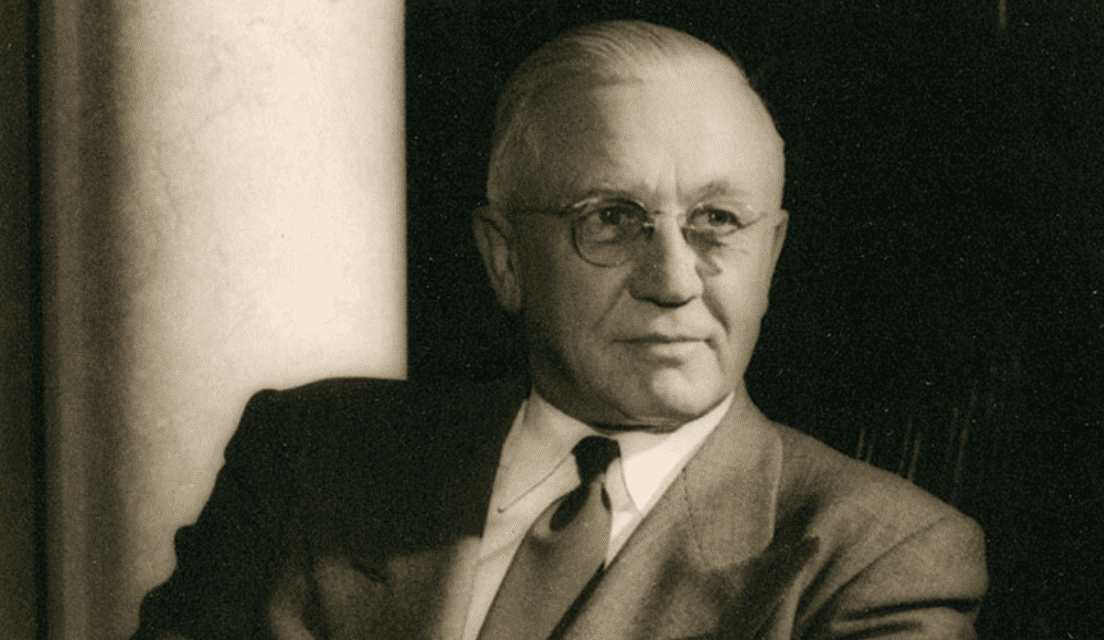
Oscar Rennebohm was a significant figure in Wisconsin’s business and politics during the first half of the last century, although his impact here continues to this day.
A casual drive through Madison today makes it impossible to miss the name Rennebohm. From the University of Wisconsin’s pharmacy school building to the city parks and active community grants, the name is woven right into the fabric of Dane County. Yet the story behind the signage, a classic, self-made Wisconsin trajectory from country boy to pharmacy mogul and, ultimately, the governor’s mansion, is often overlooked.
Oscar Rennebohm was born in the tiny Columbia County community of Leeds in 1889, moving down to Milwaukee with his family when he was ten. But it was his arrival at the University of Wisconsin, where he graduated with a pharmacy degree in 1911, that set the trajectory for the rest of his life.
He didn’t waste any time. After a brief stint working for others, a 23-year-old Rennebohm bought a struggling Madison drugstore in 1912, operating it as a Rexall franchise. It was a gamble that paid off massively. Through sharp business instincts and a relentless work ethic, that single shop ballooned into a ubiquitous local chain. “Rennie’s,” as locals came to call them, became neighborhood fixtures across Madison.
When World War I broke out, Rennebohm stepped away from his booming business to enlist, earning a commission as an Ensign in the U.S. Navy. That sense of civic duty stuck around long after the war ended. By the 1940s, he was leading state and national pharmaceutical associations and serving on the UW Board of Regents.
Politics was the next logical step. Running as a Republican, Rennebohm was elected Wisconsin’s Lieutenant Governor in 1944, serving alongside the aging Governor Walter Samuel Goodland. When Goodland died in office in early 1947, Rennebohm quietly stepped into the state’s top job. He proved his mettle as acting governor, easily winning election in his own right in 1948 and serving until 1951.
As governor, Rennebohm ran the state with the pragmatic efficiency of a seasoned executive. His term was defined by a massive push for educational reforms and a fierce advocacy for public welfare. With thousands of World War II veterans returning home to Wisconsin, he pioneered a state housing program specifically for veterans, creatively funding it through a targeted increase in the liquor tax.
Even after he chose to step back from politics in 1951 to return to his business empire, his impact on the state only grew. In 1949, he established the Rennebohm Foundation. Over the decades, that entity has quietly poured more than $96 million into Madison’s education, healthcare, and social services. It’s the reason the UW School of Pharmacy sits inside Rennebohm Hall today.
Rennebohm passed away in 1968 at the age of 79 and was laid to rest at Forest Hill Cemetery. Twelve years later, in 1980, the iconic homegrown drugstore chain was officially sold to Walgreens, closing a major chapter in local retail history.
Oscar Rennebohm’s legacy isn’t just about the storefronts he built or the elections he won. He represents a specific brand of mid-century Wisconsin leadership: a man who parlayed immense commercial success into genuine, lasting public service, leaving behind a foundation that still shapes the capital city today.
Photo: Oscar Rennebohm Foundation