State Sen. Van Wanggaard is raising conflict-of-interest concerns after a University of Wisconsin Law School center supported four convicted felons seeking shortened prison sentences while one of its staff members served on Gov. Tony Evers’ Commutation Advisory Board.
The four applicants were Daniel Cerney, Mighty Howell, Michael Maldonado and Sabir Wilcher. All four cases were considered by the Board Friday. Each of the four individual was convicted in a homicide case.
“It is a rigged system!” Wanggaard, R-Racine, said Tuesday. “Board members are considering applications their close colleagues are urging. The supposed ‘consideration’ of releasing killers early seems like a guarantee now.”
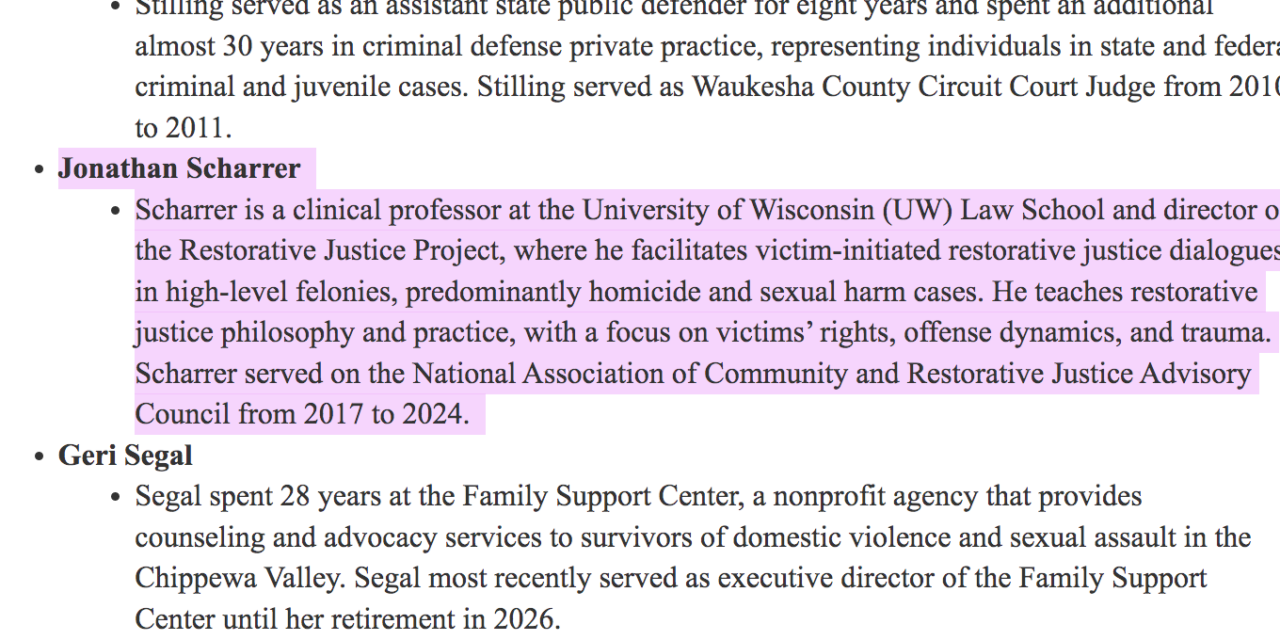
Jonathan Scharrer, a UW Law School clinical professor and director of the Restorative Justice Project at the Frank J. Remington Center, is one of nine members of the board, according to Wanggaard. The senator said Scharrer was listed on Remington Center letterhead accompanying a letter supporting the four applicants.
Wanggaard said Scharrer recused himself from consideration of one of the four applications supported by the center.
“As we combed through the documents, we realized the Law School’s Remington Center wrote a letter in support of 4 of the 12 applicants,” Wanggaard said. “Jonathan Scharrer is listed on the Remington Center’s letterhead. He is also a member of Governor Evers’ Commutation Board. If that’s not a conflict of interest, I don’t know what is.”
Wanggaard’s office discovered the connection while reviewing more than 1,800 pages of records received from the governor’s office last week. The records were released in partial response to a public records request the senator submitted in May and included application materials for the 12 inmates heard by the board Friday.
The senator has since submitted a public records request to the Remington Center seeking information about its involvement. That request remained pending Tuesday, according to Wanggaard’s office.
The UW Law School identifies Scharrer as director of the Restorative Justice Project. The program works with crime victims and offenders and develops alternatives to the traditional criminal justice system.
Evers appointed Scharrer to the Commutation Advisory Board in June. The governor’s office cited his experience facilitating victim-offender dialogues involving serious and violent crimes.
The advisory board held its first hearings Friday, interviewing 12 inmates seeking reduced sentences. Six of the 12 had homicide convictions, including Cerney, Howell, Maldonado and Wilcher.
Cerney was convicted of two counts of first-degree intentional homicide for killing William Leis and Leis’ 85-year-old mother in Monroe County. He was 17 at the time of the crimes, according to coverage of Friday’s hearing.
Howell was convicted of intentional homicide and attempted armed robbery in 1993. Wilcher was sentenced to life in prison in 1995 for first-degree intentional homicide while armed. Both were teenagers when they committed the crimes, according to Milwaukee Neighborhood News Service.
Maldonado was convicted in a 1995 murder-for-hire case. He has maintained that another man committed the killing, although Maldonado acknowledged purchasing the gun used in the crime, according to FOX6 News.
A commutation shortens or changes a sentence that is still being served. The advisory board reviews applications and makes recommendations, but Evers has sole authority to grant a commutation under the Wisconsin Constitution.
The governor’s commutation guidelines require most applicants to have served at least half of their incarceration term or at least 20 years of a life sentence. Certain convictions, including sexual assault, child abuse and child trafficking, are excluded. Homicide is not an excluded conviction.
Crime victims are notified and allowed to provide input. The board is directed to consider the effects of a commutation on victims and public safety.
Wanggaard said 809 applications had been submitted through Aug. 14. His office initially reported 810, but later found that the list supplied by the governor’s office contained one duplicate. The Senator says he is still seeking records involving the remaining 797 applicants.
Evers restored Wisconsin’s dormant commutation process through two executive orders in April. No Wisconsin governor has commuted a sentence since Republican Gov. Tommy Thompson issued his final commutation in 1995.
Previously at Dairyland Sentinel