

Wisconsin border counties sharply outpaced neighboring states in manufacturing employment after the Manufacturing and Agriculture Credit was phased in, though researchers caution that the nearly 11,900-job gap is not a direct count of jobs created by the tax credit.
Wisconsin manufacturing gained substantial ground against neighboring states in the decade after the state phased in a major manufacturing tax credit, according to a new University of Wisconsin-Madison economic report released Monday.
Researchers at UW-Madison’s Center for Research on the Wisconsin Economy found that manufacturing employment in Wisconsin border counties grew about 17% from 2012 through 2025, while employment in neighboring counties across the state line fell about 3.8%. The difference works out to roughly 11,900 manufacturing jobs when Wisconsin’s actual performance is compared with the trajectory of those neighboring counties. Wisconsin Manufacturers & Commerce, the state’s chamber of commerce and manufacturers’ association and a longtime advocate for preserving the credit, highlighted the UW-Madison findings Monday.
“The MAC, the state’s most effective tool for supporting manufacturing growth and job creation, is critical to Wisconsin’s future because the manufacturing industry delivers outsized benefits to workers, families, communities, and the broader economy,” said WMC President/ CEO Kurt R. Bauer. “Manufacturers of all sizes across the state use the MAC to purchase new equipment, expand operations, and, most importantly, reinvest in employees and hire new workers, all of which stimulate Wisconsin’s economy.”
Read the full statement.
Growth came largely from existing plants
One of the report’s more significant findings involves where the employment gains occurred.
Census business data through 2023 showed the difference came primarily from existing Wisconsin manufacturing plants expanding, rather than from Wisconsin opening substantially more new plants.
From 2013 through 2023, cumulative job creation at continuing manufacturing establishments amounted to 101.5% of the 2012 manufacturing employment base on the Wisconsin side of the border, compared with 74.8% in neighboring counties. Job creation from new establishments was nearly identical, 21.9% in Wisconsin and 22.7% across the state line.
Wisconsin’s border counties also increased their share of the state’s manufacturing property base. Those 19 counties accounted for 14.5% of Wisconsin’s Class 3 manufacturing real estate value in 2012. By 2024, their share had climbed to 17.5%.
That does not mean manufacturing surged everywhere in Wisconsin.
Statewide manufacturing employment increased just 1% between 2012 and 2025, from 453,819 jobs to 458,245, according to the report. Real manufacturing value added was 2.4% lower in 2025 than in 2012. The researchers argue that those statewide numbers cannot show what would have happened without the credit, which is why they focused on counties where manufacturers could operate on either side of a state border.
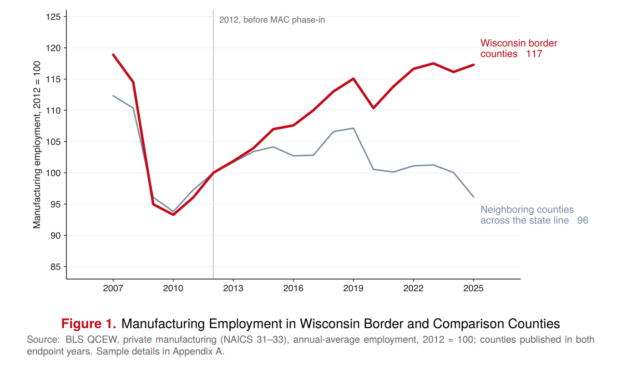
The authors do not attribute all of that difference to the tax credit. Illinois went through a budget impasse and restored its 9.5% corporate tax rate in 2017, and other economic and policy changes occurred during the period.
The study does not claim that the Manufacturing and Agriculture Credit, commonly known as the MAC, single-handedly created 11,900 jobs. It finds that Wisconsin’s position relative to nearby states changed considerably after the credit took effect and concludes the evidence suggests the MAC materially improved Wisconsin’s competitiveness as a manufacturing location.
How the tax credit works
Wisconsin enacted the Manufacturing and Agriculture Credit in 2011 and phased it in beginning in tax year 2013. The credit reached its full 7.5% rate after the phase-in.
Current Wisconsin Department of Revenue guidance says eligible taxpayers may claim a credit equal to 7.5% of qualified production activities income associated with qualifying Wisconsin manufacturing or agricultural property. There is no fixed maximum dollar amount, although the amount that can be used is limited by the applicable tax liability. The credit is nonrefundable, and unused credits may be carried forward for up to 15 years.
A continuing policy fight
The credit has repeatedly been targeted for changes by Gov. Tony Evers.

Daily news from our state.
His 2025-27 executive budget proposed limiting the manufacturing portion of the credit to the first $300,000 in qualified production activities income for each qualifying firm while leaving the agricultural portion unchanged. The administration estimated the change would increase state tax collections by $418.5 million in fiscal year 2025-26 and $373.8 million in 2026-27. The administration argued that the credit had not produced measurable gains in Wisconsin’s share of national manufacturing employment and disproportionately benefited high-income taxpayers.
“At a time when Wisconsin families are struggling to make ends meet and affordability is top of mind, it’s frankly baffling that the leaders of the state’s progressive political movement are advocating for the elimination of a policy proven to create and retain family-supporting careers,” Bauer said. “The MAC creates opportunities, strengthens communities, and grows the economy. Eliminating it would punish workers, families, and Wisconsin’s economic future.”
The new CROWE study directly addresses one of the central arguments in that long-running debate: whether the manufacturing credit has affected where companies choose to keep and expand production.
The authors acknowledge that a broad tax credit also benefits qualifying manufacturing activity that might have remained in Wisconsin without it. They describe that as an inherent tradeoff of a generally available incentive, compared with programs in which government officials choose individual companies or projects for assistance.
While their conclusion is narrower than WMC’s claim that the credit itself created thousands of jobs the researchers nonetheless conclude that the MAC materially imporced Wisconsin’s position as a place to manufacture.
The paper states that its conclusions are those of the authors and do not necessarily represent CROWE, the UW-Madison Department of Economics or the university.