Wisconsin absentee requests still running 18% behind 2022 pace
Returned ballots are down nearly 23%; Dane and Milwaukee counties still account for more than two-fifths of the drop
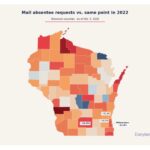
Wisconsin voters had submitted 344,066 applications for mail absentee ballots as of Oct. 8, down 74,321 from the same point in the 2022 election cycle, according to Wisconsin Elections Commission county data.
That is a 17.8% decline from the 418,387 applications reported at the comparable point four years ago. It is the same rate Dairyland Sentinel reported Tuesday using Oct. 5 data.
This comparison uses WEC county-level absentee files from Oct. 8, 2026, and Oct. 13, 2022. Both dates were 26 days before Election Day. Wisconsin’s general election is Nov. 3 this year. The 2022 election was Nov. 8.
Applications rose by 14,617 statewide between Oct. 5 and Oct. 8. Returned ballots grew faster, rising by 26,103 to 105,378. That is still 22.6% below the 136,134 ballots returned at the same point in 2022.
Clerks had sent 331,013 ballots as of Oct. 8, down 18.2% from four years ago.
The decline remains largest in Dane and Milwaukee counties.
Dane County had 49,912 absentee applications as of Oct. 8, compared with 65,892 at the same point in 2022. That is a drop of 15,980 applications, or 24.3%.
Milwaukee County declined from 71,063 applications to 55,852, a decrease of 15,211, or 21.4%.
Together, Dane and Milwaukee counties account for 31,191 of the 74,321 fewer applications statewide, about 42% of the total decline.
The so-called WOW Counties are also running behind their 2022 pace, though by less.
Waukesha County had 30,569 applications, compared with 35,977 four years ago, a decrease of 5,408, or 15%. Washington County is down 16.1%, and Ozaukee County is down 16.2%.
The drop is nearly statewide. Seventy of Wisconsin’s 72 counties are behind their 2022 pace. Florence County is two applications ahead and Marquette County is even, with 728 applications both years.
Returned ballots
The steepest percentage declines in returned ballots are in smaller counties, where low totals can make percentage swings larger. The five largest drops by percentage:
- Iron County: 121 returned, down from 221 (−45.2%)
- Ashland County: 205 returned, down from 352 (−41.8%)
- Lafayette County: 146 returned, down from 229 (−36.2%)
- Waushara County: 220 returned, down from 341 (−35.5%)
- Door County: 506 returned, down from 730 (−30.7%)
In raw numbers, the largest declines are in the state’s most populous counties. The five largest drops by total ballots:
- Milwaukee County: 16,097 returned, down 6,683 from 22,780 (−29.3%)
- Dane County: 15,724 returned, down 6,353 from 22,077 (−28.8%)
- Brown County: 5,503 returned, down 1,632 from 7,135 (−22.9%)
- Waukesha County: 8,543 returned, down 1,537 from 10,080 (−15.2%)
- Winnebago County: 3,103 returned, down 1,109 from 4,212 (−26.3%)
Milwaukee and Dane counties alone account for 13,036 of the 30,756 fewer returned ballots statewide, about 42% of the decline.
The figures do not indicate how the voters requesting absentee ballots intend to vote. Wisconsin does not register voters by political party, and the Elections Commission says its voter data do not contain party preference information.
Nor are absentee applications the same thing as votes cast.
Wisconsin voters may request a mail absentee ballot for any reason. For most voters, the deadline to request one for the Nov. 3 election is 5 p.m. Oct. 29. In-person absentee voting can begin Oct. 20 and may continue through Nov. 1, depending on the municipality. Absentee ballots must reach the municipal clerk by 8 p.m. on Election Day to be counted.
That means the Oct. 8 totals are a snapshot of mail absentee demand less than four weeks before the election, not a prediction of final turnout.
As with its earlier report, Dairyland Sentinel used the WEC county file for all county-level comparisons rather than mixing county totals with municipal rollups.
The Elections Commission has cautioned that Wisconsin’s highly decentralized election system relies on information entered by local election officials and that some residual data errors can occur despite quality-control efforts.
Dairyland Sentinel will continue tracking WEC absentee data through Election Day, including changes after in-person absentee voting begins Oct. 20.
Previously at Dairyland Sentinel