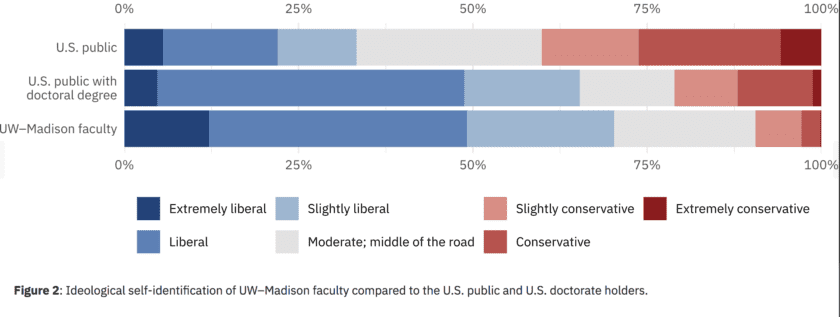
A new report from the Tommy G. Thompson Center on Public Leadership reveals a significant ideological gap among faculty at the University of Wisconsin–Madison. The study, released March 8, 2026, found that 70% of tenured and tenure-track faculty identify as liberal, while only 9% identify as conservative.
According to the report, this imbalance extends beyond personal belief into professional evaluation. “Significant minorities of faculty would be less likely to hire a candidate who expressed a conservative view on topics such as immigration, abortion, affirmative action, or transgender sports participation,” the executive summary states.
The survey, led by political science professor Alex Tahk, used a randomized experiment to measure how political viewpoints affect hiring. The data shows that faculty treated conservative viewpoints less favorably than liberal ones by margins ranging from 11 to 38 percentage points.
Campus Climate and Self-Censorship
The report indicates that conservative faculty feel a lower sense of belonging on the Madison campus. A large majority of conservative respondents believe that someone with their views would feel “not at all” or only “slightly” welcome. Even liberal faculty acknowledged this disparity, with far fewer stating that conservatives would feel welcome compared to progressives.
Confidence in First Amendment protections also varies by viewpoint and race. Only 42% of conservative faculty felt their rights were protected “quite a bit” or “a great deal,” compared to 63% of liberal faculty. Faculty of color reported similar concerns, with only 46% expressing high confidence in their speech protections.
Institutional Consequences
The risk of expressing controversial views appears higher for those on the right. While few faculty reported institutional consequences overall, the report found a clear disparity in how those consequences are distributed.
“Conservative faculty who do express views report experiencing institutional consequences—such as warnings from administrators—at substantially higher rates than liberal faculty who express views,” the study notes. The report suggests that for many conservative faculty, self-censorship may be a rational choice within the current institutional framework.
The study concludes that these findings call into question whether a trade-off is necessary between viewpoint diversity and racial diversity, noting that faculty of color were not more liberal than white faculty on average.
The full report, “Faculty Perspectives on Academic Freedom, Free Expression and Campus Climate at the University of Wisconsin–Madison,” is available at the Tommy G. Thompson Center on Public Leadership website.