Dairyland Sentinel Wisconsin State Budget Primer
Highlights
UPDATED Wednesday, September 16, 8:49 am
Budget Kickoff & Pending Agencies: September 15 was the statutory deadline for state agencies to submit 2027–2029 budget requests 50 of the departments, agencies and boards’ budgets were available at press time.
Fiscal Environment: Most cabinet agencies strictly adhered to Governor Tony Evers’ “zero-growth” mandate for General Purpose Revenue and completed Act 201 5% budget reduction exercises, despite state forecasters projecting a general fund surplus approaching $3 billion. Some, however, did not. See below.
The starting gun has officially fired on Wisconsin’s next state budget. September 15 marks the statutory deadline for state agencies to submit their formal biennial funding wish lists to the Department of Administration Division of Executive Budget and Finance.

No spin or clickbait in this four minute update.
The submissions officially kick off a nearly year-long marathon that will ultimately determine how taxpayer dollars are spent from July 2027 through June 2029. While the final product won’t be signed until next summer, the critical first steps have been playing out inside state agency offices for months, and official requests are now rolling in.
Decoding the Jargon: “General Purpose Revenue” vs. “All Funds”
When the final tally of all state requests is published, the top-line number will be massive. Likely well over $100 billion. However, lawmakers won’t actually be fighting over all of that money.
State budgets are divided into distinct funding buckets. The massive headline number is the “All Funds” budget. But that total is significantly higher than the General Purpose Revenue budget, which is generated by general state taxes like income and sales taxes. General Purpose Revenue represents the flexible state dollars over which the governor and lawmakers have the most policy control.
The remainder of the “All Funds” total consists of restricted revenue streams:
- Federal Funds (Program Revenue-Federal / Segregated Revenue-Federal): Grants and aid passed down from Washington, D.C.
- Program Revenue: Money earned by charging specific service fees, such as university tuition, professional licenses, or state park passes.
- Segregated Funds: Cash legally walled off for dedicated uses, such as the state gas tax feeding the Transportation Fund.
Capital infrastructure projects, such as major university buildings or state facilities, are mostly funded via borrowing and tracked in a separate Capital Budget, with only the ongoing “debt service” (the state’s monthly loan payment) appearing in the main operating budget.
The Running Tally: 50 Agency Submissions Tracked
Below is our updated synthesis of the state agencies, departments, boards and authorities whose available 2027-29 budget materials have been reviewed and logged in our tracking database
As of 11:58 PM on September 15, 2026, 50 state agencies, departments, commissions, and authorities have officially logged their 2027–2029 biennial budget onto the Department of Administration website.
Out of Wisconsin’s state government bodies required to submit baseline budget files:
- 50 Agencies Submitted & Processed: Ranging from the state’s largest operational bodies (DHS, DPI, DOT, DOC) to self-funded regulatory authorities and executive judicial agencies.
- Key Major Agency Submissions Pending: The formal legislative budget draft from the Legislative Branch and State Supreme Court / Court System operating requests will be incorporated alongside the new Governor’s official Executive Budget address presented to the Joint Committee on Finance in early 2027.
Agency Requests Breakdown
2027-29 Biennial Budget Agency Requests
Agency budget requests for the 2027-29 biennial budget were due to the State Budget Office in September 2026.
Agriculture, Trade and Consumer Protection, Department of
Financial Institutions, Department of
Insurance, Office of the Commissioner of
Safety and Professional Services, Department of
Wisconsin Economic Development Corporation
Educational Communications Board
Higher Educational Aids Board
Medical College of Wisconsin
Public Instruction, Department of
University of Wisconsin System
Wisconsin Technical College System, Board of
Environmental Improvement Program
Lower Wisconsin State Riverway Board
Natural Resources, Department of
Fox River Navigational System Authority
Kickapoo Reserve Management Board
Employment Relations Commission
Labor and Industry Review Commission
Board on Aging and Long-Term Care
Child Abuse and Neglect Prevention Board
Health Services, Department of
Children and Families, Department of
Board for People with Developmental Disabilities
Health and Educational Facilities Authority
Workforce Development, Department of
Military Affairs, Department of
Veterans Affairs, Department of
Wisconsin Housing and Economic Development Authority
Administration, Department of
Board of Commissioners of Public Lands
Lieutenant Governor, Office of the
The Executive “Zero-Growth” Mandate & Act 201
For the 2027-29 budget, Gov. Tony Evers’ instructions generally direct agencies to prepare requests based on 100% of their fiscal year 2026-27 adjusted base and assume zero growth in overall GPR appropriations in each year of the biennium. The instructions include exceptions for the Universities of Wisconsin, specified corrections and health services costs, K-12 school aids, certain entitlement and assistance programs, cybersecurity expenses and standard budget adjustments. Additional GPR-funded staff generally must be accommodated through base reallocations.
Separately, Act 201 requires agencies other than the Legislature and courts to submit state-operations alternatives showing both zero growth and a 5% reduction from the fiscal year 2026-27 adjusted base in each year of the biennium. Federal appropriations and debt service are excluded from those targets.
Those constraints come as Wisconsin’s projected general fund balance at the end of the current biennium approaches $3 billion.
These entities requested significant staffing increases and higher biennial funding than their doubled adjusted spending baselines.
- Universities of Wisconsin: Requested $770.9 million more in all-funds spending over the biennium, a 4.9% increase over the doubled adjusted base. The net all funds increase is entirely attributable to GPR, with GPR rising $770.9 million, or 26.0%. UW also requests 631.4 additional FTE, increasing from 38,239.4 to 38,870.8. The staffing increase includes 408.4 FTE for workforce and business initiatives, 124.5 for health care and research, 89 for affordability and education initiatives, and 9.5 for State Laboratory of Hygiene programs.
- Department of Revenue: Requested $21.7 million more in all-funds spending over the biennium, a 4.0% increase over the doubled adjusted base. Within that total, GPR rises $13.2 million, or 3.0%. DOR also requests 43 additional FTE, increasing from 1,179.8 to 1,222.8. The request includes 19 FTE for statewide debt collection, 18 associated with marijuana legalization and enforcement, four for centralized gaming enforcement and two for alcohol-beverage regulation.
- Wisconsin Elections Commission: Requested $7.375 million more in all-funds spending over the biennium, a 51.1% increase over the doubled adjusted base. Within that total, GPR rises $3.381 million, or 30.8%. WEC also requests 13 additional permanent FTE, increasing staffing from 36 to 49, a 36.1% increase. Separately, the request includes $3.7506 million in program revenue for WisVote 2.0, which carries no additional FTE.
Political Dynamics & Next Steps
This budget cycle is shaped by an impending transition in executive and legislative leadership. With Governor Evers not seeking a third term, a new governor will take office in January 2027 to deliver the formal executive proposal. Also significant, legislative leadership changes and contested races in the upcoming November elections will determine the partisan makeup of the Legislature that considers the next state budget.
Following the September 15 deadline, the State Budget Office and the nonpartisan Legislative Fiscal Bureau will analyze agency requests. Key milestones over the next year include:
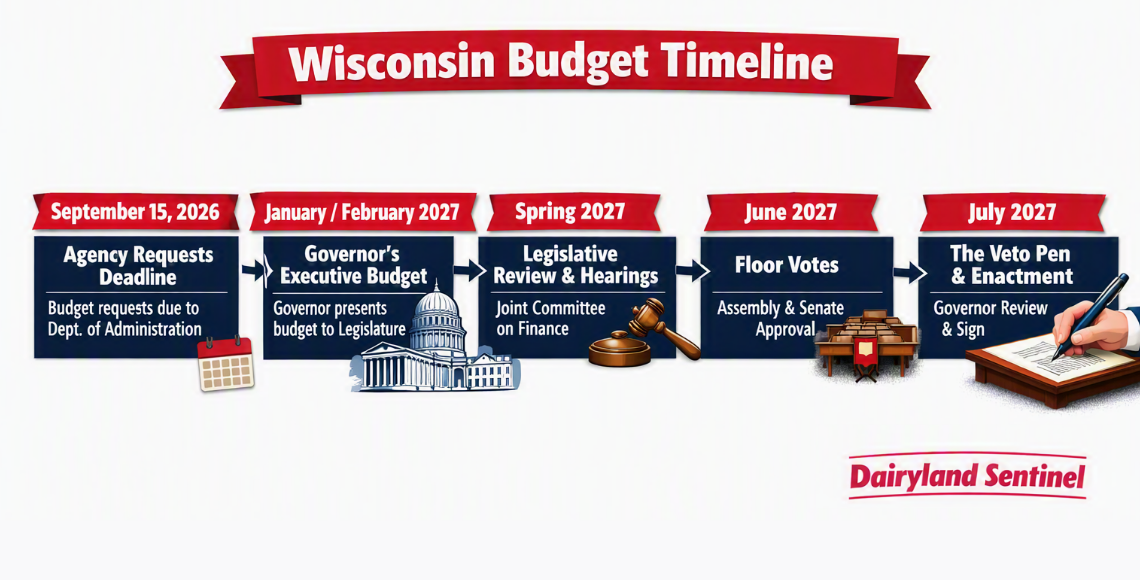
The Budget Timeline
Following the Sept. 15 agency-request deadline, the State Budget Office, the governor’s office and the Legislative Fiscal Bureau will spend the fall reviewing agency requests, performance measures and the state’s revenue outlook.
Here is a look at the road ahead for the 2027-2029 budget (Click on icon for details):
September 15, 2026
Agency Requests Deadline
The statutory deadline for state agencies to submit their formal budget requests to the Department of Administration.
January/February 2027
Governor’s Executive Budget
The governor delivers the budget message and executive budget proposal to the newly sworn-in Legislature. State law requires the budget message on or before the last Tuesday in January unless the Legislature approves a later date requested by the governor. The executive budget bill is then introduced by the Joint Committee on Finance and referred to that committee.
Spring 2027
Legislative Review & Hearings
The Joint Committee on Finance effectively takes control of the bill. The committee travels the state to hold public hearings, allowing citizens to weigh in. Following hearings, the committee frequently rewrites significant portions of the Governor’s proposal.
June 2027
Floor Votes
The revised budget heads to the full Assembly and Senate. A majority vote is required in both chambers. If the two houses pass different versions, a conference committee is convened to iron out the differences.
July 2027
The Veto Pen & Enactment
The final bill goes to the governor, who may sign it, veto it or exercise Wisconsin’s partial-veto authority over an appropriation bill. The Wisconsin Constitution permits the governor to approve an appropriation bill in whole or in part, subject to constitutional and judicial limits. The Legislature may override a veto or partial veto with a two-thirds vote of the members present in each chamber.
The goal is to have the new budget signed and effective by July 1, 2027. However, a government shutdown does not happen if political gridlock pushes the process past the deadline. If enactment is delayed beyond July 1, state agencies continue operating under their appropriation authority from the prior budget until the new budget takes effect.
Editor’s note, a previous version of this story included a database input error that impacted the analysis of the Office of Public Defender’s and the UW System;s budget requests. Dairyland Sentinel regrets the error.