
Get reporting like this in your inbox, free.
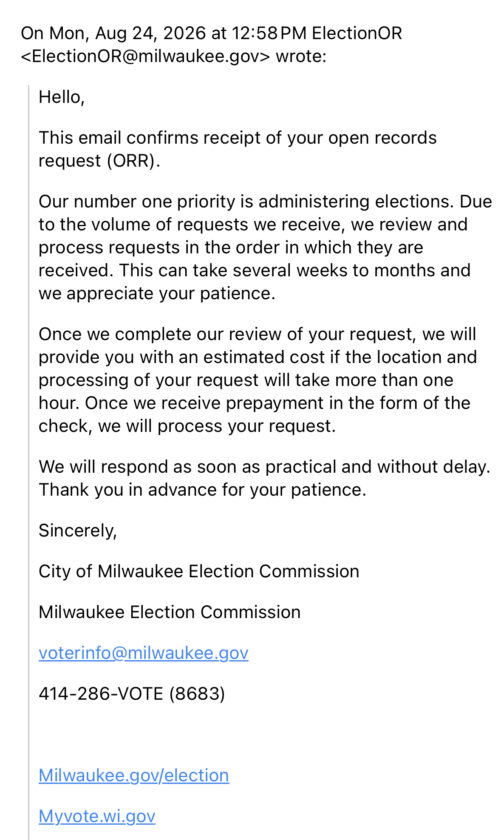
After ten days of silence and a direct follow-up inquiry, the Milwaukee Election Commission has finally acknowledged our public records request regarding the August 11 Partisan Primary. Their response came with a warning that it could take “several weeks to months” to produce the documents.
The Commission responded Monday afternoon, just over an hour after Dairyland Sentinel sent a second email Monday demanding an acknowledgment of our original August 14 request under Wisconsin’s transparency laws.
While the city confirmed receipt, their stated timeline raises the possibility that the Primary Election records we seek will not be available to the public before the November 3 General Election.
“Our number one priority is administering elections,” the Commission wrote in an unsigned email from their general records account. “Due to the volume of requests we receive, we review and process requests in the order in which they are received. This can take several weeks to months and we appreciate your patience.”
The email also noted the city will require prepayment by check if locating and processing the records takes more than one hour. This is despite our formal request that fees be waived in the public interest for news-gathering purposes.
Wisconsin’s Public Records Law is clear. Under Wis. Stat. § 19.35, authorities must respond to requests “as soon as practicable and without delay.”
A History of Central Count Failures
The delay in fulfilling the records request comes amidst growing calls for accountability regarding Milwaukee’s handling of absentee ballots. The August 11 Partisan Primary marks the third major mishap at the city’s central count operation in recent election cycles, following:
- 2020 Election: A flash drive containing voting data was left behind at the facility.
- 2024 Election: Unlocked tabulator doors triggered a recount of approximately 31,000 ballots.
- August 11, 2026 Primary: Election staff left the central count facility without exporting results from five of the nine tabulators, requiring a police-escorted return trip and delaying results by roughly 90 minutes.
Legislative Demands for Accountability
These recurring issues have drawn the attention of state lawmakers. On August 21, State Rep. Dave Maxey (R-New Berlin), who chairs the Assembly Committee on Campaigns and Elections, sent a blistering formal request for answers to Milwaukee Election Commission Executive Director Paulina Gutiérrez.
Maxey labeled the sequence of events on election night “a travesty, plain and simple” and argued that the recurring issues are a “gift to the very people trying to convince Wisconsinites their votes don’t count.”
In his letter, Maxey issued a 30-day deadline for Gutiérrez to answer eight specific questions regarding training failures, municipal ballot volumes and whether she would support an independent review by the Wisconsin Elections Commission or the FBI. If she cannot correct the recurring mistakes, Maxey stated, she should resign.
What We Are Seeking
Our open records request was specifically tailored to capture the full picture of the Central Count process on August 11, rather than just the final certified documents. The request encompasses:
- Completed Form EL-104: Every completed Inspectors’ Statement associated with the Milwaukee Central Count, including all attachments, amendments and corrections.
- Working Documents: Any preliminary, interim or predecessor versions of the Inspectors’ Statement submitted or maintained by election officials.
- Incident and Discrepancy Reports: Forms documenting ballot reconciliation, rejected ballots, challenges, equipment issues and seal information.
State election statutes strictly regulate the creation and retention of these materials. Wis. Stat. § 7.52 requires election officials to “immediately complete the inspectors’ statement” upon finishing the tally sheets to ensure a complete and accurate return of all cast votes.
Wisconsin’s chief election inspector is required to complete Form EL‑104 because it serves as the polling place’s official chain‑of‑custody and compliance record. State administrative rules direct the chief inspector to certify on the form that they are properly trained and that required procedures were followed throughout the day. The document captures the nuts‑and‑bolts details of running a polling place: ballot counts, poll‑book reconciliation, spoiled and unused ballots, provisional ballot handling, equipment seal checks, and any incidents or irregularities that occurred.
Clerks and canvassing boards rely on EL‑104 to verify that each polling location balanced its numbers and secured its materials. During audits, recounts, or legal challenges, the form becomes a key reference showing how ballots moved through the polling place and whether statutory steps were followed. In short, EL‑104 is the polling site’s accountability record, a concise, signed summary of what happened inside that room on Election Day.
We will continue to press for the timely release of these public documents and keep our readers updated on the status of our request as well as the legislative inquiry promised by Rep. Maxey.
Previously at Dairyland Sentinel
Elections Commission Response to Dairyland Sentinel