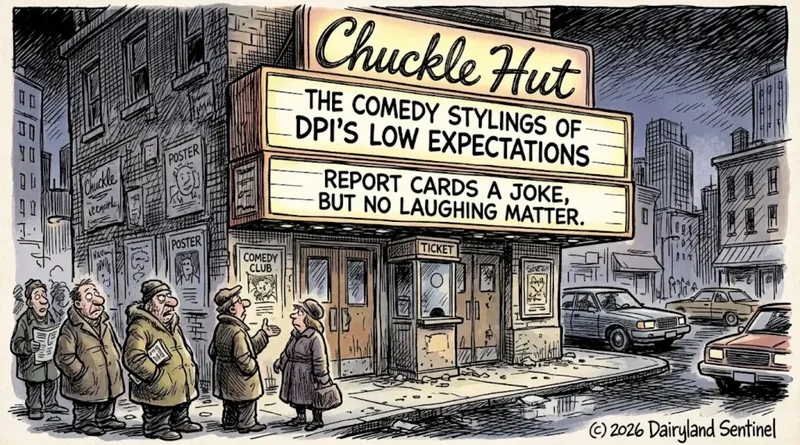

Sen. Wimberger: Audit shows DPI 'cooked the books' on report cards, circumvented law
Sen. Eric Wimberger, R-Gillett, co-chair of the Joint Legislative Audit Committee, said DPI "circumvented statutes" and "cooked the books monitoring achievement gaps."

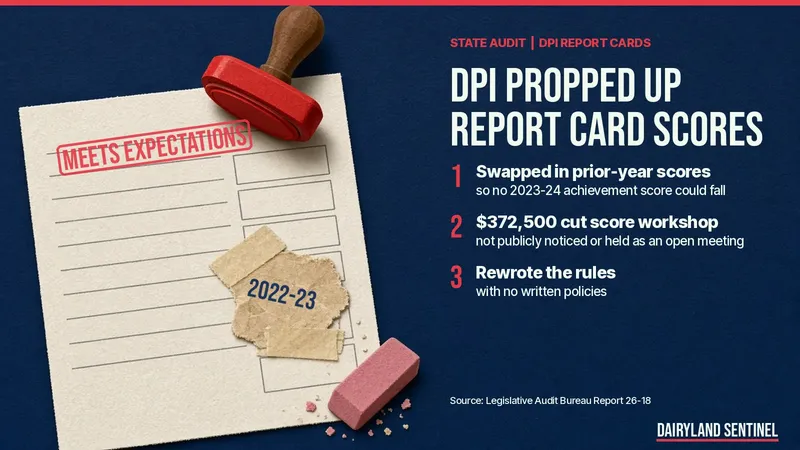
The Department of Public Instruction rewrote the rules behind Wisconsin's school report cards without a single written policy, left out information state law requires and kept schools whose scores slipped from showing a drop, state auditors said Friday.
The Legislative Audit Bureau released Report 26-18 three days after DPI put out its newest report cards. Those rated 95 percent of districts and 85 percent of public schools as meeting expectations or better. Dairyland Sentinel reported Tuesday that critics called the ratings out of step with test scores. DPI's own October numbers showed fewer than half of tested students were proficient in English language arts or math.
Sen. Eric Wimberger, R-Gillett, co-chair of the Joint Legislative Audit Committee, said DPI "circumvented statutes" and "cooked the books."
Follow this story every morning.
Get Key Reads, our free daily email: the Wisconsin news that matters, in four minutes or less.
"DPI circumvented statutes, lowered cut scores so that otherwise failing schools appear to be on track, refused to maintain records or make reports of their actions, and cooked the books monitoring achievement gaps." -Sen. Eric Wimberger
Auditors made 13 recommendations to DPI and flagged one issue for the Legislature.
Old scores swapped in
The most striking finding involves the 2023-24 report cards.
DPI lowered achievement scores across the board that year to match the spread of scores from the year before. Then it set a floor. No school or district could score below its 2022-23 mark. If the adjusted number came in lower, DPI used the old score instead.
DPI estimated it would hand about 63.8 percent of schools last year's score in English language arts and 44.1 percent in math.
Before the adjustment, 75 schools and three districts were on track to post lower language arts scores than the year before. In math it was 63 schools and two districts. DPI told auditors it never checked whether those drops were real.
"Replacing student achievement scores for a given school year with scores from a previous year may obscure actual changes in performance and make it difficult for schools or school districts to monitor such changes," the report said.
No written rules
In June 2024, DPI scrapped its old labels for student performance, including basic and proficient, and replaced them with new ones such as approaching and meeting. It set new cut scores for the Forward Exam and the ACT. In 2025 it set new thresholds for rating schools.
Auditors found no written policies for any of it.
DPI told them it relied on "the knowledge and experience of its staff and vendors."
DPI brought 88 educators together for four days in June 2024 to recommend new Forward Exam cut scores. DPI then raised a third of the recommended cut scores and lowered another third.
After more than a year of waiting for DPI to release public records, Dairyland Sentinel reported in February that the workshop, which took place at the Chula Vista Resort in Wisconsin Dells, cost $368,885 according to the Department. The audit puts the total higher, at $372,500, including $3,600 in DPI staff reimbursements.
That workshop and the ACT workshop that year were not publicly noticed or held as open meetings, auditors found.
The Institute for Reforming Government sued in Adams County in June 2026, arguing the educators counted as a governmental body under the open meetings law. Their suit cites Dairyland Sentinel's reporting. DPI did hold its 2025 school rating workshops in public.
Missing from the report cards
State law requires report cards to measure whether schools are closing achievement gaps in reading and math. In 2021, DPI swapped that measure for one it calls "target group outcomes," which follows one group of students instead of comparing groups. Auditors said that does not meet the law.
The report cards also left out required Advanced Placement and community service figures. DPI does not produce the separate school performance reports the law calls for. And it did not send improvement recommendations to every school with students below minimum standards on the Forward Exam, as the law requires.
The bureau told lawmakers that state law sets no process for changing cut scores. DPI's 2024 changes made 2023-24 test results impossible to compare with earlier years. The Legislature could write a process into law or leave it to DPI, auditors said.
LAB asked DPI to report back to the Joint Legislative Audit Committee by March 30, 2027.
Months late, no explanation
The LAB report arrived 21 months after lawmakers ordered it, and later than originally promised. The bureau first listed it for release in the "Summer of 2026," then moved the target to "Fall 2026" without explanation, Dairyland Sentinel reported in October.
On Oct. 1, Dairyland Sentinel asked the bureau for a log of its correspondence with DPI on this audit and a second pending DPI audit. The request covered only dates, senders, recipients and subject lines, the kind of timeline that could show whether DPI asked for extensions or held up documents.
State Auditor Joe Chrisman denied the request for public information on Oct. 14. He cited a state law requiring the bureau to "at all times observe the confidential nature of any audit currently being performed." Wimberger and Rep. Robert Wittke, R-Caledonia, who co-chair the audit committee, got the same request. They said their offices had no records because they get no status reports on audits in progress.
DPI pushes back
State Superintendent Jill Underly disputed several findings in a Nov. 16 letter. She wrote that DPI "has consistently administered assessments and produced report cards in alignment with statutory requirements." She said DPI would work with the Legislature to remove what she called a "defunct statute" on school performance reports.
On the score floor, she wrote that "any recommendation that the DPI justify not treating certain schools and districts differently is antithetical to the central tenet that all schools and districts be evaluated fairly and consistently."
Wimberger and Rep. Robert Wittke led the committee in authorizing the audit in February 2025.
Wimberger also said DPI "refused to maintain records or make reports of their actions."
"Accountability is not optional," Wittke said. "Wisconsin taxpayers deserve transparency and accountability, not excuses."
"Schools are 'meeting standards' even when students fail," Wimberger said. "In short, DPI unilaterally turned school report cards into an untrustworthy sham."
Read the full audit and the summary.
Previously at Dairyland Sentinel
Critics say new DPI report cards rate failing schools high under revised standards
Two Audits of DPI Slip to Late Fall; State Won’t Say Why
DOJ Prod Gets DPI to Release $8M Forward Exam Workplan & Waterpark Workshop Details
WI Lawmakers Should Investigate DPI’s Secret $369K Resort Retreat, IRG Report Explains
DPI Stonewalls Public: Where’s the Secret Waterpark Workshop Contract?
Brian Fraley is the publisher of Dairyland Sentinel, which he founded in 2023. A native of Milwaukee, he grew up in Wauwatosa. He is a graduate of the University of Wisconsin and has been involved in Wisconsin public policy, politics and journalism since 1985. He currently lives in Waukesha County with his wife and two daughters.
Dairyland Sentinel follows a published Editorial Policy, Ethics Statement and Corrections Policy.
Start tomorrow as Wisconsin’s best-informed reader.
The Wisconsin news that matters, in four minutes or less.
Already a subscriber? Support this reporting with a tax-deductible gift.