A Month-by-Month Recap of the 2026 Brewers
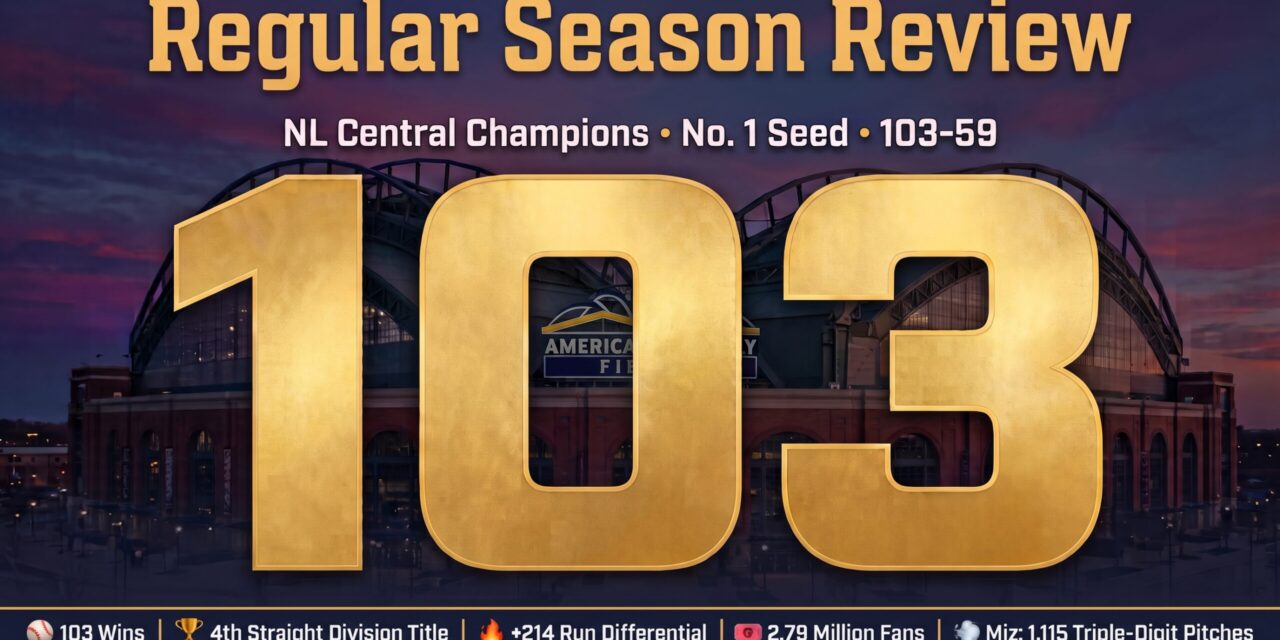
The Milwaukee Brewers just finished the best regular season in franchise history.
One hundred three wins. Fifty-nine losses. A fourth straight National League Central title. The No. 1 seed in the National League, a first-round bye, and home field in the Division Series. A staff ERA of 3.51 and a plus-214 run differential. Attendance reached 2,788,934.
This was not a cute small-market story. It was a 103-win club that stopped being anybody’s underdog sometime around Memorial Day and never handed the Central back.
Here is how it happened, month by month.
Spring training: questions, not coronations
Camp opened with more questions than answers.
Freddy Peralta was gone, and Tobias Myers went with him to the Mets. Milwaukee received Jett Williams and Brandon Sproat in the January trade. The Brewers had also remade the left side of the infield, bringing back Kyle Harrison, Shane Drohan and David Hamilton from Boston before signing Luis Rengifo to cover third base.
Brandon Woodruff was coming back from shoulder trouble, and nobody in the building pretended that was a sure thing. Quinn Priester’s health was already a concern. The rotation was young and unfinished: Jacob Misiorowski, Chad Patrick, Sproat, Harrison and Woodruff when healthy, with Logan Henderson, Robert Gasser and others still pushing.
Joey Ortiz was penciled in at short after a rough 2025 with the bat. Jackson Chourio, Brice Turang, William Contreras and Christian Yelich were the names you could still count on. Third base and the back of the rotation were arguments, not settled facts.
The biggest spring question was the old Brewers one: could Milwaukee score enough if the power stayed soft? They had lived near the bottom of the league home run charts before. They had also died last October with that problem. Spring did not solve it. It just delayed the argument until April.
Let’s rewind and see how each month unfolded. There are a lot of fascinating storylines that developed over the last six months, but I’m going to take a particular interest in two of the team’s main contributors.
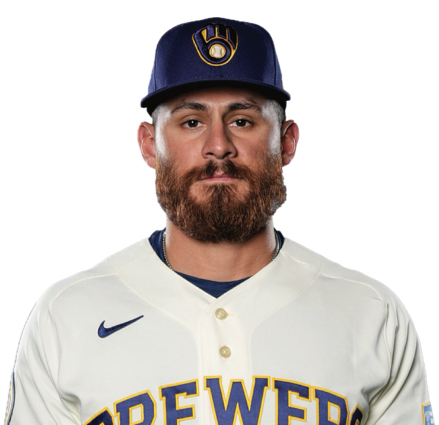

March: Opening Day roar
Monthly record: 4-1
Overall: 4-1
Ortiz end-of-month average: .357
Miz pitches at 100 mph or harder: 3
Opening Day was March 26 against the White Sox, a 14-2 rout. Misiorowski struck out 11 in five innings, and the staff piled up 20 strikeouts. Five games. Four wins. A .286 team batting average and a .858 OPS that nobody expected to hold. Milwaukee stole 13 bases and scored 37 runs.
Ortiz started 5-for-14. Miz threw only three tracked pitches at 100 mph or harder in March. The season had barely started, and the radar gun had not yet become a nightly event.
April: the only losing month
Monthly record: 12-13
Overall: 16-14
Ortiz end-of-month average: .197
Miz pitches at 100 mph or harder: 106
Then the hangover.
Twenty-five games. Twelve wins. Thirteen losses. The only losing month of the year, and it felt longer than it was. After starting 8-2, Milwaukee dropped six straight from April 7 through 14. The lineup hit .232 with a .670 OPS and 15 home runs. Ortiz fell off a cliff, going 8-for-52 (.154) for the month. His season average cratered to .197 by April 30.
This was the low point. Not panic, exactly. More like the old Brewers worry: good pitching, not enough offense, and a Central race that suddenly looked competitive again.
Buried inside the mess was Misiorowski. He threw 106 pitches at 100 mph or harder in April alone. The rest of the league’s starters were not keeping up.
Angel Zerpa’s season also ended here. His Tommy John surgery was announced in early May, after the injury and diagnosis that put him on the season-ending track. It belonged to the spring and May injury story, not the later July cluster.
May: the turn
Monthly record: 19-7
Overall: 35-21
Ortiz end-of-month average: .188
Miz pitches at 100 mph or harder: 241
Turning point number one.
Twenty-six games. Nineteen wins. The Brewers went from .480 in April to .731 in May and never really looked back. They scored 108 runs, hit 18 home runs and allowed only 72 runs. The pitching and defense started winning the close games April had given away.
Misiorowski’s May was historic. He went 5-0 with a 0.23 ERA in 38.1 innings and allowed one earned run. On May 25 against St. Louis, he threw 57 pitches at 100 mph or harder in a single start. For the full month he finished with 241 triple-digit pitches. The radar gun stopped being a novelty. It became the plot.
Ortiz was still searching. He hit .176 in May, and his season average fell to .188. The left side of the infield was the soft spot on a first-place team. That problem would force a roster move in June.
June: The Maddux, Pratt and 105.5
Monthly record: 17-10
Overall: 52-31
Ortiz end-of-month average: .208
Miz pitches at 100 mph or harder: 219
Turning point number two, and the month the season became historic.
The bats woke up. Milwaukee hit .281 with a .830 OPS and 38 home runs in 27 games. The Brewers scored 162 runs. Extra-base hits appeared everywhere. Chourio got hot after returning from the hand fracture. The “can they hit enough?” debate got quieter in a hurry.
June 12 brought the first Misiorowski game that felt bigger than a normal win. He carved up the Phillies with a Maddux, a complete-game shutout on 95 pitches. One hit. Fifteen strikeouts. Twelve of those punchouts came on pitches of 100 mph or more.
June 16 was Cooper Pratt’s major league debut against Cleveland. He had signed an eight-year, $50.75 million extension in early April without a big-league at-bat. Rengifo was designated for assignment. Ortiz shifted toward third. The infield got younger overnight, and the shortstop question that had hung over camp finally had a long-term answer.
June 26, Miz threw 105.5 mph to Pete Crow-Armstrong, the fastest pitch by a starting pitcher in the Statcast era. Milwaukee beat the Cubs 6-2 in front of 41,021 at American Family Field.
Ortiz hit .250 in June. His season average crawled back to .208. Progress, not a finished product. Miz threw 219 pitches at 100-plus for the month.
July: first-half record, deadline buys
Monthly record: 16-10
Overall: 68-41
Ortiz end-of-month average: .237
Miz pitches at 100 mph or harder: 193
No collapse. No victory lap either.
Sixteen and ten. A .615 clip. Milwaukee went into the All-Star break at 59-37, a franchise first-half wins record. Misiorowski was scratched with fatigue and missed the All-Star Game. Priester’s season ended with thoracic outlet decompression surgery in late June. Brandon Woodruff’s shoulder remained a managed situation after a short run of starts. Kyle Harrison dealt with forearm trouble. Depth was not theoretical anymore.
On July 15, Milwaukee traded for Lance McCullers Jr. and Colton Gordon from Houston. McCullers was designated for assignment about 11 days later. At the actual deadline, the Brewers bought catcher Bo Naylor and Codi Heuer from Cleveland, Dustin May and JoJo Romero from St. Louis, and Antonio Senzatela from Colorado. Depth for October, not a tear-down of the core.
July 26, Miz set another tracking-era mark with 66 pitches of 100 mph or harder in a single game. He finished the month with 193 triple-digit pitches.
Ortiz finally looked like a big-league hitter again. He hit .309 in July with three home runs and a .930 OPS. His season average climbed to .237. The Pratt move had not buried him. It had clarified roles.
August: the long month
Monthly record: 17-12
Overall: 85-53
Ortiz end-of-month average: .252
Miz pitches at 100 mph or harder: 169
Twenty-nine games. Seventeen wins. A .586 winning percentage that would look great on most clubs and merely solid on this one.
Milwaukee swept San Diego and took three of four from the Dodgers in the middle of the month. On August 18, the Brewers demolished Seattle 22-0, tying the franchise record for the largest margin of victory and the modern-era mark for the largest shutout margin. They won No. 80 on August 21, 2-1 over Atlanta.
Miz helped Milwaukee seize and hold the best record in baseball. His season had moved past the breakout stage. It was now the standard by which the staff was measured.
Ortiz hit .313 in August. His season average reached .252. He was no longer the emergency conversation. He was a contributor again, mostly at third, with the glove still carrying nights the bat did not.
Miz threw 169 pitches at 100-plus. Still absurd. Purposefully throttled down, the figure is slightly less absurd than May and June, which is what a deep season looks like when you are also trying to have something left for October.
September: clinches, 100 and 103
Monthly record: 18-6
Overall: 103-59
Ortiz end-of-month average: .270
Miz pitches at 100 mph or harder: 184
Last season, they limped into the playoffs. This year? They closed like a team that expected to blaze into October. And they have.
Eighteen and six. A .750 winning percentage. One hundred forty-six runs in 24 games. A .276/.354/.430 slash and 27 home runs. The playoff berth was locked September 11 with a 20-0 flattening of Cincinnati. The division was clinched September 15 in Pittsburgh, sealed later that night when the Cubs lost.
Milwaukee won No. 98 on September 20, No. 100 on September 24 in Philadelphia, and finished 103-59 on September 27 against St. Louis. The 100th win made this the first 100-win season in club history. They finished on a five-game streak, with home field at 55-26 and a road record of 48-33.
Ortiz finished September at .348 for the month and .270/.328/.402 for the season. A late knee bruise and abdominal swelling cost him the finale, but he was expected to be ready for the NLDS. The early-season scare had become a footnote.
Chourio finished with 25 home runs and 23 stolen bases. He became the first player in MLB history with three 20-20 seasons before turning 23.
Miz finished 16-5 with a 1.80 ERA, a 0.802 WHIP, 252 strikeouts, a .157 opponent average and 1,115 pitches at 100 mph or harder. Cy Young forthcoming. He should be the unanimous selection. He’s the ace of aces, not a prospect story anymore.
The Miz velocity ledger
The monthly radar totals tell the story almost as well as the final line:
Nearly 42 percent of his pitches were 100 mph or harder. The 1,000th triple-digit pitch came September 8 against the Cubs. The fastest was 105.5 on June 26. The Maddux on June 12 still looks fake on the box score. May’s 0.23 ERA still looks fake on the monthly ledger.
According to Elias, Misiorowski was the first pitcher since 1900 to finish with an opponent average below .160 and a WHIP below 0.81 over at least 150 innings. Murphy put the season in simpler terms: “Have I ever seen a year on the mound like that? Probably not. It’s as good as I’ve seen.”
He starts Game 1 of the NLDS Saturday.
Ortiz’s long climb
Ortiz’s year was a different kind of story.
He opened at .357 in a five-game March sample, fell to .197 by the end of April and bottomed at .188 after May. June was the first real breath, with a .250 monthly average and a .208 cumulative mark. July and August were the climb, at .309 and .313. September finished it: .348 for the month and .270 for the season.
He finished with a .730 OPS, nine home runs, 47 RBI and nine steals in 134 games. The Pratt promotion could have ended him as an everyday piece. Instead, it clarified the infield. Ortiz’s glove never left. The bat came back. The late MRI scare was an October question, not a regular-season verdict.
It was more than Miz and Ortiz, of course
The ace made the season unforgettable, but it was more than Miz.
The Brewers scored 832 runs with 154 home runs, a .258/.341/.403 team slash and 668 walks. They stole 162 bases and let a staff ERA of 3.51 do the rest. They were 28th in the majors in homers and second in runs. That is the Brewers thesis in one paragraph: get on base, run, put the ball in play and make the other team beat the pitching.
Turang had a career year at .268/.366/.450 with 21 home runs and 100 RBI. Chourio hit .291/.351/.487 with 25 home runs and 23 steals. Jake Bauers provided the on-base thump, finishing with 26 home runs, a .874 OPS, 86 RBI and 94 walks. Contreras had 153 hits and 94 RBI. Garrett Mitchell played 145 games and collected 121 hits while posting a .262/.354/.416 line.
Andrew Vaughn hit .306/.390/.444 in 104 games before a late illness injured-list stint. Pratt posted a .281/.350/.368 line with 19 steals after the call-up. Christian Yelich had a down year at the plate, .235/.315/.378. That is part of the story too.
Behind Miz, Logan Henderson went 11-3 with a 2.47 ERA. Aaron Ashby won 13 games out of the bullpen and spot work. Trevor Megill finished with a 2.63 ERA, 30 saves and 63 appearances. Abner Uribe and DL Hall made the locked-down late innings miserable for most opponents. Harrison finished 11-5 with a 4.20 ERA in a year that asked him to grow up fast.
What October still has to decide
The Brewers won 103 games with an ace who rewrote the velocity record book, a farm system that kept answering the phone and a manager who never confused process with soft expectations.
I was a high school freshman the last time this franchise went to a World Series. That was 1982. We have spent four decades waiting for a team that felt like this one.
October will decide whether this becomes the season Wisconsin remembers forever or another great regular season with a shorter ending than it deserved. The regular-season part is settled.
Best Brewers team we have ever seen over 162. The numbers are not close.
Hopefully the Fall Classic is.
Also at Dairyland Sentinel