When Andrew Carnegie declared that “the man who dies thus rich dies disgraced,” he didn’t just hand out checks. He built a self-sustaining system that permanently reshaped American public life. His lasting contribution lives on not in U.S. Steel’s historic ledgers, but in thousands of brick-and-mortar libraries that still anchor town squares across the globe, including right here in Wisconsin.
Carnegie’s gifts were never simple handouts; they were civic contracts. Driven by his belief in “the ladder of success,” Carnegie provided the capital to build the library while requiring the local community to do the heavy lifting to maintain it. To secure a grant, a town had to provide free land and legally commit to the Carnegie Formula: allocating annual municipal tax funds equal to at least 10% of the original gift amount. That single condition turned libraries from private, subscription-only clubs into permanent public rights.
Globally, Carnegie funded 2,509 libraries between 1883 and 1929. While the bulk were built in the United States (1,689 buildings), his funding reached the U.K., Canada, South Africa, New Zealand, and beyond.
Architectural Breakthroughs: Open Stacks and Public Access
Architecturally, Carnegie-funded buildings sparked a quiet revolution in how everyday citizens interacted with knowledge:
- Open Stacks: Before Carnegie, most libraries used “closed stacks,” where patrons had to ask a librarian behind a desk to fetch books for them. Carnegie buildings popularized “open stacks,” opening the floor so the public could walk the aisles and pick books directly off the shelf.
- Civic Prominence: Built mostly in Neoclassical or Beaux-Arts styles with grand entrances and prominent front steps, the structures signaled that learning was a noble civic priority.
- Inscriptions: Many featured Carnegie’s favorite motto, “Let There Be Light,” carved directly into the stone above the main entrance.
Wisconsin’s Carnegie Era by the Numbers
Wisconsin took full advantage of Carnegie’s philanthropy, ranking 7th nationwide in the number of communities that received public library grants. Between 1901 and 1915, Carnegie dollars funded 65 total structures across the Badger State (63 public library grants across 60 communities, plus 2 campus libraries at Beloit College and Lawrence University).
- First in the State: Superior holds the crown as Wisconsin’s first Carnegie library grant recipient. Its grand Central Library opened on June 16, 1902. (Note: Black River Falls established Wisconsin’s very first public library back in 1872, but didn’t receive its Carnegie grant until 1914).
- Bookends: Superior also built the last Carnegie library in Wisconsin when its East End branch opened in 1918.
- The Current Count: Of Wisconsin’s 65 original Carnegie buildings, 14 have been demolished, 28 have been repurposed (into museums, senior centers, or offices), and 23 still operate as active public libraries today.
Wisconsin’s Carnegie Libraries: Status Report
Whether serving as active lending institutions or adapted for new community uses, several notable Carnegie landmarks remain standing today:
- Baraboo (Carnegie-Schadde Memorial): Active Library. Operating continuously since 1903, the Neoclassical structure recently underwent a major $10 million expansion and renovation that integrated a modern wing with the original building.
- Bayfield Carnegie Library: Active Library. Open since 1903, Bayfield remains one of the most historically intact Carnegie libraries in the Midwest.
- Black River Falls: Repurposed. Built from 1914 to 1915 with Carnegie funds, the original Prairie-style building no longer serves as the public library but is preserved as headquarters for the Jackson County Historical Society.
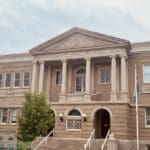
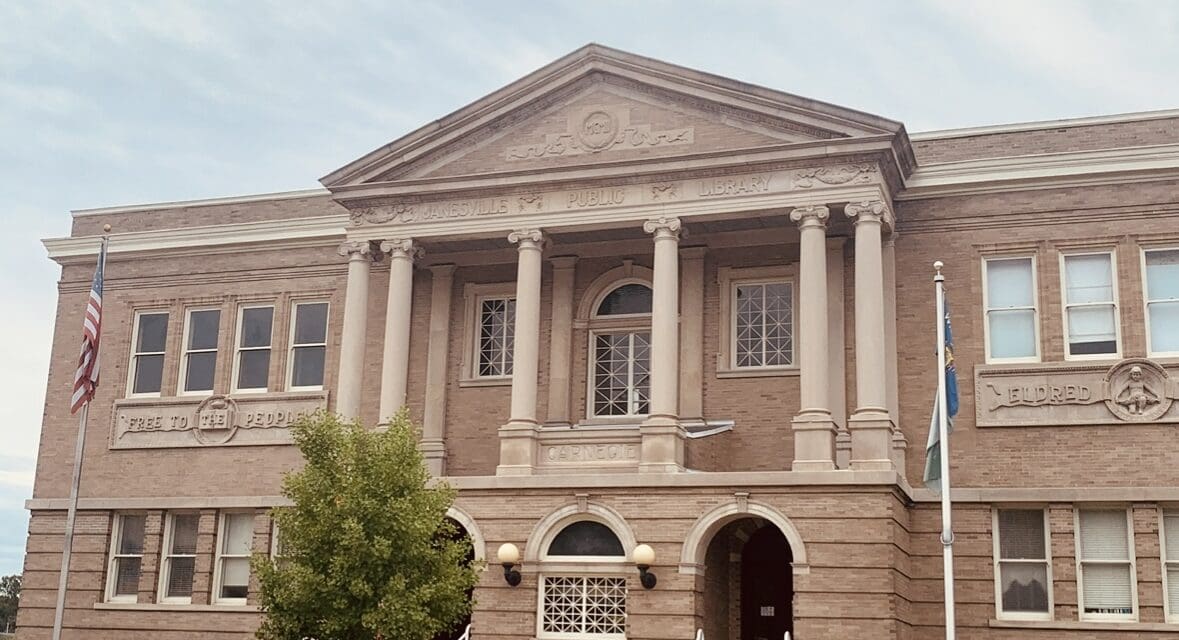
- Janesville (Old Carnegie Library): Repurposed. Built in 1903, this Neoclassical building served readers for decades before becoming the Janesville Senior Center, remaining a vibrant local hub.
- Kaukauna: Repurposed. The active public library relocated to the renovated Thilmany Eagle Mill site, while the original Carnegie building remains standing for community reuse.
- Superior (Old Central Library): Historic Landmark. Vacant as a public library since 1991 when services moved to a new facility, Wisconsin’s first Carnegie building remains a stabilized historic structure.
- Other Active Wisconsin Locations: You can still check out books inside original Carnegie buildings in towns across the state, including Antigo, Arcadia, Barron, Berlin, Columbus, Cumberland, Darlington, and Elroy.
Frequently Asked Questions
How many Carnegie libraries were built in Wisconsin? Carnegie funded 65 total library buildings in Wisconsin between 1901 and 1915. This total includes 63 public libraries across 60 communities and two academic libraries at Beloit College and Lawrence University.
How many Carnegie libraries are still active in Wisconsin today? As of 2026, 23 original Carnegie library buildings in Wisconsin still function as active public lending libraries. An additional 28 buildings remain standing and have been repurposed into museums, senior centers, or civic offices, while 14 have been demolished.
What was the Carnegie Formula for library grants? The Carnegie Formula was a grant agreement requiring towns to provide free land and commit to annual local tax funding equal to at least 10% of the initial gift amount. This guaranteed that the local municipality maintained the library building and purchased books long after construction finished.
Which city received Wisconsin’s first Carnegie library grant? Superior received Wisconsin’s first Carnegie library grant, opening its original Central Library on June 16, 1902. Superior also built the state’s last Carnegie library when its East End branch opened in 1918.