
A Dairyland Sentinel Perspectives Column by George Mitchell
In a late December interview. Speaker Robin Vos identified for Wheeler Report readers a defining issue in elections this year and beyond.
As Vos explained, “we can’t have an ever-growing government” when the state’s population is stagnant and forecast to decline.
It’s not hyperbole to assert, as Vos does, that “the future of our state” is in play. His recognition of key demographic trends is validated by a mid-2025 report from Dale Knapp, a highly respected independent analyst.
Republicans and Democrats will respond with starkly different agendas. Under the banner of affordability, Democrat proposals will mean more government spending. Republicans will say taxpayers can’t afford giving government a larger share of a stagnant or shrinking pie.
Democrats have the easier sell, namely, free stuff — subsidized day care, health insurance, food assistance — paid for by the “rich.” The GOP challenge is to make the case for efficient fiscal management and better service delivery; if not clearly laid out, it’s a message with eyes-glaze-over implications.
Republicans will get a boost if/when evidence emerges that entitlement fraud is not confined to Minnesota. The Legislative Audit Bureau needs to extract data the Evers Administration won’t disclose.
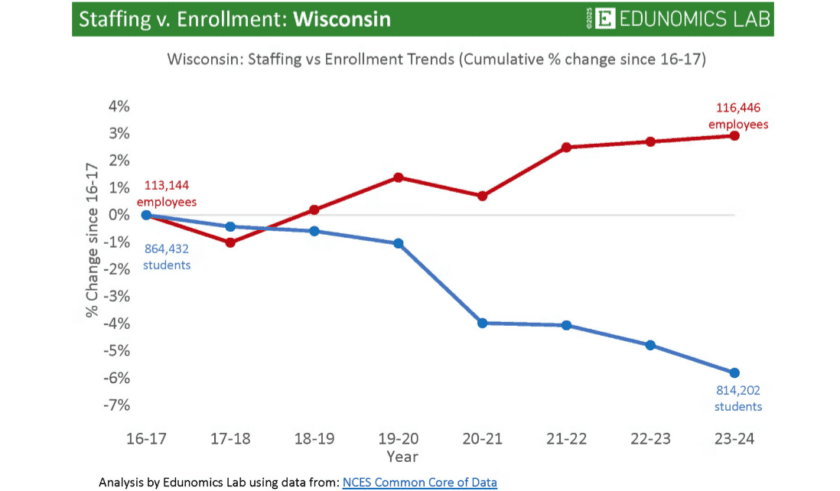
Dems have an ally in the media. Exhibit A is K-12 education, the largest single expenditure of state and local taxes. There was a time when unsustainable trends such as displayed in the graph above would have been news.
The data above, from a state-by-state analysis from Georgetown University, confirm separate analyses from Will Flanders at the Wisconsin Institute for Law & Liberty.
The response from Wisconsin media? Crickets. I have searched in vain for a single story explaining that public school staffing has grown for years while enrollment has declined. I would be glad to stand corrected. Instead, many readers are left to conclude — wrongly — that public schools (1) lose funds to private schools; (2) have squeezed inefficiencies from their budgets; and (3) often have no choice but to pursue voter referenda.
Another fact staring reporters directly in their face is the demonstrable comparative cost effectiveness of schools in the state’s private school choice programs. None other than a choice-hostile Department of Public Instruction ranks those schools, on average, higher than public schools. Using conservative accounting, per pupil funding for the private choice schools is about 70% of traditional public school funding. Once again, I will stand corrected if provided evidence that the media have shared these indisputable facts with readers.
Vos uses education to make the case for “look[ing] at how we can deliver things” more efficiently. He cites the growth of online and related virtual education and the potential expansion from the post-secondary level to K-12 grades. As it happens, parents seeking virtual education represent the fastest growing sector of Wisconsin’s successful private choice school programs. And, as expected, DPI and a backwater segment of the public school establishment has taken notice of this and will seek to rein it in.
Give credit to Vos for not ducking perhaps the biggest issue facing Wisconsin.
George Mitchell was a revenue and budget official in the Lucey Administration. He is a former Milwaukee County Director of Public Works and a longtime school choice advocate.