Wisconsin Democrats have tried to change how electoral votes are awarded. Now they plan on trying again.
Wisconsin Democrats did not wait until they won the Legislature to propose changing how the state awards its presidential electoral votes.
They’ve been plotting this for decades.
They even introduced bills in March that would commit Wisconsin’s 10 electoral votes to the winner of the national popular vote, even if that candidate lost Wisconsin. Neither bill reached a floor vote.
Now the proposal’s supporters are preparing to try again, with their party set to control the governor’s office and both legislative chambers in January.
Unofficial results give Democrats an 18-15 Senate majority and a 53-46 Assembly majority, Democrat David Crowley will succeed Gov. Tony Evers. Wisconsin last had unified Democratic control during the 2009-10 legislative session.
“National popular vote will be something that we’ll prioritize early in the session,” Sen. Kelda Roys, D-Madison, told The New York Times.
The Times also reported that Rep. Clinton Anderson, D-Beloit, plans to reintroduce the legislation. He acknowledged its limited place in his conversations with voters.
“I want to make it a priority, but it’s not the thing I heard on the doors I knocked,” Anderson said.
This proposal would change whose victory determines where Wisconsin’s electoral votes go. A floor vote would put lawmakers on the record.
The March bills went nowhere
Assembly Bill 1152 was introduced March 13, 2026, with Anderson as its lead author. Senate Bill 1117 followed March 19, with Sens. Bob Wirch and Roys among its authors.
Both went to committees and both died there without a hearing.
An earlier measure, 2023 Senate Bill 144, failed to pass April 15, 2024.
The effort goes back further still. Assembly Bill 313 was introduced in 2007 and failed to pass. Roys, then an Assembly member, was the lead author of another version introduced Feb. 15, 2010, during the 2009-10 session. It received a public hearing but did not pass, even with Democrats in control of state government.
Democratic majorities will give the next proposal a clearer path. They do not guarantee passage. Supporters will need to introduce a new bill, and not every Democrat necessarily will support it.
What would change for Wisconsin
The National Popular Vote Interstate Compact would not abolish the Electoral College. It would change how participating states select their presidential electors. Member states agree to appoint electors pledged to the presidential ticket receiving the most votes nationwide. A plurality would be enough. The ticket would not have to win more than half the national vote.
The arrangement would govern a presidential election only when states holding a majority of electoral votes have joined and the compact is in effect by July 20 of that election year. Under the current allocation, that means at least 270 of 538 electoral votes. Those provisions are in the latest Wisconsin bill’s text.
Two past elections show how Wisconsin’s statewide choice could differ from the compact’s result.
In 2004, Democrat John Kerry carried Wisconsin by 11,384 votes. Republican President George W. Bush won the national popular vote. Applying the compact to those recorded results would have assigned Wisconsin’s 10 electors to Bush rather than Kerry.
In 2016, Republican Donald Trump carried Wisconsin by 22,748 votes after the recount. Democrat Hillary Clinton won the national popular vote. Applying the same rule to those results would have assigned Wisconsin’s electors to Clinton.
The figures appear in the Federal Election Commission’s 2004 results and 2016 election report. These examples apply a different rule to the votes actually cast. Campaigns and voters might have behaved differently under that rule.
Wisconsin’s closely divided electorate gives presidential campaigns a reason to spend time and money here. In our Oct. 28, 2024, Key Reads, Dairyland Sentinel noted the campaign visits and cluttered mailboxes, airwaves and internet streams. Even with that disruption, we wrote that “we appreciate the elevated role Wisconsinites play.”
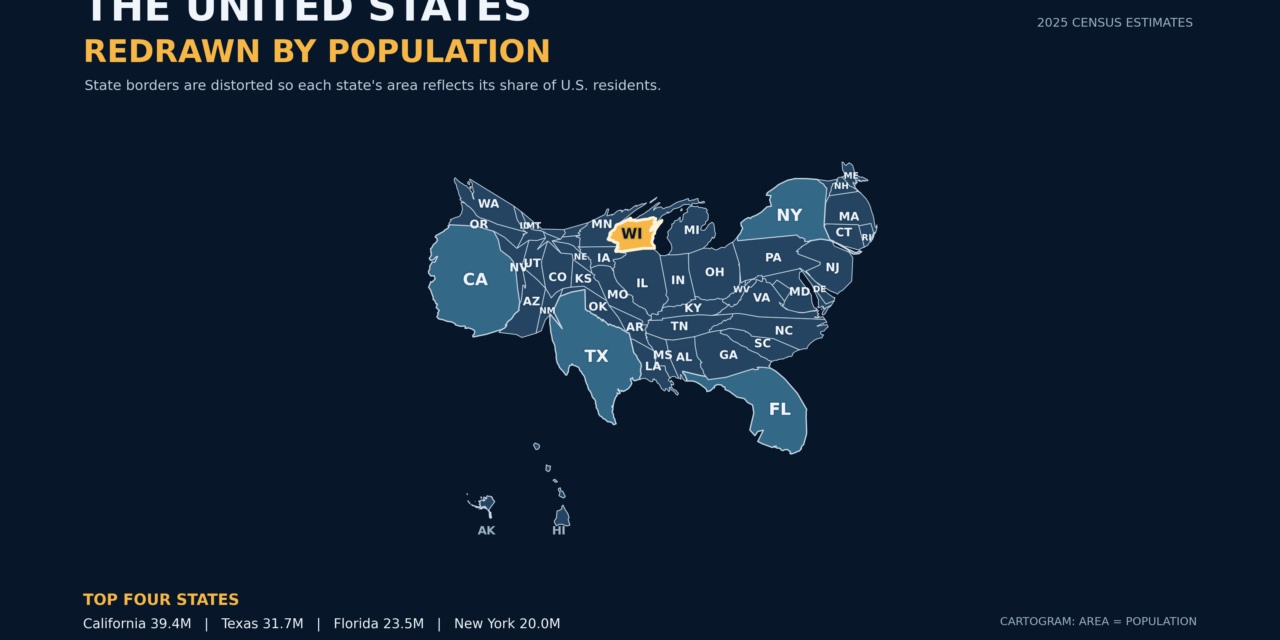
Wisconsin’s population is only the 20th largest of the 50 states. Many experts agree it is unlikely candidates would pay attention to individual smaller state’s such as ours, instead investing in more national, populist messaging.
Wisconsin votes would still count toward the national total under the compact. Winning Wisconsin itself, however, would no longer determine which ticket received its electors.
Trent England, founder of Save Our States, which opposes the compact, described the possible change in a 2019 Daily Signal interview: “some voters who get a lot of attention today would get less attention.” He also said some voters receiving less attention would get more.
England argued that major metropolitan areas would gain influence. Supporters argue that a national count would encourage candidates to pursue votes in states they now largely ignore. Neither prediction has been tested under an operating compact.
Still short of 270
Eighteen states and the District of Columbia have enacted the compact, representing 222 electoral votes, according to the National Conference of State Legislatures. Virginia joined in 2026. Another 48 electoral votes are needed.
NCSL’s Nov. 6 election report says the unofficial results set up Democratic control in Wisconsin, Pennsylvania, Michigan, Arizona and Nevada. Together, those states hold 61 electoral votes: Pennsylvania has 19, Michigan 15, Arizona 11, Wisconsin 10 and Nevada six.
If all five joined, the compact’s total would reach 283. Wisconsin alone would bring it to 232, still below the threshold.
Party control is not enough by itself. Michigan did not enact the compact during its 2023-24 Democratic trifecta. Its House Bill cleared a committee but went no further.
In 2019, Nevada’s Democratic governor, Steve Sisolak, vetoed his state’s compact legislation. His veto message warned that it could leave Nevada with “a greatly diminished voice in the outcome of national electoral contests.”
Legal questions remain, too. The Constitution gives states broad authority to appoint presidential electors. Whether this agreement requires congressional consent is disputed. A 2019 Congressional Research Service report examines the arguments on both sides and identifies the possibility of substantial litigation if the compact becomes effective.
Dan Lennington, managing vice president and deputy counsel at the Wisconsin Institute for Law & Liberty, predicted Nov. 7 on X: “The compact won’t survive litigation. I would guess every center-right public-interest firm would sue (and many others).
Wisconsin’s March bills failed without a floor vote. Their supporters will soon have a Democratic governor and legislative majorities. The next question is whether they bring a new bill to a vote.