

Dairyland Sentinel has been working with renown data guru Joe Handrick to pull together data from around the state as Wisconsinites engage in early voting. Here is our first look at how the first day of in-person voting compares with the first day of in-person voting in 2002
In-person absentee voting, what most of us call early voting, began Tuesday, Oct. 20, two weeks before the Nov. 3 election. Here is our first look at how that first day compares with the first day in 2022, the last midterm.

The figures below are after one day of in-person voting.
Statewide
On the first day, 55,659 Wisconsin voters cast a ballot in person. On the first day in 2022, 33,644 did. That is an increase of 65.4%.
It appears voters across the state were anxious to get out and cast their ballot on the first day they were able to.
Dane vs. Waukesha
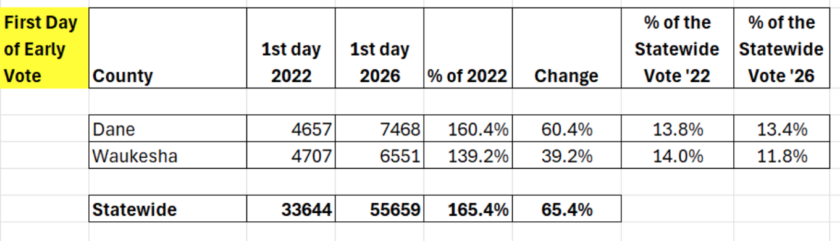
Both Dane and Waukesha counties saw an increase in first-day in-person voting compared with 2022, but the increase was much larger for Dane County.
Dane went from 4,657 first-day votes to 7,468, up 60.4%. Waukesha went from 4,707 to 6,551, up 39.2%.
In 2022, Waukesha County out-voted Dane County on the first day of in-person voting, by 50 votes. This year Dane County, driven largely by the City of Madison, jumped ahead of Waukesha County by 917.
Even with the large increase in Dane, its share of the statewide first-day in-person vote is less than it was in 2022, 13.4% this year compared with 13.8%. Waukesha’s share fell much more, from 14.0% to 11.8%. Both counties grew more slowly than the state as a whole.
Mail ballots
The mail vote is a different story. As of Oct. 20, before any in-person votes were counted, 191,074 mail ballots had come back statewide. At the same point in 2022, 258,761 had. That is a drop of 26.2%. The state’s Oct. 21 numbers, which take in the first day of in-person voting, put mail returns at 202,118, down 25.6%.
Cities vs. rural counties
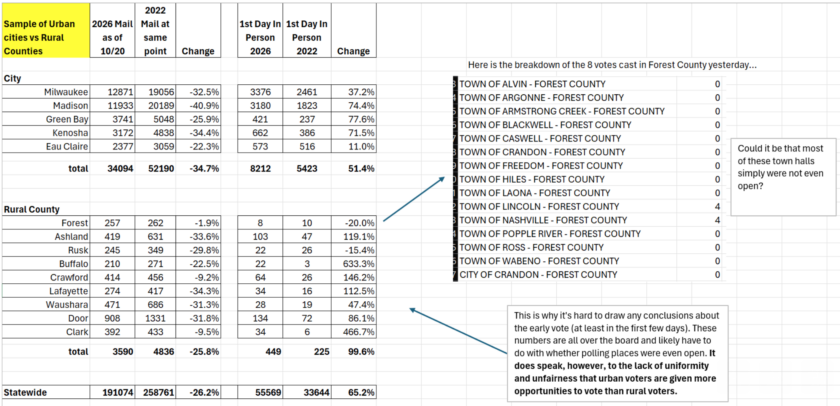
To see how this looks on the ground, we pulled a sample of five cities (Milwaukee, Madison, Green Bay, Kenosha and Eau Claire) and nine rural counties (Forest, Ashland, Rusk, Buffalo, Crawford, Lafayette, Waushara, Door and Clark).
Mail is down in both groups. The five cities are at 34,094, down 34.7% from 52,190 at the same point in 2022. The nine rural counties are at 3,590, down 25.8% from 4,836.
First-day in-person voting is up in both groups. The five cities cast 8,212 in-person votes on the first day, up 51.4% from 5,423 in 2022. The nine rural counties cast 449, up 99.6% from 225.
Milwaukee and Madison alone cast 6,556 of those city votes. Milwaukee had 3,376, up 37.2%. Madison had 3,180, up 74.4%.
Beyond that, the numbers are all over the board. Buffalo County went from 3 first-day votes in 2022 to 22 this year. Clark County went from 6 to 34. Forest County went from 10 down to 8, and Rusk County from 26 down to 22. Among the cities, Green Bay was up 77.6% and Eau Claire was up 11.0%.
Forest County
Here is the breakdown of the 8 votes cast in Forest County on the first day. Of the county’s 15 municipalities, 13 recorded zero. The towns of Lincoln and Nashville recorded 4 each.
Could it be that most of these town halls simply were not even open?
The state’s MyVote Wisconsin site notes that office hours vary by municipality and that some municipal offices may not offer additional in-person absentee hours.
Conclusion
This is why it’s hard to draw any conclusions about the early vote, at least in the first few days. These numbers are all over the board and likely have to do with whether polling places were even open.