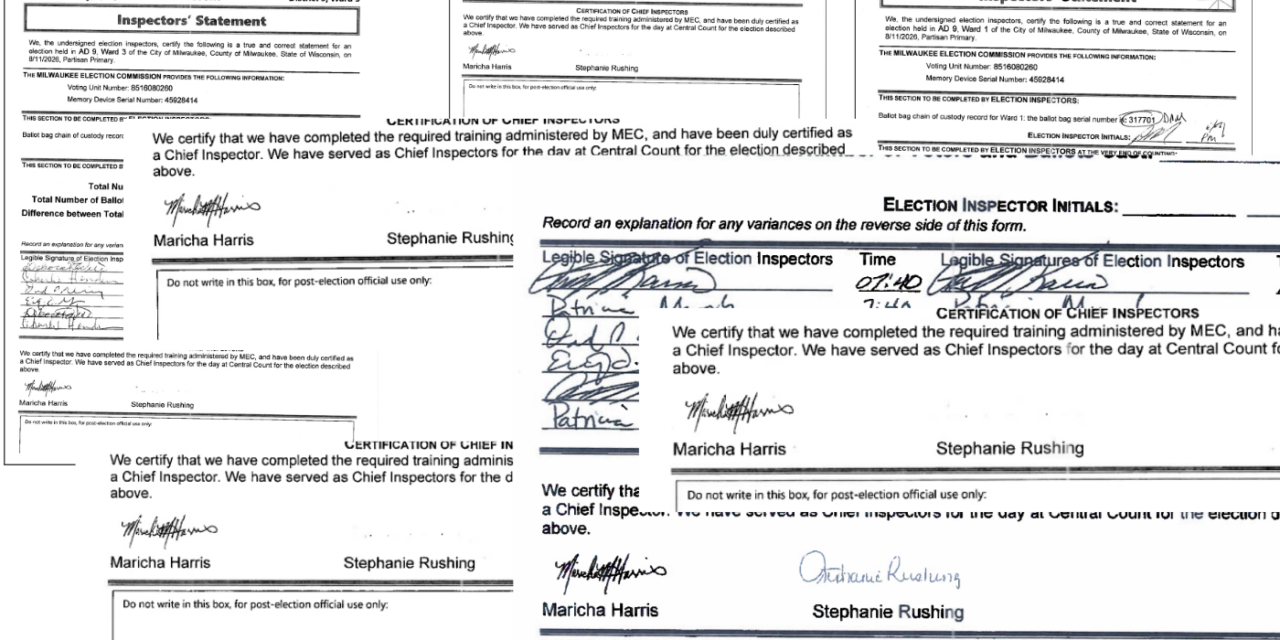
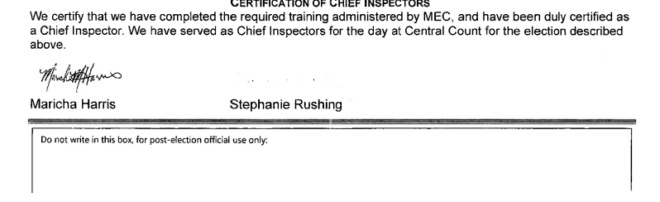
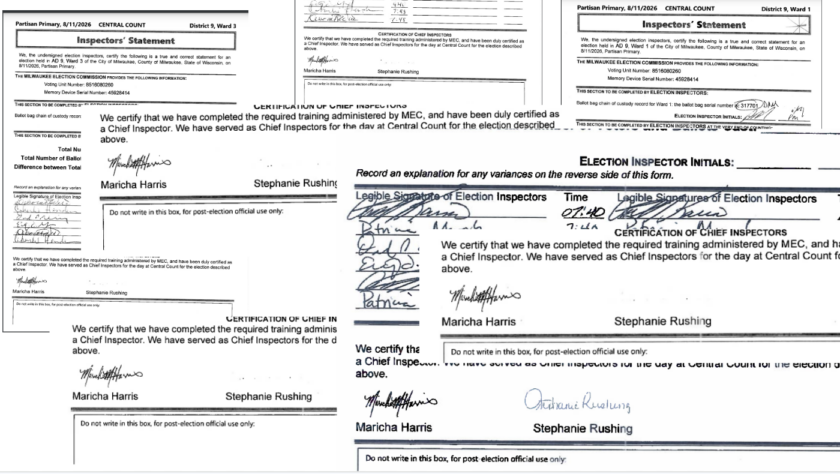
Hundreds of original EL‑104 forms from Milwaukee’s Central Count for the August partisan primary appear to show identical, digitally printed signatures in the chief inspector field. The spacing is uniform. The typeface is uniform. The placement is uniform. None of the forms appear to contain a personal signature of a chief inspector written on election night.
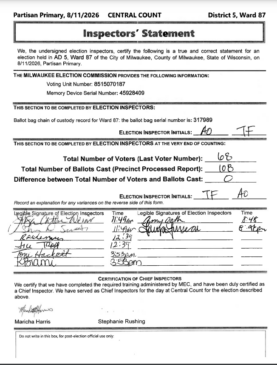
The “CERTIFICATION OF CHIEF INSPECTORS” section lists what appears to be electronic signatures of “Maricha Harris” and “Stephanie Rushing.” This uniform printing is in stark contrast to the section on the exact same pages of the forms where other election workers (such as Patricia Murphy, Catherine M. Markwiese, Sandy Stripes, and Warren Engstrom) personally hand-signed their names and often manually entered their shift times as required.
Sign up for Wisconsin’s best free weekday newsletter
This discovery comes amid mounting scrutiny over Milwaukee’s central count operations. State Rep. Dave Maxey (R-New Berlin) recently demanded answers from Milwaukee election officials following administrative errors during the primary. Concurrently, the Wisconsin Elections Commission (WEC) has considered formal intervention to press the city for answers and the release of primary source materials.
In addition to these state-level inquiries, Dairyland Sentinel submitted our own formal public records request to the Milwaukee Election Commission (MEC) seeking internal Central Count documents, specifically the completed EL-104 forms and preliminary reconciliation working documents. To date, the MEC has not fulfilled our request. We are seeking significantly more detailed information and documentation than what the commission has provided thus far.
These documents came to light after the Milwaukee Election Commission posted copies of the EL-104 forms to its website today. The release was prompted by mounting pressure from the Wisconsin Elections Commission, which had drafted a letter demanding transparency following the primary night errors at Central Count where staff mistakenly downloaded audit logs instead of election results. While the MEC promised state regulators it would release these records by September 4 to rebuild public confidence ahead of the November election, the selective release still falls short of fulfilling our broader public records request for the preliminary working documents that would show exactly how the breakdown unfolded.
The Milwaukee Election Commission has not responded to a request for comment regarding the uniform signatures.
The EL‑104 is the inspectors’ statement. It is the official record of what happened inside each polling place. It documents ballot counts, poll book reconciliation, provisional ballots, equipment seal numbers, incidents, and closing procedures. Clerks and canvassing boards rely on it to confirm the site followed required steps. It becomes part of the audit trail. It is reviewed during recounts. It is used to verify that the numbers balance.
Wisconsin law requires the chief inspector to personally attest on the EL‑104 that they hold current certification. The requirement comes from Wisconsin Administrative Code EL 11.04(1). The rule states:
“On election day, the chief election inspector shall state on the inspectors’ statement, Form EL‑104, that the chief election inspector holds a current certification.”
The Wisconsin Elections Commission’s training materials explain who completes the certificate portion of the EL‑104. WEC guidance states:
“The chief inspector or an election inspector designated by the chief inspector completes the certificate on the cover sheet of the Inspectors’ Statement (EL‑104).”
This instruction applies only to the certificate section. It does not replace the legal requirement in EL 11.04(1) that the chief inspector personally attest to their certification on election day.
A digital signature could be added by anyone at any time. A uniform signature block across dozens of forms suggests a process that bypassed the personal attestation required by state code.
The signature is not a formality. It is the legal statement that the person in charge of the polling place was certified and accountable. It confirms the chief inspector was present. It confirms they oversaw ballot handling. It confirms they verified the numbers before materials left the site.
Here is the inquiry sent to the commission by our publisher.
On behalf of Dairyland Sentinel, I am soliciting a comment from Paulina Gutierrez or someone authorized to comment on behalf of the commission.
You may add other commentary, but our questions, specifically are
- Were these electronic signatures digitally inserted and if so, why?
- Were these signatures inserted prior to the EL-104 forms being filled out?
- Do you have evidence that this occurs elsewhere in the state?
- Do you recognize why this practice could raise concerns?
Chain of Custody: Why the Signature Matters
Wisconsin’s chain of custody for ballots and election materials depends on documented, accountable handoffs. EL‑104 is the record that shows who handled ballots, when they were sealed, and whether the numbers reconciled. The chief inspector’s personal signature is the anchor that ties those actions to a certified individual.
Chain of custody requires:
- A named, certified person responsible for the polling place
- A signed record showing ballots were issued, counted, and secured
- A documented seal check on ballot containers
- A verified reconciliation of poll book numbers and ballot totals
- A signed handoff of materials to the municipal clerk
If the signature is printed or electronically inserted, the record loses its link to a real person. It becomes unclear who actually verified the numbers or oversaw the procedures. That weakens the reliability of the audit trail and complicates any review, recount, or investigation.
This does not invalidate ballots. Wisconsin law protects voters from poll worker mistakes. But it does weaken the integrity of the official record and raises questions about training, oversight, and compliance inside Milwaukee’s election administration.
Dairyland Sentinel will update this story when the Milwaukee Election Commission responds.
From the Wisconsin Election Commission’s Election Day Manual
Documenting Election Day
Other than the poll list, election inspectors must complete and certify additional forms that help to “tell the story” of an election.
Inspectors’ Statement (EL-104)
The completed certificate, incident log, Observer Log (EL-109), all challenge documentation forms, and any Orders to Leave (EL-110) are attached together to create the Inspectors’ Statement (EL-104).
The chief inspector or an election inspector designated by the chief inspector completes the certificate on the cover sheet of the Inspectors’ Statement (EL-104) listing the following information:
a. Ward or wards served by the polling place
b. Municipality
c. County
d. Election Date
e. Verify Tamper-evident Seal
i. Pre-election
ii. Post-election
f. Ballot Bag Tamper-evident Seal Number
i. Also recorded on the Ballot Container Certificate (EL-101)
g. Total number of voters
h. Number of absentee voters
i. Number of provisional voters
All election inspectors sign the completed certificate on the original Inspectors’ Statement (EL-104).
a. If there are multiple shifts, each shift should sign and indicate the hours they worked at the polling place.
b. If the standard inspectors’ statement does not have sufficient space for the number of inspectors working at the polling place, the election inspectors may sign on an additional page that is then attached to the EL-104 as an addendum.
The chief inspector signs the certification that he or she has completed the required training administered by the Wisconsin Elections Commission. If more than one chief inspector served at the polling place, they should each sign the certification.