
A Dairyland Sentinel Perspective Column by George Mitchell
Democratic gubernatorial candidate David Crowley is more of a threat to Wisconsin’s school choice programs than was Francesca Hong.
While I believe Hong’s chances in November were very slim, Crowley has a shot at winning. His stated choice agenda — a cap on enrollment and more regulation — basically mirrors proposals advanced by Governor Evers.
This is music to the ears of its opponents.
Yet Milwaukee-based City Forward Collective inexplicably describes “Crowley’s support for Wisconsin’s voucher programs.” This magical thinking will contribute to an unwarranted sense of confidence among choice parents and the leaders of schools they have chosen for their children.
Based on Crowley’s stated views, it’s reasonable to assume he would sign bills that choice critics unsuccessfully advanced in the last legislative session. If elected, and if partisan control of the Legislature flips, choice opponents will use Crowley’s message as a starting point for undermining parental options.
An enrollment cap
Choice opponents would delight in capping enrollment, a recurring Evers proposal. Doing so would suffocate future planning for schools currently participating. It effectively would close the door, in Milwaukee and statewide, to schools not yet in one of the state’s four choice programs.
More regulation
From the early years of the Milwaukee program, choice opponents have identified regulation imposed by additional state laws and DPI rules as the most effective way of keeping private schools from participating. Crowley is all in, telling PBS that participating private schools “should be held to the same standards as public schools.”
The idea that schools in the choice programs lack “accountability” is laughable. They in fact operate under tougher standards than do public schools, such as a requirement for independent accreditation and multiple annual financial audits. Most important, unlike public schools, they have no captive customers and must rely every year on the voluntary choices of individual parents.
The negative impact of a Crowley victory would be apparent in short order. Taking him at his word, his 2027-29 budget proposal would include an enrollment cap and regulations that effectively would put DPI into the classrooms of participating choice schools. A flip in legislative control would nullify Republicans’ ability to block adverse proposals, something GOP leaders have done throughout the Governor Evers era.
Those singing Crowley’s praises should understand that if he is elected, there is zero evidence that further progress can be made in reducing the substantial difference in per-pupil funding between public and private choice schools. A more likely scenario is that the gap will grow.
City Forward Collective equates Crowley’s opposition to Hong’s plan as “defend[ing] Milwaukee families’ educational options.” The truth is that capping enrollment stifles options. But for the work of choice supporters two decades ago, an enrollment cap then in state law would have remained, depriving more than 15,000 current Milwaukee choice students from participation.
As for “Crowley’s support for Wisconsin’s voucher programs,” I find nothing on the record regarding his views on the statewide, Racine, and special needs programs. One can reasonably assume he would support an enrollment cap and expanded regulation of participating private schools.
This is the opposite of “support.”
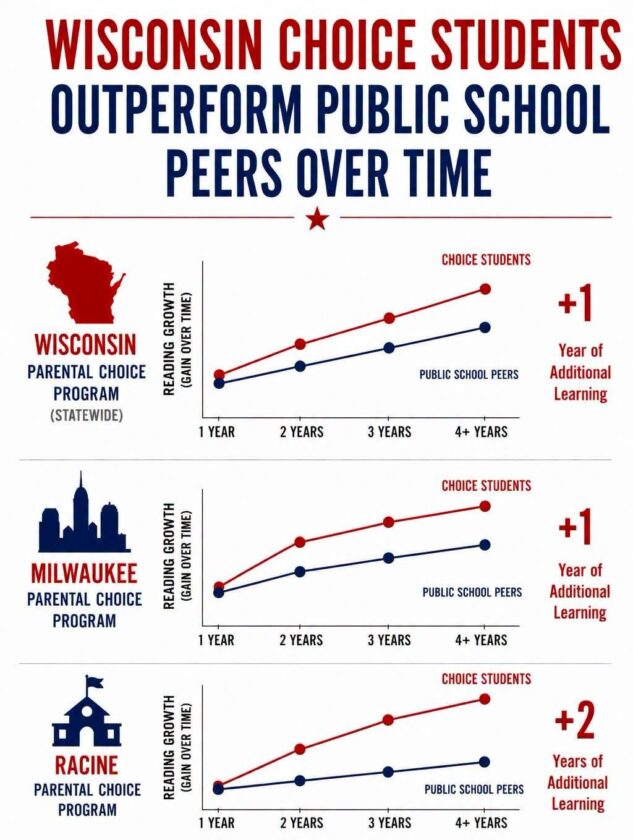
As previously described at Dairyland Sentinel, exhaustive new scholarly research documents the cost-effectiveness of school choice. The gains depicted in the charts below are at risk under the Crowley version of support.
A true supporter would call for more, not less, choice so that more Wisconsin students could make these gains at a lower cost to taxpayers.