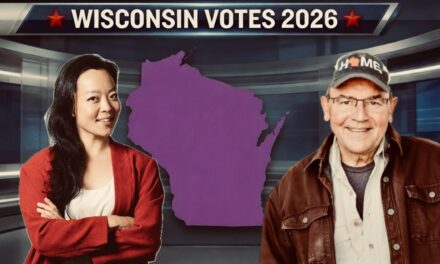
Nearly 800,000 Wisconsin voters cast ballots in Tuesday’s Democratic primary for governor. That may be the most consequential number to come out of an election decided by less than half a percentage point.
Milwaukee County Executive David Crowley narrowly defeated state Rep. Francesca Hong for the Democratic nomination, completing one of the more remarkable political comebacks in recent Wisconsin history. Crowley dropped out of the race July 8. Ten days later, after Lt. Gov. Sara Rodriguez abruptly ended her campaign, he got back in as Gov. Tony Evers endorsed him. Crowley entered the final weeks of the campaign with a tsunami of establishment support but well behind Hong in public polling.
Then he won.
The comeback and Hong’s stunning collapse will understandably get most of the attention. But take a look at how many people voted. The latest results show nearly 793,000 votes cast in the Democratic gubernatorial primary.
That’s a huge number for an August partisan primary in Wisconsin, especially when you put it alongside the last two competitive gubernatorial primaries.
Start with 2018. That Democratic gubernatorial primary wasn’t some sleepy affair nobody cared about. Democrats were choosing a candidate to take on Republican Gov. Scott Walker, one of the most polarizing political figures in the country at the time, and there were plenty of choices. The field included Tony Evers, Mahlon Mitchell, Kelda Roys, Mike McCabe, Kathleen Vinehout, Matt Flynn and former Madison Mayor Paul Soglin. Ten Democratic candidates appeared on the ballot, a state record for a gubernatorial primary, if memory serves.
Evers won with 225,082 votes, or 41.8%. Altogether, 538,857 votes were cast in the Democratic gubernatorial primary.
Tuesday’s Democratic primary drew more than a quarter-million more votes. That’s an increase of more than 47%.
Now go back just four years. The 2022 Republican gubernatorial primary was a bruising contest between Tim Michels and former Lt. Gov. Rebecca Kleefisch. Donald Trump endorsed Michels. Former Gov. Scott Walker and most of the state GOP establishment backed Kleefisch. Michels won with 326,969 votes while Kleefisch received 291,384. Timothy Ramthun, Kevin Nicholson and Adam Fischer were also on the ballot and between all of them, and including write-ins, 693,519 votes were cast in the Republican gubernatorial primary. Wisconsin Democrats just blew past that number by nearly 100,000 votes.
Put the three elections next to each other:
2018 Democratic governor primary: 538,857
2022 Republican governor primary: 693,519
2026 Democratic governor primary: nearly 793,000
There are a dozen reasons not to read too much into this. Primary turnout isn’t general election turnout. Wisconsin doesn’t register voters by political party. The candidates change. The issues change. So does the rest of the ballot. And the fact that nearly 100,000 more people voted in this Democratic primary than voted in the 2022 Republican primary does not mean Democrats start November with anything resembling a built-in 100,000-vote advantage.
But dismissing it would be foolish, too. Nearly 793,000 people chose to participate in a Democratic gubernatorial primary in August. That’s where the story becomes bigger than Crowley and Hong or establishment liberal vs. upstart Socialist.

One thing I noticed: Ben Wikler left one hell of a foundation behind.
Wikler took over the Democratic Party of Wisconsin in 2019. During his tenure, Wisconsin Democrats built an organization designed to operate year-round instead of disappearing after Election Day and rebuilding every two years. The results during those years speak for themselves. Joe Biden narrowly carried Wisconsin in 2020. Evers won reelection in 2022. Janet Protasiewicz won a Wisconsin Supreme Court race in 2023 that flipped ideological control of the court. Susan Crawford followed with another Democratic-backed Supreme Court victory in 2025.
Wikler left the state party chairmanship last year, but the infrastructure didn’t leave with him. It would be a stretch to look at Tuesday’s turnout and give Wikler credit for nearly 793,000 votes. As I mentioned, there are too many variables in any primary to make that claim.
Organizations do matter in politics, though. Habits matter. Voter lists, volunteers and fundraising networks matter. So does spending years identifying voters and giving them reasons to participate in elections that don’t happen in November. Whatever else happened Tuesday, the Wisconsin Democratic Party Wikler left behind demonstrated that it can still get an extraordinary number of people to participate in an August election. As they have in every April this decade.
And then there’s Tony Evers.
For a guy who announced he wasn’t running again, Evers doesn’t look much like a lame duck.
Remember how this happened. Crowley dropped out of the race in July and endorsed Rodriguez. Rodriguez’s campaign then imploded amid financial problems and she quit the race. Crowley reconsidered and jumped back in. Evers, who had previously indicated he would stay out of the Democratic primary, changed course and endorsed Crowley.
Less than a month later, Crowley is the Democratic nominee for governor.
That doesn’t mean Evers delivered the election to him. Crowley had his own political base and his own story to tell. Hong faced increased scrutiny during the closing weeks. Outside groups spent heavily. A chaotic race produced a chaotic finish.
Still, Crowley had quit the race. He came back with the sitting governor behind him and, just 24 days later, pulled off an upset that almost nobody would have predicted.
Evers has been doing this for years. He’s easy to underestimate. He’s not a riveting speaker. He doesn’t dominate a room or generate the kind of national political attention that attaches itself to governors with presidential ambitions.
He just keeps winning.
He beat Walker in 2018. Republicans made defeating him a national priority four years later and he won again, this time by more than 90,000 votes. Now, in the final year of his governorship, Evers stepped into a scrambled Democratic primary and put his name behind a candidate who had literally quit the race days earlier.
That candidate is now the nominee.
Maybe Evers’ endorsement moved several thousand votes. Maybe it helped reassure Democratic voters who were suddenly trying to figure out what the heck had happened to their primary. Maybe it helped Crowley consolidate institutional support quickly enough to make an otherwise impossible comeback possible. We can’t measure that from election returns.
No spin or clickbait in this four minute update.
You can speculate, as I do, just how much Bernie Sanders and AOC’s refusal to endorse Hong was the nail in her campaign’s coffin. Coming on the heels of her bullhorn photo op in Madison and a series of awkward national media hits, she clearly didn’t finish strong. There’s plenty of room to speculate how and why she came up short.
We can, however, see with certainty who won and how many people showed up. That’s makes Tuesday worth looking beyond the Crowley-Hong horse race.
Eight years ago, 538,857 Democrats voted in a crowded primary to choose who would take on Scott Walker. Four years ago, 693,519 Republicans voted in the Michels-Kleefisch showdown. This week, nearly 793,000 people voted in the Democratic primary for governor.
Maybe that’s simply the natural product of an unusually competitive race in an unusually political state. Maybe not.
Wikler spent six years building a party organization designed to keep Democratic voters engaged between presidential elections. Evers, even on his way out the door, just reminded everyone that he retains considerably more political clout than the term “lame duck” would suggest.
Almost 800,000 Wisconsinites showed up for an August Democratic primary. That turnout doesn’t predict November, but it does reveal something real: the party infrastructure built under Ben Wikler and reinforced by Tony Evers still moves voters. Republicans now have less than three months to prove they can match it.