By Brian Fraley, Publisher, Dairyland Sentinel
When the Wisconsin Department of Public Instruction (DPI) released its technical report on the 2024 Forward Exam standard-setting process, the disclosure came with a catch.
The list of workshop participants appeared more than 300 pages into the document, embedded on page 322. The list was sorted alphabetically by first name and formatted in a way that made it difficult to sort which school districts were represented or how often. Disclosure? Sure. Transparency? Not so much.

If you love Wisconsin, you’ll love our newsletter.
The report confirms that dozens of educators from across Wisconsin participated alongside DPI staff in the multi-day standard-setting workshop, an event held at a Wisconsin Dells resort that included access to a water park and carried a total price tag of $368,885. That total is for 88 workshop attendees, plus DPI staff and workshop facilitators.
To date, DPI has not released itemized receipts for the conference despite multiple public records requests. While the agency has acknowledged the total cost, it has not detailed lodging rates, meals, facility rentals, or ancillary expenses. We also do not know if participants also charge their districts for milage reimbursement for their travel or any other expenses.
The original request
On January 21, 2025, we sent the following request to the Department. They acknowledged receipt of the request a few weeks later and provided a report of the workshop, however even after another release of records this week, we are awaiting answers to some of our questions. The bulk of our original request, submitted to Superintendent Jill Underly and DPI more than a year ago:
Under the Wisconsin Open Records Law, §§19.31 to 19.39 I am requesting an opportunity to inspect or obtain copies of public records that relate to the panel of “nearly 100 experts from across the state” who recommended the updated achievement benchmarks for the forward exam, as per your statement of early today as reported by Corrinne Hess of Wisconsin Public Radio.
Specifically:
1) Who were these experts? How are they chosen? Please provide documentation, including invitations and relevant discussions regarding the geographic and ideological diversity. Please also provide any communication with anyone in your department regarding the vetting of these experts including correspondence with any groups or individuals consulted regarding the composition of this group.
2) When and where did they meet? Please provide agendas, minutes and any Zoom or other recording of the meetings.
3) Were any of the 100 experts asked to sign a non disclosure agreement or similar document that would shield the public from information regarding the discussions? Please provide any relevant emails and other documents given to the advisory group, including any Non Disclosure contracts or discussions regarding any such agreements.
4) Please provide a complete timeline of this consultation process and include an itemized listing of any state expenditures including staff time and equipment purchases, meeting space rental, food, travel, lodging or other accommodations.
The Price of Silence
This lack of transparency has already carried a significant cost for the agency. As reported yesterday by the Dairyland Sentinel, the Legislature’s Joint Committee on Finance moved to “hit pause” on a $1 million funding request from the DPI specifically because of the revelations regarding this resort retreat. Committee Co-Chair Mark Born (R-Beaver Dam) cited the Dairyland Sentinel’s reporting as the primary reason for withholding the funds, noting that the “secrecy” and “high cost” of the event raised serious questions about the proper use of taxpayer dollars.
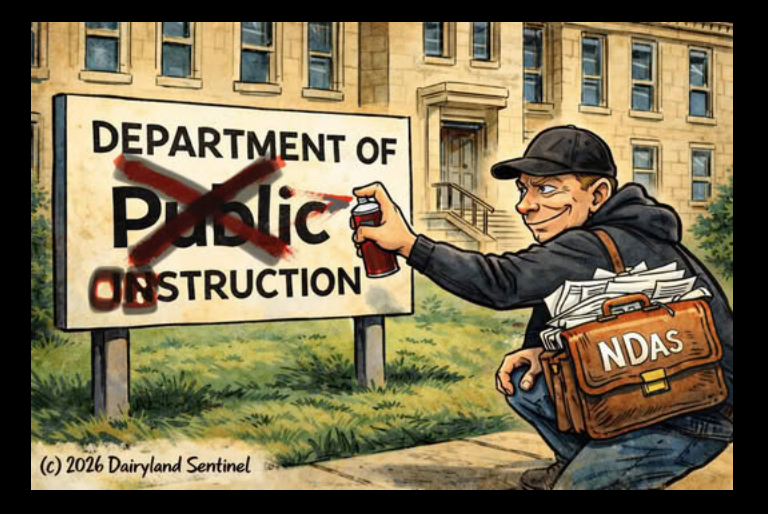
Uncovering the details of what actually happened during those four days at the Chula Vista Resort is made even more difficult by the strict Non-Disclosure Agreements (NDAs) attendees were required to sign (see link at the end of this article). According to the Wisconsin Forward Exam Confidentiality Agreement, participants were strictly prohibited from discussing “test items, graphics, tasks,” or even “measurement/research/report data” outside of the review process. They were specifically warned that any disclosure could result in “civil legal liability for copyright violations” and “district-level disciplinary action”. This threat of legal and professional retaliation creates a formidable barrier for any participant who might wish to speak out about the deliberations that led to the lowering of state proficiency standards.
So the public is inconveniently left with DPI as the only source for answers, unless the school districts themselves press their employees to reveal details of what happened in the Dells in the Summer of 2024.
“After the workshop, please feel free to share the process with others, but please keep private the recommendations, the contents of your conversations, and the test items.”
DPI/DRC SECURITY BRIEFING, JUNE 2024
Accountability is hampered by a surprising lack of official documentation. Despite the nearly $400,000 price tag, the DPI has asserted that no recordings or transcripts were made of the workshop sessions, and it has failed to provide any formal meeting minutes. This raises a fundamental question of government accountability: If there are no notes, no recordings, and no transcripts, how was the final 324-page technical report actually drafted? Without these primary records, the public is forced to trust a curated summary produced after the fact, with no way to verify the “collaborative” feedback the DPI claims drove the process.
While the DPI’s technical report was positioned as a final answer, it served more as a distraction. The participant list, alphabetized by first name of attendee in the DPI report, shows representation from large urban districts, small rural schools, and charter networks. As of this week have also obtained the emails that invited these participants, yet we still do not know the criteria for their selection. Why were these individuals chosen and not others?
Below is the full list of workshop participants as disclosed by DPI, reorganized by school or district (listed first) for clarity.
Standard Setting Workshop Participants by School or District
Abbotsford Elementary
- Dawn Carmichael
Adams Friendship School District
- Leah Hover Preiss
Amery School District
- Julie Severson
Appleton Area School District
- Julie Bowe
- Samantha Fischer
Berlin School District
- Michele Collins
Brown Deer School District
- Carlos Alba
Cashton School District
- Clara Krause
Cudahy School District
- Amy Paladino
Delavan Darien School District
- Amber Williams
Edgar School District
- Emily Morzewski
Elmwood School District
- Jenny Sauve
Eau Claire Area School District
- Debra Erickson
Florence County School District
- Kate Millan
Fond du Lac School District
- Marvina Thao
- NaQuisha Mann
Fort Atkinson School District
- Denise Engstrom
Freedom Area Schools
- Dana Osowski
Green Bay Area Public School District
- Katherine Genisot
- Luceth Escandell
- Teresa Tenorio
Greendale School District
- Kristin Martens
- Michael Brock
- Yesenia Saavedra
Hayward Community School District
- Sarah Letke
HOPE Christian Schools and Open Sky
- Ashley Kerrens
- Kajuanna McAfee
- Lakeshia Montgomery Freeman
Janesville School District
- Joshlyn Schlichter
Juda School District
- Kimberli Grimm
Kenosha Unified School District
- Ann H Grugel
Kettle Moraine School District
- Angela Kraft
Kewaskum School District
- Jamie Miller
Kimberly Area School District
- Amy Betters Midtvedt
Madison Metropolitan School District
- Delia Watkins
Menasha Joint School District
- Samantha Roberts
Menominee Indian School District
- Mary Juckem
Menomonie School District
- Emily Minor
Merton Community School District
- Lindsay Bialobrzeski
Milton School District
- Abbie Nash
- Caitlin Nelson
Milwaukee Public Schools and affiliated charters
- Amanda Carson
- Cynthia Cuellar Rodriguez
- Helen Makovec
- Elizabeth Watts
- Morgan Woods
Montello High School
- Jennifer Hacht
Nekoosa School District
- Tori Joosten
New London School District
- Gloria Peterson
- Lynn A Schaal
Onalaska School District
- Lorie Peterson
Oregon School District
- Celia Paczwa
Osceola School District
- Lorraine Anderson
Phelps School District
- Emily Kuckkahn
Port Edwards School District
- Beth Willcome
Portage Community School District
- Matt Dietzenbach
Racine Unified School District and charters
- Amy Bloom
- Mallory Umar
- Michelle Burch
- Nicole Radcliffe
- Valerie Morey
- Katherine Demers
Rice Lake Area School District
- Sadie Gunnink
Sauk Prairie School District
- Joel Liedtke
- Scott Bakken
Shell Lake School District
- Sharon Ricci
South Milwaukee School District
- April Sterbin
Sturgeon Bay School District
- Amy Richard
- Jane Lewis
Two Rivers Public School District
- Cayolyn Johnsen
United Community Center
- Sarah Schindler
Waunakee Community School District
- Lori Armstrong
Waukesha School District
- Bryn Perry
- Hillary Kuehnl
- Joanna Binsfeld
- Deyse Van Kempen
Wautoma Area School District
- Jenna Simacek
West Allis West Milwaukee School District
- Jonathan Touhy
West Bend School District
- Monica Green
West Salem School District
- Theresa Martinson
Wheatland Joint School District
- Margaret P Rovik
Whitnall School District
- Shawn Anne Pierner
Wittenberg Birnamwood School District
- Nicole Steigerwald
Wisconsin Rapids Public Schools
- Abigail Lynn Kreisa
The list raises unresolved questions. How were participants selected? What individuals or districts declined or were excluded, and why? How much did each attendee cost taxpayers? Why do the itemized receipts remain unavailable?
DPI has said the workshop was necessary to establish new academic benchmarks. Did these participants have a real impact or were they mere grassroots fig leaves that gave a bureaucratic policy change the cover of collaboration?
Under the new state standards, Proficiency rates jumped 12% under the new state benchmarks, causing a majority of students to “meet expectations.” Critics argue the bar has been lowered to make state averages look more favorable. With nearly $400,000 in taxpayer funds spent at a water park resort to produce these results, Wisconsin taxpayers deserve to know the truth of who really made the decisions and why they were made.
Parents, school boards, and taxpayers may now want to ask a simple question, and take it from there: Did someone from our school district participate in this endeavor?
Published Wednesday, February 4, 2026 at 10:19 am
Previously on Dairyland Sentinel