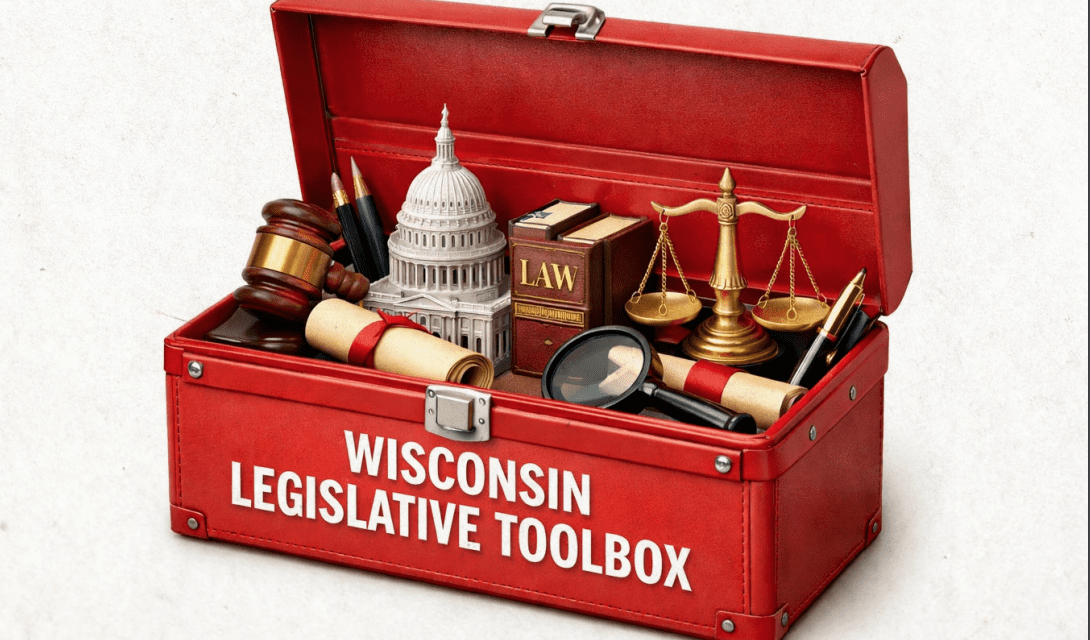
DELAFIELD, Wis. – The Institute for Reforming Government (IRG) released a new handbook Monday titled the “Wisconsin Administrative Reform Toolbox,” intended to serve as a practical playbook for other states to replicate Wisconsin’s model of legislative oversight over the executive branch.
The report documents a decade of efforts in Wisconsin to “restore legislative authority over unelected bureaucracies.” According to IRG, the toolbox distills these lessons into a “practical, legislator-facing framework designed to help states reclaim lawmaking authority, discipline administrative overreach, and restore democratic accountability.”
“Wisconsin didn’t just debate administrative reform — we enacted it,” said Jake Curtis, IRG General Counsel and Director of the Center for Investigative Oversight. “Over more than a decade, lawmakers built a durable framework. This Toolbox provides a blueprint for states ready to do the same.”
The toolbox organizes Wisconsin’s existing framework into seven specific legislative tools. Five of these are based on laws already enacted in Wisconsin, while two represent “next-phase reforms.”
The Wisconsin Playbook
The report highlights several key pieces of legislation that form the “Wisconsin model”:
- 2011 Act 21: Requires “explicit statutory authority and economic impact analysis” before state agencies can regulate.
- 2017 Act 39: Imposes a “30-month deadline” to prevent stalled or “indefinite rulemaking.”
- 2017 Act 57 (REINS Act): Requires “legislative approval for rules costing $10 million or more” over a two-year period.
- 2017 Act 108: Creates a process to “repeal unauthorized or obsolete rules.”
- 2017 Act 369: Ends “judicial deference to agency interpretations” and strengthens legislative oversight.
Future Reforms
The report also outlines two additional measures currently awaiting action in the Wisconsin Legislature: a Regulatory Budget (AB 277 model), which would require “cost offsets for new regulations,” and a Sunset Review (AB 274 model), requiring “periodic reauthorization of administrative code chapters.” Both bills recently passed the Legislature and are awaiting Governor Tony Evers’ signature or veto.
IRG stated that the “modern administrative state has effectively created a ‘headless fourth branch’ of government.” The group argues that by adopting these “tested reforms,” other states can avoid “starting from scratch” while reining in “vast economic burdens” imposed by administrative agencies.
“This Toolbox ensures that experience can now inform reform efforts across the nation — while strengthening the case for protecting these gains here at home,” the report concluded.