Executive Summary
George Mitchell’s analysis argues that early media coverage of Milwaukee Public Schools desegregation shaped public understanding for decades. Initial reporting established a narrative that persisted even as later evidence showed the plan functioned differently in practice.
Mitchell focuses on the failure of major newspapers to examine outcomes. Coverage emphasized intent and legality while giving limited attention to how the plan affected students and families.
The analysis reaffirms what MPS acknowledged two decades after the fact, namely, that the desegregation plan was designed to minimize disruption for white families, placing most transportation and reassignment burdens on Black students. Claims of voluntariness were reported without fully examining the limited options available to Black families.

Mitchell also criticizes the lack of clear public presentation of busing maps and logistics, which he argues would have changed public understanding at the time.
The analysis documents how academic performance claims by MPS leadership were widely reported but later shown by independent review to be misleading, with limited follow-up coverage.
Mitchell notes that later admissions by plan architects confirmed the plan’s intent to avoid disrupting white residents, but these acknowledgments surfaced decades after public narratives were established.
He concludes that recent anniversary coverage repeated earlier omissions, leaving key context absent from the historical record.
Key Takeaways
- Early coverage shaped decades of public perception.
- Outcomes received limited media scrutiny.
- The plan minimized disruption for white families.
- Black students bore most busing burdens.
- Key logistics were not clearly presented.
- Performance claims went largely unchallenged.
- Later admissions confirmed earlier concerns.
- Recent coverage repeated major omissions.
THE MILWAUKEE MEDIA AND DESEGREGATION OF MPS SCHOOLS
Setting The Record Straight
George Mitchell, January 2026
Half a century has passed since federal Judge John Reynolds directed the Milwaukee Public Schools (MPS) to desegregate classrooms. The adverse impact of the plan to implement his ruling continues to this day.
This month, the Milwaukee Journal Sentinel published an article and a separate column noting the 50-year milestone. Errors of omission and/or commission in each piece recall the Milwaukee media’s key early missteps in covering the desegregation story. Readers then and now have been left without important facts.
Why does this matter? Because uncorrected journalistic errors are consequential. In this case, flawed coverage that followed the Reynolds ruling left readers without a serious examination of the desegregation plan. The Milwaukee Journal and Milwaukee Sentinel came up short because they did not want to rock the boat. The need to do exactly that was left to others.
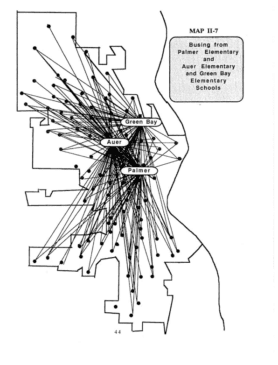
What’s clear in hindsight was apparent to some at the time of the plan’s development and implementation. The plan’s defects undermined potential benefits from ending segregation. Of greatest importance, as the busing map illustrates, the plan made impossible actual integration of Black and white students. That objective was subordinated to a different goal, namely, ensuring that the plan had the least impact on white students and families. Limiting the impact on white students required Black students to bear most of the impact.
While some leaders in the Black community alleged this at the time, the media variously dismissed their skepticism or treated their views as “claims.” The actual evidence supporting their concerns escaped media analysis. Forthright acknowledgement of a “white benefit” agenda by key MPS sources did not occur until the late 1990s.
Had those Black leaders received an objective hearing, the actual course of the desegregation story likely would have been quite different.