
Origins
The story of Monroe, Wisconsin began decades before it was formally incorporated in 1882. The first settlers arrived in the area around 1835 after the discovery of lead deposits in southwestern Wisconsin drew prospectors and families seeking opportunity. Beyond mining, these early settlers were attracted by the rich soils and the presence of the Sugar and Pecatonica rivers, which offered fertile ground for agriculture and water supply for livestock and milling operations.
The region’s physical landscape made it more than a resource camp. Its productive farmland allowed settlers to establish sustainable farms, creating a settlement that could endure long after the initial mineral rush had faded.
Monroe developed gradually as a hub for commerce and transportation in Green County, becoming its county seat and largest community. Its growing importance shaped its civic institutions and architecture as the 19th century progressed.
The community adopted the name Monroe in honor of President James Monroe, a symbol of national unity and expansion during the early 19th century. This choice reflected the aspirations of a settlement striving for permanence and identity within the young state of Wisconsin.
Nearby, the political landscape of the surrounding region was also forming. Green County had been created from part of the Wisconsin Territory and was named for General Nathanael Greene, a hero of the American Revolutionary War.
Swiss Immigration and the Dairy Transformation
A defining migration began in the 1860s when waves of immigrants arrived from Switzerland. Many came from regions such as Canton Glarus, where poor crop yields and economic hardship had pushed families to seek new opportunities in America. In Wisconsin, the rolling hills and pastureland north of Monroe reminded them of home.
These Swiss settlers brought deep cheesemaking traditions with them. Dairy farming and cheesemaking were not new activities, but the Swiss brought specialized knowledge of products such as Emmentaler-style Swiss cheese and Limburger, which quickly adapted to Green County’s abundant grasslands and herd-ready terrain.
In 1868, a Swiss immigrant named Nicklaus Gerber opened one of the earliest organized cheese factories in the county, first producing Limburger and then establishing operations for Swiss cheese. By the early 1900s, Green County had become one of the most important cheese producing areas in Wisconsin, with hundreds of factories processing local milk into marketable cheese.
This shift from crop farming and small dairy operations to organized cheesemaking helped build economic stability and cultural identity in Monroe and surrounding communities. It set the region on a path to become synonymous with high quality dairy production.
The Birth of Cheese Days
In 1914, Monroe locals launched a celebration that would become one of the oldest food festivals in the Midwest. Inspired by a sauerkraut festival in nearby Forreston, Illinois, a group of local businessmen organized Cheese Days in just nineteen days, promoting it with a roadster-driven publicity campaign through town.
The first Cheese Day was held October 28, 1914, with thousands of visitors gathering to celebrate local cheesemaking and enjoy community events. Free cheese sandwiches were provided to visitors, and the event included music, entertainment and displays of local pride.
Cheese Days became an annual tradition, with a parade first introduced in 1915 and a growing number of attractions celebrating Swiss music, food, crafts and dairy culture. Over time it evolved into a biennial festival held on the third weekend of September in even numbered years, drawing more than 100,000 attendees to Monroe’s Historic Courthouse Square.
The event reflects a living cultural heritage that connects local industry with community identity and tourism, and includes parades, traditional Swiss music, polka dancing and family activities.
Architecture and Heritage Sites
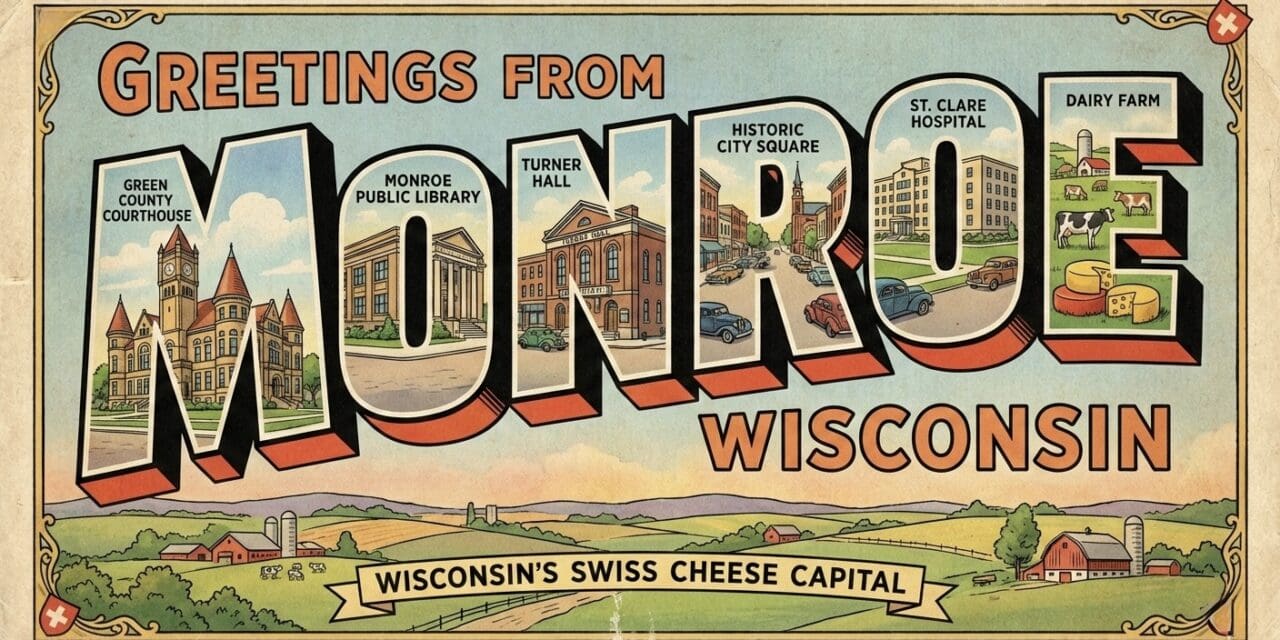
The growth of Monroe in the late 19th century is visible in its historic architecture. The Green County Courthouse, constructed in 1891 in a Richardsonian Romanesque style, stands on Courthouse Square and serves as an architectural focal point for the city’s civic life. The courthouse is listed on the National Register of Historic Places.
Other historic structures in Monroe include late 19th century homes and the former First Methodist Church, now the Monroe Arts Center, reflecting the city’s maturation as a community with rich cultural life.
The National Historic Cheesemaking Center
To preserve and interpret the region’s legacy, Monroe is home to the National Historic Cheesemaking Center. Housed in a restored railroad depot, the center features equipment and displays documenting early cheesemaking processes and the evolution of Wisconsin’s dairy industry. Exhibits include replicas of cheese factories, tools used in historic dairying, and stories of local cheesemakers.
The center helps visitors understand how cheesemaking shaped the region’s economy and culture, from farmstead beginnings to commercial production and export.
Monroe Today
Today, Monroe is home to a population of approximately 11,000 residents, serving as both the economic and cultural center of Green County. While its Swiss dairy heritage remains central to its identity, the modern city reflects a diversified local economy built on manufacturing, health care, agriculture, and regional services.
Cheesemaking continues to be a cornerstone of Monroe’s economy, with several nationally recognized producers operating in and around the city. Companies such as Klondike Cheese Company, Alp and Dell Cheese Store, and Decatur Dairy carry forward the Swiss traditions that helped define the region while supplying specialty cheeses to markets across the United States. These businesses provide jobs, attract visitors, and reinforce Monroe’s reputation as a leader in Wisconsin’s dairy industry.
Health care is another major employer, anchored by SSM Health Monroe Hospital and Clinic, which serves residents throughout Green County and neighboring communities. The city is also known as the longtime headquarters of The Swiss Colony, a nationally known mail order and online retail company whose roots in Monroe date back to the early 20th century and which remains one of the area’s largest private employers.
In addition to these anchors, Monroe supports a range of small manufacturers, agricultural suppliers, retailers, and professional services that contribute to a stable regional economy. Tourism tied to Cheese Days, the National Historic Cheesemaking Center, and the city’s historic courthouse square brings seasonal visitors and reinforces Monroe’s role as a destination as well as a workplace.
More than a century after its incorporation, Monroe remains a city shaped by its landscape, its immigrant roots, and its willingness to adapt. From a lead mining settlement to the Swiss Cheese Capital of the United States, Monroe’s evolution reflects how culture, industry, and community can grow together, preserving the past while supporting a sustainable future for the generations that follow.
Additional information
Wisconsin Historical Society: Brief History of Monroe
History of Cheesemaking at National Historic Cheesemaking Center
Travel Wisconsin on Historic Cheesemaking Center