
Joshua Glover: A Fight for Freedom and a Catalyst for Change
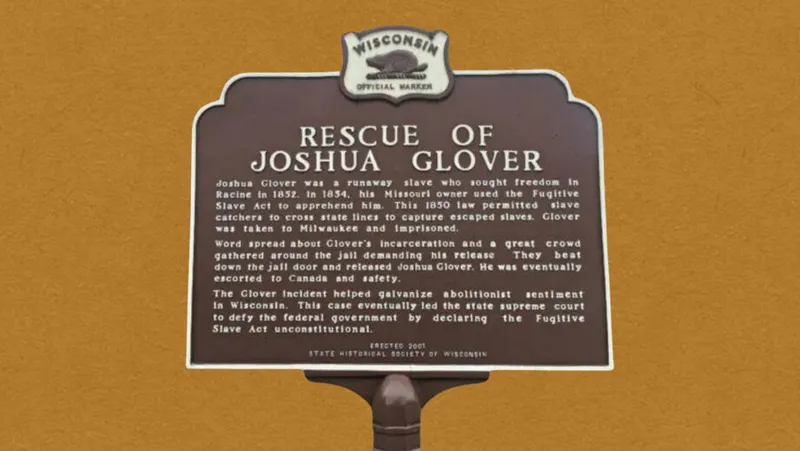
On the night of March 10, 1854, a posse of two federal marshals, four other men and a St. Louis slaveholder named Benammi Garland broke into a cabin near Racine and seized Joshua Glover.
Glover had escaped slavery in Missouri and settled in Racine in 1852, where he worked at a sawmill. Garland had bought him on New Year’s Day 1850 and held him on his farm outside St. Louis, according to the National Park Service.
The men who grabbed Glover were acting under the Fugitive Slave Act of 1850, which required authorities in free states to help return people who escaped slavery.
Follow this story every morning.
Get Key Reads, our free daily email: the Wisconsin news that matters, in four minutes or less.
The jailbreak
Racine was an abolitionist town, and the marshals did not think they could hold Glover there. So they took him to the Milwaukee County jail to wait for a federal judge.
Word reached Sherman Booth, the Milwaukee abolitionist and newspaper editor. Booth and antislavery lawyers tried and failed to free Glover in court. At the same time, they stirred up a crowd outside the courthouse that grew to about 5,000 people, according to the Encyclopedia of Milwaukee.
On the evening of March 11, the crowd forced its way into the jail and freed Glover. Rescuers took him to a safe house in Waukesha. From there, he made his way to Canada. He was never caught.
The court fight
Federal authorities arrested several of the rescuers, including Booth.
In June 1854, Wisconsin Supreme Court Justice Abram Smith granted Booth a writ of habeas corpus and ordered him released, ruling the Fugitive Slave Act unconstitutional. The full state Supreme Court backed him that July. Booth was later convicted in federal court, and the state court again ordered him freed on the same grounds.
The U.S. Supreme Court overturned the Wisconsin rulings in Ableman v. Booth in 1859. The justices held unanimously that state courts cannot override federal courts, and they upheld the Fugitive Slave Act.
Ripon
The Glover rescue happened while Congress was debating the Kansas-Nebraska bill, which would let settlers in those territories decide whether to allow slavery.
Nine days after the jailbreak, on March 20, 1854, opponents of the bill met at a schoolhouse in Ripon. Alvan Bovay brought Whigs, Free Soilers and Democrats together there to form a new party against the spread of slavery. The Little White Schoolhouse is now a National Historic Landmark and is known as the birthplace of the Republican Party.
The Kansas-Nebraska fight drove that meeting. But the Encyclopedia of Milwaukee says the Glover case played a key role in raising antislavery feeling in Wisconsin and in forming the state’s Republican Party. The court fight also gave the new party a states’ rights argument that broadened its appeal.
Wisconsin was a marginally Democratic state at the start of the 1850s. By the end of the decade, it was solidly Republican.
Canada
Glover settled in Etobicoke, now part of Toronto. He worked for more than 30 years for Thomas Montgomery, a local landowner best known as the owner of Montgomery’s Inn, according to Heritage Toronto.
He died in 1888. Despite efforts to bury him with family, his body was sent to the University of Toronto medical school.
Sources and further reading:
Encyclopedia of Milwaukee: “Joshua Glover”
National Park Service: Joshua Glover
Federal Judicial Center: Ableman v. Booth
Heritage Toronto: In Pursuit of Freedom: The Life of Joshua Glover
Dairyland Sentinel follows a published Editorial Policy, Ethics Statement and Corrections Policy.
Start tomorrow as Wisconsin’s best-informed reader.
The Wisconsin news that matters, in four minutes or less.
Already a subscriber? Support this reporting with a tax-deductible gift.