Tomorrow at 10:00 AM, the Joint Committee on Finance is scheduled to decide the fate of $2 million in supplemental funding for the Department of Public Instruction (DPI). While the agency warns that withholding these funds could lead to staff layoffs, a Dairyland Sentinel investigation into the department’s federal grant guidance raises a more pressing question: Has the DPI’s advice on resort-based conferences created a future tax liability for local school districts?
What is the program?
The Individuals with Disabilities Education Act (IDEA) is a federal law ensuring services to children with disabilities. It is a massive funding source for Wisconsin schools, providing approximately $224 million in “Flow-through” grants for the 2025-2026 fiscal year.
What are the parameters for funding?
Federal law is strict about how this money is spent. Under the Uniform Grant Guidance (2 CFR § 200.404), any cost charged to a federal grant must be “Necessary and Reasonable.” A cost is generally considered “reasonable” if it does not exceed what a “prudent person” would spend under the same circumstances. Furthermore, federal funds must supplement local spending, not supplant (replace) it.
How is the program administered?
The DPI acts as the “pass-through” agency, receiving federal cash and distributing it to Wisconsin’s 421 school districts. The DPI is responsible for maintaining the Allowable Costs Guidance that local school business managers rely on to stay in compliance.
What did the DPI say about using these funds for resort conferences?
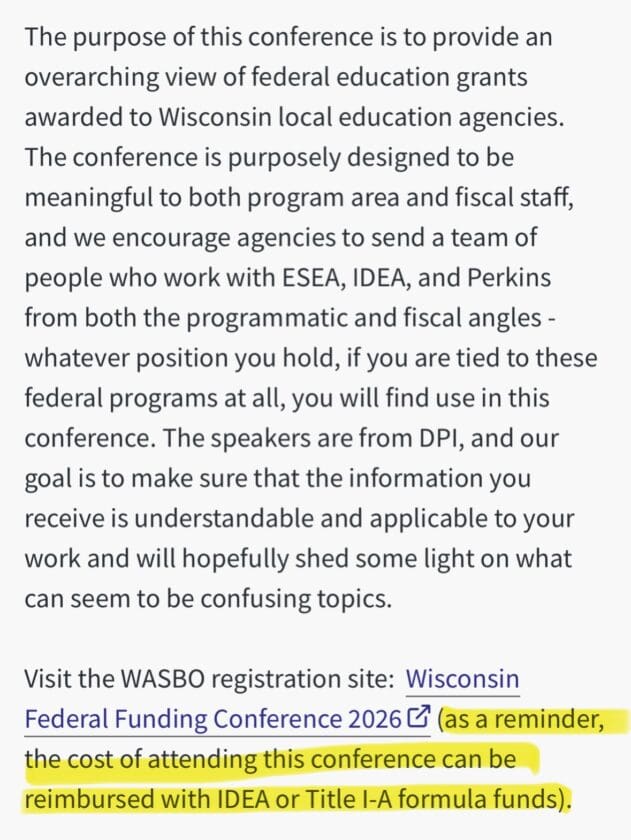
The 2026 Wisconsin Federal Funding Conference was held at the Kalahari Resort just last week. Official guidance provided to attendees by the Wisconsin Department of Public Instruction stated that the costs of the conference could be reimbursed using federal IDEA or Title I-A funds. The conference agenda included a 2-hour and 15-minute “Networking Social” at the resort.

What questions does this raise?
The intersection of federal law and DPI policy raises several concerns for local taxpayers:
- The “Prudence” Question: Does a multi-day stay at a luxury waterpark resort, including a scheduled “Networking Social” reception—meet the federal “Reasonable” standard for technical training?
- The “Necessary” Question: Could this training have been conducted at a lower-cost venue, such as a state office building or via a webinar, as suggested by U.S. Department of Education FAQ guidelines?
- The Liability Question: If a federal audit determines these resort stays are “unallowable,” who pays the money back?
What could happen?
When federal funds are determined to be mismanaged, the federal government can demand a dollar-for-dollar repayment. Because the DPI is the pass-through agent, a finding of “unreasonable” spending could force local school districts to repay those federal grants using local property tax revenue.
As the DPI asks for $2 million in state funding tomorrow, the Legislature may choose to determine if the agency’s guidance is protecting local districts or exposing them to significant federal risk. exposing them to significant federal risk.
Originally published, March 2, 2026