
A wish list or a blueprint? Education reforms under attack in Wisconsin
Wisconsin State Superintendent Jill Underly submitted a budget request that would smother several effective and popular education reform programs.
At a glance
- The state superintendent's request was sent to the Department of Administration
- The Governor and the new legislative majorities will write and approve the next budget
- They can choose to ignore all, some, or adopt Underly's plan in full
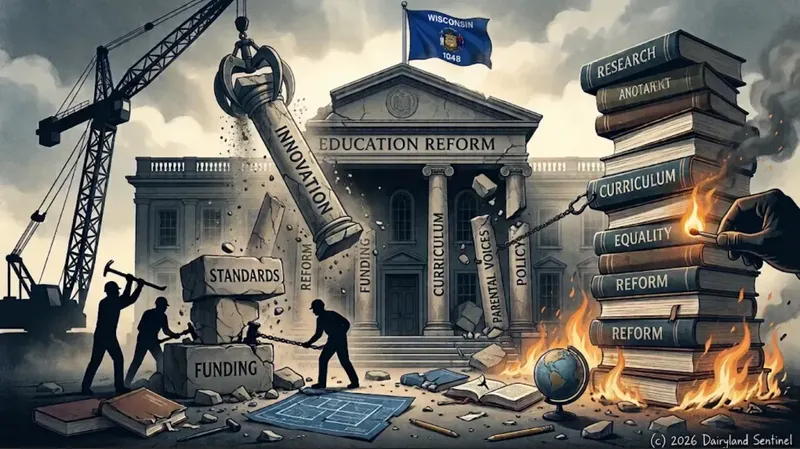
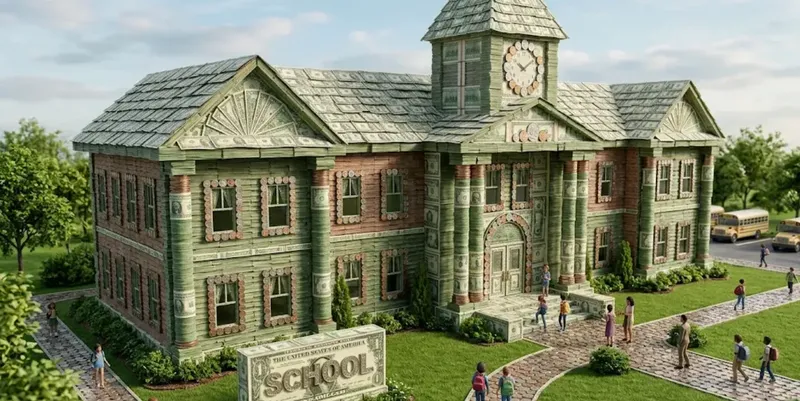
Will State Superintendent Jill Underly's 2027-29 budget request be a soon-forgotten education-establishment wish list, or the blueprint for next year's education budget?
Underly is neither an executive nor a policymaker. She's an administrator. She cannot write a state budget and she cannot pass a law. The obnoxious, 486-page request her department filed with the Department of Administration last week is a wish list.
Gov.-elect David Crowley takes office in January and governors typically submit a budget bill in February.
The Legislature then rewrites it.
You can see the details of the process in the Legislative Fiscal Bureau's paper on the state budget process.
Underly's horrific request still matters. It shows what the educational establishment hopes to do: smother the parental choice program through attrition. Choke off charter schools through central control. Dismantle the popular and effective education reforms of the past thirty-plus years as sop to the teachers' unions.
Districts would get inflation-adjusted revenue-limit increases. Schools in the choice programs, and most independent charter schools, would not. The Special Needs Scholarship Program would be closed to new students.
Underly, in a Nov. 13 news release, called the plan "a comprehensive, multi-year approach to strengthening Wisconsin's schools" and said the state should "end the era of operating referendums as a routine budgeting tool." She said the request "does not increase the statewide property tax levy."
The release put the scale at roughly $2.75 billion in new aid for K-12 schools and libraries.
No mention was made about improving outcomes for kids.
To establishment protectors like Underly, children are mere vessels for tax dollars.
Her plan is simple: Diminish the role of parents by giving them fewer choices for their children, stifle innovation by limiting alternatives to the government-assigned brick and mortar school in your neighborhood, and pour money into a system without regard to whether it meets the needs of students or delivers greater achievement in the classroom.
Closing the Special Needs Scholarship Program
The Special Needs Scholarship Program, created in 2015 Wisconsin Act 55, pays for eligible students with disabilities to attend a participating private school. The request would shut the door to new pupils after the 2027-28 school year and limit the program to schools already participating in 2027-28 (page 409).
DPI projects 3,800.3 full-time equivalent students participate in the program this year and 3,955 next year. In 2028-29, enrollment would fall to 3,766 in-part because an estimated 170 students who graduate with a full scholarship would not be replaced (page 409). After payments issued in 2028-29, the request would also end the option for a school to be paid the actual cost of serving a student, a cost a DPI table puts at $443,027 this year, and would repeal the current indexing formula (pages 409-411).
Her proposal admits the SNSP is "a program that continues to grow" (page 439), then marks it for shrinkage and would assess new fees on private schools participating in the program.
Inflation for districts, a freeze for choice and charter schools
Follow this story every morning.
Get Key Reads, our free daily email: the Wisconsin news that matters, in four minutes or less.
Without regard to performance, school districts would receive a per-pupil revenue-limit increase of $366 in 2027-28 and $374 in 2028-29, then inflationary uppers after that. The $366, the request says, "reflects adjusting the $325 per member adjustment, first provided in FY24, by inflation" (page 148). Districts would also get an additional $742 in 2027-28, current Per Pupil Aid folded inside the revenue limit, and the Per Pupil Aid appropriation would be zeroed out (pages 148 and 158).
Private schools in the Milwaukee, Racine and Wisconsin Parental Choice programs would be paid a single rate of $12,552 for every grade, in both years, with the automatic increases in current law repealed (pages 397-398 and 403-404). Current payments are $11,305 for grades 4-year-old kindergarten through 8 and $13,799 for high school. The request would raise the K-8 payment by $1,247 and then freeze it. It would cut the high school payment by $1,247, about 9 percent, and then freeze that too.
DPI's own enrollment tables show 8,310 Milwaukee choice high school full-time equivalent students next year, and 6,910 in the Racine and statewide programs combined, for 15,220 in all. At $1,247 apiece, the high school cut comes to $18,979,340, or about $19 million, including about $10.4 million in Milwaukee (8,310 times $1,247 equals $10,362,570). Those figures are our calculations from the enrollment tables in the request.
Independent charter schools would be held at this year's rate of $12,797 in 2027-28. In 2028-29 the payment would rise to $13,700, matching the low revenue ceiling proposed for districts that year, however, the automatic indexing formula would be repealed (page 390).
The state would start paying "new" authorizer charter costs directly from the general fund, rather than deducting aid from resident districts (pages 148 and 390). So districts would get increased aid, even if they had fewer students.
Meanwhile the Choice and Charter options would be smothered. Again, none of Underly's proposals are based on, or tied to performance.
New power over charter schools, and rules still missing
Underly's wish list would give her new power over who may authorize independent charter schools, including the power to approve or deny new authorizers, set standards, review performance, order corrective action, and renew or revoke authorizing authority (page 391). The four legacy authorizers named in Wis. Stat. s. 118.40 (2r) (a) through (d) would be exempt from renewal and revocation questions: the common council of the city of Milwaukee, the University of Wisconsin-Milwaukee, the University of Wisconsin-Parkside and Milwaukee Area Technical College. Newer authorizers, including the Office of Educational Opportunity, a county executive, tribal colleges and technical colleges other than MATC, would be covered.
The request says further charter-school changes, and the specific accountability changes for choice schools, "will be available in a separate document" (pages 391, 397-398 and 403-404). The request does not include that document, and the Nov. 13 news release does not describe the changes either.
Let's be clear, current law requires private schools in the choice programs to administer the same state exams as public schools and to meet other academic and financial conditions. The Underly budget request signals that those rules would change... and then withholds the details. Lawmakers and parents can see the payment freeze and the scholarship phaseout, but not the accountability regime that would go with them.
A budget request that hides that piece is asking for a blank check for traditional schools, and a house of horrors for innovators.
The formula, special education, mental health and careeer/tech ed
The largest item is general equalization aid and the revenue-limit formula (pages 146-148). DPI asks to raise the general aid appropriation from a base of $5,581,190,000 to $7,986,784,000 and $8,357,941,600. After shifting $574,720,600 in Per Pupil Aid into general aid and accounting for the School Levy Tax Credit and related offsets, the net general-fund impact is $429,393,500 and $800,551,100 (pages 146-148).
The low revenue ceiling would be set in 2028-29 at 95 percent of the prior-year statewide average, estimated at $13,700, benefiting an estimated 125 districts (page 148). The request says the package would hold the projected school levy "relatively flat," a more cautious claim than the news release's line that it "does not increase the statewide property tax levy."
Special education categorical aid would rise from a base of $871,826,900 to $1,165,954,000 and $1,497,084,000, to reimburse 50 percent of aidable costs in the first year and 60 percent in the second, and to make the appropriation sum sufficient (page 165). The actual reimbursement rate in 2025-26 was 38.4 percent, and the rate for 2026-27 is estimated at about 40 percent (page 166).
Aid for school mental health programs would double, from a $12,000,000 base to $24,000,000 in each year (page 357). School-district spending on school nurses would qualify, alongside school social workers. Private schools would not. "The department further requests that private schools no longer be eligible for this aid, effective with aid payments distributed in FY28" (page 357). The Get Kids Ahead grant would rise from $10,000,000 to $40,000,000 each year (page 351). The news release said the request would increase "Mental Health Aid to $24 million over the biennium." The request itself is $24,000,000 each year, or $48,000,000 over the biennium, and that is before the $40,000,000-a-year Get Kids Ahead grant. If the department cannot describe its own request accurately, lawmakers should read the document, not the news release.
Beginning in 2028-29, DPI also asks for $12,500,000 a year for 100 literacy coaches, plus a separate $13,000,000 math and literacy grant, of which $500,000 would go to administration (pages 249-250 and 256). The news release cited $12.5 million for the grants and did not mention those administrative costs. Again, no standards or achievement benchmarks are mentioned, just an increase in spending and personnel.
Career and technical education would get $43,468,000 in 2028-29 only, plus $6,000,000 each year for student organizations (pages 305 and 317)?!?
What happens next
None of this is law. It's not even a bill. It is the state superintendent's request to the Department of Administration, filed as every agency files a request.
Governor-elect Crowley and the new legislative majorities will write and approve the next budget.
Elections have consequences, so it should not surprise anyone that there will be changes to programs funded by the Republican-led legislature in recent years.
How profound will those changes be? That's what will play out over the next several months in Madison.
We already know what Underly wants. It's what her base (the teachers' unions) want.
The question now belongs to Crowley and the Legislature: Will they treat Underly's mess of a proposal merely as a wish list, and leave it on the shelf, or adopt it as the blueprint for next year's education budget?
Brian Fraley is the publisher of Dairyland Sentinel, which he founded in 2023. A native of Milwaukee, he grew up in Wauwatosa. He is a graduate of the University of Wisconsin and has been involved in Wisconsin public policy, politics and journalism since 1985. He currently lives in Waukesha County with his wife and two daughters.
Dairyland Sentinel follows a published Editorial Policy, Ethics Statement and Corrections Policy.
Start tomorrow as Wisconsin’s best-informed reader.
The Wisconsin news that matters, in four minutes or less.
Already a subscriber? Support this reporting with a tax-deductible gift.