
State’s Rural-Urban Balance Explored in New Report
State’s Rural-Urban Balance Explored in New Report
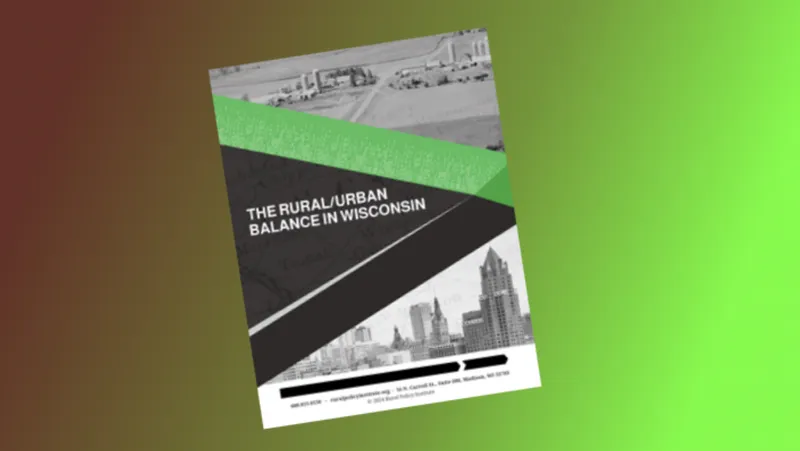
The Rural Policy Institute has released its full report, “Rural-Urban Balance in Wisconsin,” which sorts the state’s communities into rural, rural-adjacent, suburban and urban.
“This report creates, for the first time, an accurate working definition of what is indeed ‘rural’ in our state,” said Robert Welch, the institute’s executive director. “And it highlights how we remain a rural state with solid growth projected in rural areas.”
Welch, a Republican, served 10 years in the state Assembly and 10 in the state Senate.
Follow this story every morning.
Get Key Reads, our free daily email: the Wisconsin news that matters, in four minutes or less.
The institute held an event in Madison last week to discuss the findings with policymakers and community leaders, according to its announcement.
What the Research Found
The institute says that even after the Legislature’s new district maps, the number of districts with significant rural influence remains high.
An earlier version of the analysis, reported by WPR in December, broke down Wisconsin’s population this way:
- Urban: 40%
- Rural: 25%
- Suburban: 19%
- Rural-adjacent: 16%
That analysis also found that the long decline in rural population has stopped. “Between 2020 and 2023, the population of rural Wisconsin actually grew faster than the metro county population,” the study said.
Jason Mugnaini, executive director of government relations for the Wisconsin Farm Bureau Federation, told WPR that the Census Bureau’s definition of rural misses how people see themselves. He noted that New Berlin and Rhinelander have about the same population density. One is a Milwaukee suburb. The other is a Northwoods hub that has more in common with the rural areas around it.
Who Is Behind It
The institute is backed by the Wisconsin Farm Bureau Federation, the Wisconsin Towns Association, the Wisconsin Electric Cooperative Association and The Welch Group, Welch’s lobbying firm. Mike Koles, executive director of the Wisconsin Towns Association, is its president, according to the institute’s website.
The institute says copies of the full report are available on request.
Dairyland Sentinel follows a published Editorial Policy, Ethics Statement and Corrections Policy.
Start tomorrow as Wisconsin’s best-informed reader.
The Wisconsin news that matters, in four minutes or less.
Already a subscriber? Support this reporting with a tax-deductible gift.