
Jagler: DPI's massive $2.75 billion ask will yield 'zero improvement for kids'
Superintendent Underly submits a request that doesn't add up and spends bulk of state surplus.

At a glance
- The Wisconsin Department of Public Instruction is asking for $2.75 billion in new state aid for K-12 schools and libraries for the 2027-29 budget cycle
- Republican Sen. John Jagler criticized the proposal
- State Superintendent Jill Underly framed the request as a necessary measure to eliminate school operating referendums
Sen. John Jagler says the Department of Public Instruction wants to pour nearly all of Wisconsin's surplus into public schools without asking for anything in return.
"Scooping nearly the entire budget surplus into the existing system with no academic reforms will yield exactly zero improvement for kids," the Watertown Republican wrote on X Friday.
The 2027-29 request asks for $2.75 billion in new state aid for K-12 schools and libraries over two years. DPI posted it on its website Friday morning, took it down, then restored the full packet at 2:15 p.m., when State Superintendent Jill Underly issued a news release.
Jagler's objection is what the money doesn't come with. "I was hopeful that any new spending would come with accountability and expectations for higher test scores, better reading results and stronger math instruction," he wrote. "But I fear it's just a blank check for the same excuse-making we've seen for decades."
"Nothing in the budget request guarantees the money will reach the classroom or be used to reward good teachers instead of feeding a swelling education bureaucracy," Jagler continued.
He also tied the request to talk of eliminating Act 10, the 2011 law that limited collective bargaining for most public employees. "We should not regard this move, combined with eliminating Act 10, as virtuous unless that taxpayer investment is focused on serious academic reforms and accountability," he wrote.. "Sadly, I doubt this will help students."
Underly sells the plan as property tax relief. "The era of operating referendums needs to come to an end," she said in a video message released with the announcement. "We shouldn't have to choose between strong public schools and protecting property taxpayers."
A one-page DPI summary promises "$2.75 billion in new aid for Wisconsin schools and libraries" and "No statewide property tax levy increase." Fact sheets and the full request fill in the details.
None of the fact sheets carries line-item costs.
What DPI wants
The centerpiece is a rewrite of the school funding formula. Districts would get revenue limit increases of $366 per student in 2027-28 and $374 in 2028-29, with future increases tied to inflation. DPI would also fold the $742 per student now paid as separate per pupil aid into the revenue limit, for a first-year bump of $1,108 per student.
Students from low-income families and English learners would count 20% extra. About $1.98 billion in existing money, including the $1.275 billion School Levy Tax Credit, would be moved into the equalization aid formula.
Special education reimbursement would jump from about 39% of costs to 50% in 2027-28 and 60% in 2028-29. DPI also wants the state to pay whatever it takes to hit those rates, instead of setting a fixed dollar amount, the special education sheet says.
Follow this story every morning.
Get Key Reads, our free daily email: the Wisconsin news that matters, in four minutes or less.
The rest is new and bigger programs: $43.5 million in 2028-29 to expand career and technical education and $6 million a year for career and technical student organizations, plus a jump in the school mental health grant from $10 million to $40 million a year. Literacy and math grants would get $12.5 million a year beginning in 2028-29, plus $500,000 to run the program, the full request says. Literacy coaches would get $12.5 million a year after their scheduled end in July 2028. Together the reading and math money comes to less than 1% of the request.
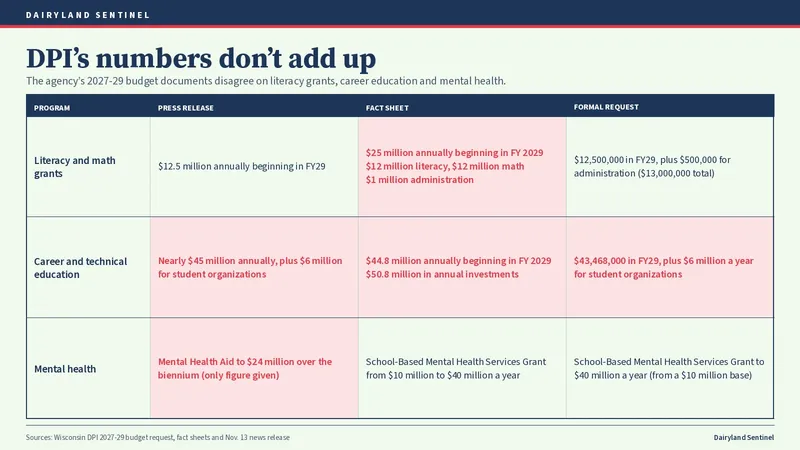
Even DPI's own paperwork does not agree. The news release and the full request put literacy and math grants at $12.5 million a year beginning in 2028-29. The request adds $500,000 to run the program, for $13 million in all. The teaching and learning sheet asks for $25 million a year, $12 million for literacy, $12 million for math and $1 million to run the program.
The career and technical education sheet calls for $50.8 million a year, including $44.8 million a year for expansion starting in 2028-29. The full request asks for $43.5 million that year for the expansion, plus $6 million a year for student organizations.
The release's only mental health figure is an increase in Mental Health Aid to $24 million over the biennium. The mental health sheet also calls for raising the School-Based Mental Health Services Grant from $10 million to $40 million a year.
The last time
Two years ago Underly asked for just over $4 billion, including a 90% special education rate, WKOW reported.
The current budget left general school aid flat at $5.58 billion both years, according to the Legislative Fiscal Bureau. Revenue limits rose only by the $325 per student locked in by Gov. Tony Evers' 400-year partial veto. The new money went to special education: $207.6 million more in the first year and $297 million more in the second, meant to cover 42% and then 45% of costs.
It did not. Special education costs grew about 9% instead of the 4% budget writers assumed, the Fiscal Bureau found. The final 2025-26 rate came in at 38.39%, DPI reported.
The money
Wisconsin ended the last fiscal year with $3.31 billion in its general fund, down from $4.61 billion a year earlier, Forward Analytics reported. The Fiscal Bureau projects spending will top revenue by $582 million this year. DPI's ask equals 83% of that surplus.
A surplus is one-time money. Higher revenue limits, inflation indexing and a 60% special education rate are not one-time costs. They grow every year after the surplus is gone.
The politics
This request lands in friendlier hands. Democrats will control the Legislature for the first time since 2010, and Gov.-elect David Crowley takes office in January. His chief of staff, Jeff Pertl, was once a policy adviser to the state superintendent at DPI, Urban Milwaukee reported.
Then there is the timing. DPI released the $28 million first part in September and said in its own news release that the school aid piece would follow in November. That put the big number after Election Day.
Other reaction
Will Flanders, research director at the Wisconsin Institute for Law & Liberty, asked, "Under the previous legislature, ridiculous DPI budget requests went straight into the trash bin. Will that continue?"
DPI says all of this comes with no statewide property tax levy increase. None of its fact sheets shows the math.
No statement from Crowley's transition team, the Evers administration or legislative leaders of either party had surfaced by Saturday morning.
Brian Fraley is the publisher of Dairyland Sentinel, which he founded in 2023. A native of Milwaukee, he grew up in Wauwatosa. He is a graduate of the University of Wisconsin and has been involved in Wisconsin public policy, politics and journalism since 1985. He currently lives in Waukesha County with his wife and two daughters.
Dairyland Sentinel follows a published Editorial Policy, Ethics Statement and Corrections Policy.
Start tomorrow as Wisconsin’s best-informed reader.
The Wisconsin news that matters, in four minutes or less.
Already a subscriber? Support this reporting with a tax-deductible gift.