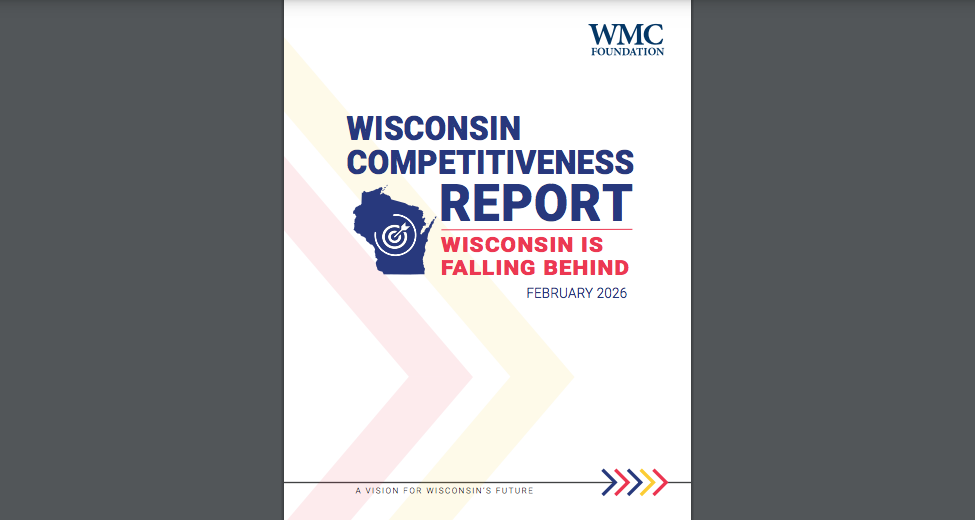
MADISON, Wis. — The WMC Foundation, an affiliate of Wisconsin Manufacturers & Commerce, released a new “Wisconsin Competitiveness Report” on Wednesday that argues the state is losing ground on population, workforce growth, education outcomes, health care costs and the tax climate, and it calls for policy changes the group says can be implemented immediately.

If you love Wisconsin, you’ll love our newsletter.
In an announcement accompanying the report, WMC President and CEO Kurt R. Bauer said the stakes are clear as families and employers weigh where to live and invest.
“When families and businesses look for a home, they make calculated decisions and weigh the pros and cons,” Bauer said. “Some states roll out the red carpet for businesses. Other states roll out the red tape. Wisconsin has to decide which state it wants to be.”
The report’s executive summary opens with a blunt warning: “Wisconsin is falling behind.” It describes the document as a “roadmap” and says it is intended to serve as “a blueprint for the next governor,” backed by business community input and economic data.
Population and workforce concerns
The report says demographic trends pose “an existential threat” to the state’s future and points to an aging population and fewer young residents as compounding pressures on the labor force and state finances.
Citing the U.S. Census Bureau, the report says Wisconsin’s median age is 40.7, and residents 65 and older make up 19.2% of the population.
On the youth side, the report says Wisconsin lost 58,000 residents under 18 between 2010 and 2020, and that the under-18 population fell by another 40,000 from 2020 to 2024. The report also cites projections indicating Wisconsin’s population “could decline by nearly 200,000 residents by 2050.”
The report also says Wisconsin’s labor force participation peaked in 1997 and has declined, adding that the state recorded its “lowest labor force participation rate on record” last year, with less than 65% of residents working or actively seeking work.
Manufacturing, taxes and regulation
The report describes manufacturing as “the bedrock of Wisconsin’s economy” and says the sector contributed $73.7 billion to Wisconsin’s GDP in 2024. It also says Wisconsin manufacturers sold $209 billion in manufactured goods and generated an estimated $42.8 billion in earnings for manufacturing workers.
The report argues that taxes and regulatory policy are central to competitiveness. It says Wisconsin’s corporate tax rate is the 12th highest in the nation at 7.9%, and it cites the Tax Foundation in stating that 95% of Wisconsin businesses are structured as “pass-throughs,” meaning business profits are taxed under the individual income tax code.
Policy prescriptions and political critique
The executive summary says the report’s recommendations include “reforming our tax code,” “controlling hospital costs,” “equipping schools to guide students toward career pathways,” and “attracting new residents through smart policy.”
The report also criticizes proposals it attributes to Democratic Gov. Tony Evers, including changes it says would affect public assistance requirements and unemployment benefits.
In the foundation’s announcement, Bauer framed the report as an attempt to move from diagnosis to action.
“It’s our responsibility not only to recognize the obstacles ahead but to champion innovative solutions to lift our state out of economic uncertainty and guide it toward a more prosperous future,” Bauer said.
The full report is dated February 2026 and is titled “Wisconsin Competitiveness Report.”